The Maltese Falcon: The beginning of noir

The Maltese Falcon (1941)

John Huston’s 1941 screenplay was the first serious attempt to bring the hard-boiled nature of Hammett’s fiction to the screen. The 1931 version may have more closely followed the story of the novel, but it did not carry the hard-boiled spirit of Spade to the screen, and the 1936 version, Satan Met a Lay, with Bette Davis played the story as broad comedy.

David Spicer wrote in his book Film Noir (2002) that Huston’s film “was much closer than previous versions to the cynical tone of Hammett’s hard-boiled novel, retaining as much of Hammett’s dialogue as possible”.  William Luhr, in his book on the 1941 version says that: “Spade does not happily juggle a plethora of women but is bitterly involved with only two… For him, sexuality is not carefree but dangerous and guilt-ridden. The mystery and the evil world it reveals dominate the mood of the movie, and this sinister atmosphere does not entirely disappear at the end. Such an atmosphere presages film noir.”

The Spade of Hammett’s novel is deeply cynical, and at the end of the novel, but not in Huston’s film, he is ready to resume his affair with Archer’s wife. Mayer and McDonnell in The Encyclopedia of Film Noir (2007), say this about the final scenes in Huston’s screenplay: “Huston replaces Hammett’s cynicism with a more romantic gesture from Spade as he tells Brigid, ‘Maybe I do [love you]‘. While Ricardo Cortez’s Spade in 1931 is more or less resigned to handing Wonderly over to the police, Huston extends this sequence by accentuating the psychological disturbance within the detective. His torment is palpable, especially when he shouts into her face that ‘I won’t [fall for you] because all of me wants to, regardless of the consequences’. While this is not an existential moment, as some claim, it does represent a significant moment in the development of film noir. Unlike the novel, where survival is all that matters to the detective, Spade’s torment in the 1941 film nearly destroys him.”

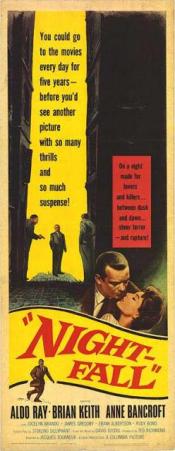
Nightfall (1957): Final curtain call for classic noir

Nightfall (1957)

Jacques Tourneur’s Nightfall signals the coming end of the classic noir cycle, followed only by Murder By Contract and Touch of Evil in 1958, and Odds Against Tomorrow in 1959.

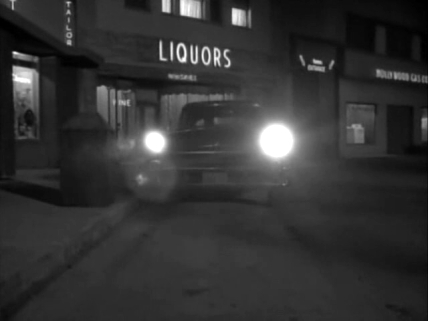
Despite Tourneur’s directorial elan, excellent noir photography from Burnett Guffey, and a script based on a David Goodis novel, the movie clearly attests to the decline of the film noir cycle. The story of the innocent man entrapped by fate and on the run from both the cops and hoods has been played out many times before, and Tourneur does not manage to invest the scenario with any real tension. Even at 78 minutes the screenplay takes too long to reach its rather pat resolution.

Nightfall (1957)

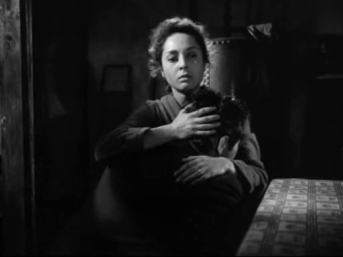
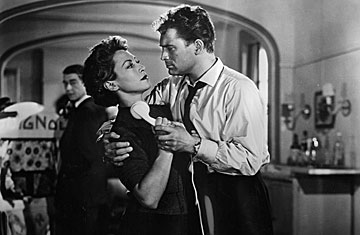
Aldo Ray and Ann Bancroft in the leads are well cast, and the development of their relationship from a pick-up at a bar in LA and its flowering in the snow-drifts of Wyoming, is handled with economy and flair. The dialog is intelligent and the inter-play between two mis-matched hoods and their prey is strikingly good. The violence whether threatened or real is particularly noir.  The two merciless hoods threaten to snap the legs of the protagonist on the boom of an oil rig, and the pitiless gunning down of a victim is still shocking to a jaded noir sensibility. But a climactic fight in the snow against an out-of-control snow plough is bereft of any true suspense, and even the final gruesome aftermath lacks real impact.

A Lighter Shade of Noir: Matinee Double-Bill

A Woman's Secret (1949) Hollywood Story (1951)

A Woman’s Secret (1949) and Hollywood story (1951), two flicks that carry a film noir classification on IMDB which I watched in the past week, I found  to be hardly noir at all.

A Woman's Secret (1949)

A Woman’s Secret, an RKO-feature, has great credentials. The movie is directed by Nicholas Ray from a screenplay from Herman J. Mankiewicz, with photography from George Diskant, and starring Maureen O’Hara, Melvyn Douglas, and Gloria Grahame.  It starts off noir with a shooting off-screen, and the use of flashback in the narrative, but plays out as sophisticated melodrama with a biting wit, and some really funny slapstick when the wife of the investigating cop does her own snooping with a handbag carrying fingerprint powder and a giant magnifying glass. The story of the conflict between a naive young singer (Grahame) and her controlling mentor (O’Hara), has shades of All About Eve but this motif is not taken too seriously.  The two female leads are charming, with Grahame displaying an engaging gift for comedy.  Melvyn Douglas is as debonair as you would expect and takes the role of narrator and referee.  Great fun.

Hollywood Story (1951)

Hollywood Story is a programmer from Universal that has a 50s television feel.  Richard Conte is a producer in LA that wants to make a movie about the murder of a big silent movie director 20 odd years before, and his delving into the past has violent consequences.  A  strictly b-effort that plays well as a whodunit with noir atmospherics, and some really funny lines.

Christ in Concrete (1949): Simply a masterpiece

Christ in Concrete (1949)

The moving simplicity of the Pietro Di Donato novel, Christ in Concrete, has been brought to the screen with rare sincerity. It is two hours of genuine human drama, which makes no concession to convention.

– Variety (1949)

The camerawork by C. Pennington Richards is some of the best of the era, with the city streets, darkened hallways, and construction sites void of any softened corners guaranteed by Hollywood of the 1940s. With Dmytryk, Richards gave Christ in Concrete an astonishing look, which manages to straddle and suggest both film noir and Italian neo-realism. The deep focus crisp black-and-white photography evokes a handful of strong movies yet to be made, including On the Waterfront, Edge of the City, America, America, Sweet Smell of Success, Touch of Evil, and Pickup on South Street. Visually, Christ in Concrete looks like the most influential movie nobody ever saw… Christ in Concrete shares its rough-edged moral outrage with Visconti’s La Terra Trema but its gilded professionalism with Wilder’s Double Indemnity. It’s a knockout combination. Dmytryk found some kind of artistic voice in exile in England unlike any heard from him before or since.

– Matthew Kennedy, Bright Lights Film Journal (Nov 2003)

Based on the novel by Italo-American Pietro Di Donato, Christ in Concrete (aka Give Us This Day), a powerful leftist denunciation of capitalism from director Edward Dmytryk, had to be filmed in the UK, and was buried a few days after its US release by a reactionary backlash. Telling the story of Italian immigrant building workers and their families in Brooklyn during the Depression, the film is the closest an Anglo-American movie ever got to the aesthetic and socialist outlook of Italian neo-realism. Teeming tenements and residential streets are shot with a provocatively gritty realism and film noir atmospherics.

Christ in Concrete (1949)

The cast is superb with particularly powerful performances from the two leads, Sam Wanamaker and Lea Padovani, who embody the immigrant experience, which is so imbued with vitality and compassion that the film soars above any other similar work of the period. Enriched by a poetic script, the innovative cinematography of C.M. Pennington-Richards, outstanding art direction from Alex Vetchinsky, and a brilliantly evocative score by Benjamin Frankel, the movie is a revelation.

The opening scene in a deprived urban locale that follows a drunken man from the street and up the stairs of a dirty tenement building is a tour-de-force. An inspired mise-en-scene and a moving camera that follows the action from below Ozu-style, framed by the drama of the musical motifs, had me enthralled. This scene and the rest of the movie, except for panaromic shots of New York shown in the opening credits, were filmed in a studio lot in Denham, England!

Christ in Concrete (1949)

Film as art, Christ in Concrete is simply a masterpiece.

Film Noir Digest: Dassin Retrospective

Jules Dassin: 1911-2008

Rififi (1955)
Rififi (1955)

The New York Film Forum from March 27 to April 12 will host a Jules Dassin retrospective over 12 days.  March 31 mark the anniversary of Dassin’s passing. All of Dassin’s major features will be screened, including:

  • Brute Force (1947)
  • The Naked City (1948)
  • Thieves’ Highway (1949)
  • Night And the City (1950)
  • Rififi (1955)

Full program

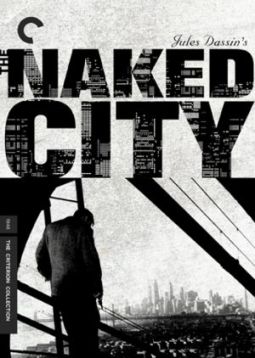
The Naked City (1948): “There are 8 million stories… “

The Naked City 1948

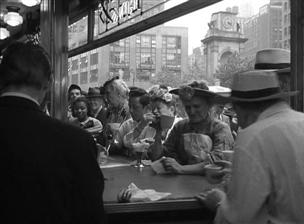
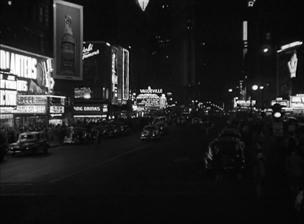
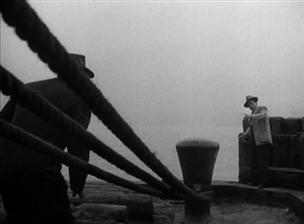
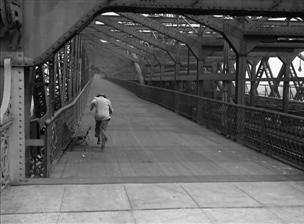
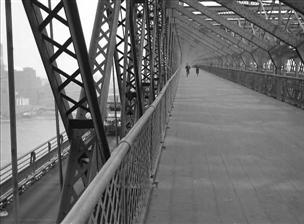
Jules Dassin’s third major feature, The Naked City, is legendary for its cine-verite portrayal of the city of New York: on the streets and in deep focus, with a stunning climax on the Williamsburg bridge.  Deservedly, in 1949 William H. Daniels received an Academy Award for Best Black-and-White Cinematography and Paul Weatherwax  an Oscar for Best Film Editing.  Miklós Rózsa and Frank Skinner contribute a solid musical score.   A voice-over narration by producer, Mark Hellinger, who died before the movie’s release, follows the story of a murder investigation by NY homicide cops.

The Naked City 1948

The Naked City 1948

The story is well-paced with the who-dun-it and why tension elegantly elaborated. While the cast is solid and the dialog has a sardonic edge, the picture is essentially a police procedural of little irony or depth, and with a ‘magazine expose’ feel . Once we are into the story, Hellinger’s voice-over becomes tedious, and by the climax downright annoying, as he starts addressing a hood on the run. Thematically, there is little to distinguish The Naked City as a film noir. We have to wait for Thieves Highway the following year to begin to appreciate Dassin’s greatness as a noir director.

The Naked City 1948

thenakedcity76-_sm

It is the city of New York and its people that hold our attention, and the several bit-portrayals of people going about their lives are truly engaging. The final scene where a street-sweeper in profile scoops up yesterday’s papers from the gutter and moves on into the New York night gives an arresting hard-bitten closure to the story behind the murder and to the film itself.

The Naked City 1948

The Naked City 1948

The B Connection: Lewton, Renoir and Truffaut

Desperate

In a book I am currently reading, The Early Film Criticism of François Truffaut by Wheeler Dixon (Indiana University 1993), there is an interesting section that deals with the obvious influence on Truffaut of Hollywood b-movies, particularly film noir.

According to Dixon, Truffaut and even his mentor, Jean Renoir, preferred b-features over a-productions. In a 1954 interview, Renoir was quite emphatic:

I’ll say a few words about Val Lewton, because he was an extremely interesting person; unfortunately he died, it’s already been a few years. He was one of the first, maybe the first, who had the idea to make films that weren’t expensive, with ‘B’ picture budgets, but with certain ambitions, with quality screenplays, telling more refined stories than usual. Don’t go thinking that I despise “B” pictures; in general I like them better than big, pretentious psychological films they’re much more fun. When I happen to go to the movies in America, I go see “B” pictures. First of all, they are an expression of the great technical quality of Hollywood. Because, to make a good western in a week, the way they do at Monogram, starting Monday and finishing Saturday, believe me, that requires extraordinary technical ability; and detective stories are done with the same speed. I also think that “B” pictures are often better than important films because they are made so fast that the filmmaker obviously has total freedom; they don’t have time to watch over him.

So all you b-movie fans you are in hallowed company!

[Cross-posted at Another Cinema Blog]

Strangers in the Night (1944)

Strangers in The Night (1944)

One of  director Anthony Mann’s early films, Strangers in the Night, a Republic Pictures 56-min b-filler from 1944, is being restored by the Film Noir Foundation.  To see what all the fuss is about, last night I had a look at a copy recorded from Spanish TV, which was in fair condition, if  marred by big yellow sub-titles.

I found a gothic-style thriller that  rarely transcend it’s b-origins.  I suppose it remains of interest as an Anthony Mann project, but the direction and the production as a whole are at best competent.

A story-line about a returning WW2 vet looking for a small-town girl whom he knows only from letters is the pretext for an off-beat treatment of  sexual frustration morphing into a dangerous delusion, and eventually murder.  Two middle-aged b-actresses playing out a possibly lesbian menage steal the movie from the headlined stars who provide the romantic interest.

Worth a look.

The Reckless Moment (1949): “we want to liquidate our stock while the market is high”

The Reckless Moment (1949)

The Reckless Moment (aka The Blank Wall) (1949)

Columbia Pictures 82 mins
Directed by Max Ophuls

Cinematography by Burnett Guffey
Screenplay by Henry Garson and Robert W. Soderberg
Adapted by Mel Dinelli & Robert E. Kent
from Elisabeth Sanxay Holding’s story, ‘The Blank Wall’

Cast:
Lucia Harper – Joan Bennett
Martin Donnelly  – James Mason
Ted Darby – Shepperd Strudwick
Nagle – Roy Roberts
Sybil – Francis Williams

After concealing her daughter’s accidental killing
of a man a housewife is blackmailed by a hood

The Reckless Moment, Max Ophuls’ last Hollywood picture is a great film. It is a brilliant example of the dynamics of the auteur working inside the studio system. Ophuls’ takes a basic blackmail story and through his long and fluid takes and subtle mise-en-scene infuses it with a complexity and subtlety rarely matched in film noir.  Joan Bennett as the threatened middle-class housewife, Lucia Parker, and James Mason as the Irish blackmailer Donnelly, are both impeccable, but it is Joan Bennett as the wife and mother plunged into a noir world of criminality that carries the drama forward. She struggles to defend an idyllic domesticity against a rising tide of darkness that would engulf her family. Veteran noir cinematographer, Burnett Guffey, smoothly establishes the impending entrapment within mobile tracking shots that move from light to dark, from unruffled clarity to shadows and unsettling movement, from the beguiling every-day to  menacing disturbance.  The Reckless Moment is richly rewarding and its richness is best savored over repeated viewings.

The Reckless Moment (1949)

After viewing the movie and starting my research, I became more and more perturbed. Reviews by many respected critics were scathing at worst or damning by faint praise in their dismissal of the film.  Bosley Crowther in the New York Times on the film’s opening, rather smugly concluded “a feeble and listless drama with a shamelessly callous attitude”, and Variety said “a tense melodrama projecting good mood and suspense… matter-of-fact technique used in the script and by Max Ophuls’ direction doesn’t permit much warmth to develop for the characters”.  Many books on film noir ignore it or mention it only in passing.

Finally, I came across an article by the film critic Robin Wood, where my feelings about the film were confirmed, and alas I was also made starkly aware of my signal failings as a writer on film. The article is titled, Plunging Off the Deep End into the Reckless Moment’, and appeared in the Spring 2002 edition of the CineAction film journal. The Deep End is  a 2002 remake of Ophul’s film by Scott McGhee and David Siegel, which beside the Ophuls original, Wood says, “dwindles into insignificance”.  In his erudite article in a shot-by-shot analysis of a particular early scene in Ophuls’ work, Wood perceptively draws out Ophuls’ mastery and his purpose, with flair and passion:

If [Ophuls] had directed The Reckless Moment in complete freedom the film would certainly have been different; it would not necessarily have been better. The film’s richness of meaning derives from its being ‘a Hollywood film’ as well as ‘an Ophuls film’: it is nourished by a whole system of generic convention and highly developed methodology (which Ophuls everywhere modifies, inflects and enriches). I personally find it a denser, more complex, ultimately more rewarding film than La Ronde, a film generally thought of as ‘pure Ophuls’. The richness derives largely from the interaction between two major Hollywood genres, usually regarded as incompatible: the woman’s melodrama and film noir. Its structure is built upon an alternation between the domestic world and the noir world, represented by Lucia’s upper middle-class home near a small town, and Los Angeles. The film opens with Lucia ‘invading’ Los Angeles to confront Ted Darby [an older man Lucia’s daughter is seeing played by Shepperd Strudwick], which is answered by Donnelly’s invasion of the home; in the second half the pattern is repeated by Lucia’s step by step descent (bank, loan office, pawn shop) into the noir world in her efforts to raise the blackmail money… The second shot is the sequence’s longest and most elaborate long take with camera movement (just over two minutes without a cut). Lucia completes her entry into the dining room; the table is laid for the family dinner; there is a window in the background, darkness outside, where Lucia and Donnelly will end their negotiations, the sequence as a whole leading Lucia from the apparent security of the brightly lit dining room into a world of darkness and shadows, the Donnelly world of film noir…  Perhaps the most remarkable aspect of this extremely complex, marvellously controlled shot is Ophuls’ treatment of space, its effect almost subliminal. On the one hand we have been given, in unbroken movement, a tour of the entire open plan layout of the downstairs of the house, the exact relation of kitchen to dining room, dining room to living room, the various exits and possible entrances, all clear if we concentrate. At the same time, however, the continuous reframings, the camera’s turns and returns, become so disorienting that all our confidence in knowing exactly where we are, in what direction we are facing, is undermined. It’s an extraordinary effect, at once establishing and destroying our sense of the well-designed security of the bourgeois home corresponding, we may feel, to Lucia’s growing sense of anxiety and dread, her sense that the secure existence (her own, her family’s, the household’s) she has so carefully (and at such personal cost) striven to build and preserve is crumbling around her. The effect is underlined by the two most obvious decisions evident in Ophuls’ mis-en-scene: Lucia’s stasis, as if paralysed, contrasted with Donnelly’s constant restless movement about the room? the tracking camera and its continuous reframings that consistently favour Donnelly, bringing him into the foreground, his dark overcoat dominating the image, Lucia reduced often to long shot or excluded from the frame altogether…

I recommend the full article to readers of FilmsNoir.Net – but only if you have seen the movie, which came out on DVD in 2006.

The Sniper (1952): Off Target

The Sniper (1952)

A sharp-shooting psychopath who hates woman goes on a killing
spree in San Francisco and is pursued by the police.

Director Edward Dmytryk started work on The Sniper just after he finished serving a 12 month jail sentence for refusing to co-operate with the infamous HUAC. Upon his release Dmytryk recanted and squealed to the HUAC naming names. Producer Stanley Kramer then offered him this Columbia production. Ironically, the veteran right-wing actor and HUAC collaborator, Adolphe Menjou, was signed to play an un-sartorial cop sans moustache.  The NY-based Daily Worker was not impressed: “Movie director Edward Dmytryk, ex-member of the Hollywood Ten who turned informer for the FBI, is now palsy-walsy with his erstwhile foe – the rabid witch-hunter and haberdasher’s gentleman – Adolphe Menjou. Now Dmytryk and Menjou are together again – this time as friends. Menjou has a leading role in The Sniper, which Dmytryk, gone over to warmongering and restored to favor of the Big Money, is now directing for Stanley Kramer productions.”.

A solid b-production, The Sniper is a taut thriller, which does not quite come off as a film noir, although there are strong moments in this gritty story of a young loner battling a deep and violent pathological hatred of young woman. Shot on location on the streets of San Francisco, angle shots and off-kilter staging sustain the visual interest throughout, with those scenes in the seconds before the sniper shoots three of his victims being particularly suspenseful.

The Sniper (1952)

The acting is rather stolid and this weakens the drama. While the script attempts to explain the sniper’s pathology and sermonises on how the law should handle such offenders, there is little real depth to the portrayal. Filler scenes used to establish his immediate motivation are too obviously contrived, with the younger women he encounters socially being unnecessarily mean-spirited. But in a sequence in an amusement park, the pathology and the anger of the sniper are deftly explored without artifice and with chilling accuracy.

The police investigation has just too many convenient coincidences, and the meetings with the cops and the good burghers of ‘Frisco demanding action on the pursuit are too stagey by half. A fair b-thriller of considerable historical interest.

The Sniper (1952)