James Gunn’s ‘Deadlier than the Male’: Psychology of the Femme-Fatale

Helen Brent had the best-looking legs at the inquest. She had a white sharkskin suit that had cost $145. She had an air of impeccable good breeding that had cost a great deal more. From the looks of things, she was no usual divorcee. Obviously, she was a woman of great wealth, of travel, of culture, of charm; she was a gorgeous blonde; she had been around. Perfectly poised, she crossed her legs with stunning and careless showmanship.

Her name was Helen Brent, she said, and she was thirty-one; her home was in San Francisco; she was in Reno to get a divorce from her husband, Mr. Charles Brent.
She had been in Reno—how long?
Six weeks; during that time she had stayed at a boarding house on the edge of town, run by a Mrs. Krantz and her daughter, Miss Rachel Krantz; Miss Rachel Krantz was in the courtroom.
On the previous Thursday, she had left the Krantzes’ and gone to the Hotel Riverside?
Yes.
She had gone back to the Krantzes’ at eleven that night to pick up a handbag?
Yes.
And about what time had she left the Krantzes’ to go to the hotel?
About five.

Deadlier than the Male is the only novel by American writer James Gunn, who wrote the book in 1943 at the age of 23.  The story was adapted by Hollywood for the 1947 film noir Born to Kill.  In his short life – he died at the age of 46 in 1966 – Gunn wrote screenplays for movies and television.  Little is known of his life, and he remains a tantalizing mystery.

The novel was chosen as the 50th book to be published by French publisher Gallimard under the Le Série Noire imprint.  In 1966, the radical French philosopher, Gilles Deleuze, in a tribute on the publishing of the 1,000th title in the series, which was started in 1945 by editor Marcel Duhamel, wrote:

The most beautiful works of La Série Noire are those in which the real finds its proper parody, such that in its turn the parody shows us directions in the real which we would not have found otherwise. These are some of the great works of parody, though in different modes: Chase’s Miss Shumway Waves a Wand; Williams’s The Diamond Bikini; or Hime’s negro novels, which always have extraordinary moments. Parody is a category that goes beyond real and imaginary. And let’s not forget #50: James Gunn’s Deadlier than the Male.

The trend in those days was American: it was said that certain novelists were writing under American pseudonyms. Deadlier than the Male is a marvelous work: the power of falsehood at its height, an old woman pursuing an assassin by smell, a murder attempt in the dunes—what a parody, you would have to read it—or reread it—to believe it. Who is James Gunn anyway? Only a single work in La Série Noire appeared under his name. So now that La Série Noire is celebrating the release of #1000, and is re-releasing many older works, and as a tribute to Marcel Duhamel, I humbly request the re-release of my personal favorite: #50.[1]

In a review in 2008 of the re-issue by Black Mask Publishing, British academic Robin Durie said of the novel:

It’s very hard to imagine the almost hallucinatory events of the novel translating to the big screen in 1947 [in Born to Kill] – although it’s just about possible to imagine John Waters or David Lynch making some headway with it. It’s also possible that Claude Chabrol might have fancied having a go at turning it into a movie, based on his admiration for the book: “It has a freely developed plot and an absolutely extraordinary tone, pushing each scene towards a violent, ironic and macabre paroxysm…an unexpected dimension, a poetic depth…  Of course, nothing like this has ever been written before. The parody is wildly inconsistent, but Deleuze is surely right when he says that, by this means, Gunn creates directions in the real which are wholly new.”  … At the same time, Chabrol is correct in his capturing of the intensity of the rhythm of Gunn’s writing. Each chapter builds – or perhaps better, meanders – towards, or into, extraordinary points of what are, in effect, bifurcations. It is as if the novel is following those bifurcating pathways described by Borges.”[2]

Deadlier than the Male is like no other noir fiction.  The weird story of a deranged con-artist who marries into a wealthy San Francisco family, while told in the third person, reveals the thoughts and motivations of the central character, an attractive 30-something divorcee, Helen Brent.   In film noir-style, the book opens in flash-back as Helen gives testimony at an inquest in Reno into a double murder.  Helen, in Reno to engineer a quick divorce, by chance stumbles on the victims of a double domestic murder.  We know the killer and that, unbeknown to Helen, he was still at the murder scene when she came across the bodies.  Gunn’s story goes on to explore how the lives of these two people become entwined, and how lies upon lies lead to the final denouement where Helen’s true self is revealed to not only the reader but to herself.  As the story plays out there is a virtual  cavalcade of odd-ball characters drawn with keen psychological insight in a series of ongoing scenarios that are woven in an almost surreal  “more or less undifferentiated present” [Durie].

These psychological insights are strongest as we follow Helen’s obsession to find out the ’truth’.  A truth which as she uncovers seeks to hide by lies and intimidation.  Her motivations are never fully fathomed but at the end we know fully what she is capable of.  Helen is sexy, smart, charming, even loving, and constantly battling her better instincts to strive for a physical security which can only be bought by money – and lots of it.  Pitted against her is a lurid drunken widow out to find the killer out of loyalty to one of the victims – her debauched friend and drinking companion who dallied with younger men.   The comic encounters of this ridiculous aging sleuth are nevertheless successful – albeit not without real danger – she just escapes death at the hands of psychopathic hood in the sands dunes of Frisco in a scene as violent and perverse as you would find in a Coen Bros. movie.

… ‘The truth is, Helen, you’re uncivilized still. You’re out of the jungle, or to be more exact, you’ve gone back to it. You have enough intelligence and enough courage to realize you don’t need other people. You’ve decided to live alone with your strength. And that’s where you fall down’…

…Helen’s mind seemed to grow endlessly inside her head. She saw herself standing alone, in an infinity of space and matter. She was quite solitary, and very strong. No one was close to her, no people. She would never be able to have anyone close to her again.

A must read.  Get the re-issued paperback here – also available is the eBook version for 99cents.

Postscript: The obscure French film Corps et biens (1986) from director Benoît Jacquot is also based on Gunn’s novel.


[1] Gilles Deleuze, The Philosophy of Crime Novels
[2] Book review by Robin Durie

The Car in Noir: High Wall (1946)

The car in the film noir is a complex symbol expressing the various kinds of escape its protagonists attempt. It is also a tool of death… But as a symbol of the modern urban landscape, the car comes to mean much more: it functions as the symbol of all that has brought America to this ambiguous state of spiritual anxiety. Taunting us as the apex of industrial achievement with its commercial appeal and status, the car in the film noir has been transformed into an object of dubious distinction, like a desperado of sorts, an accomplice. Whether noir characters use it to escape their pursuers (legal or criminal) or their past, the automobile symbolizes that dangerous flight into the unknown that contrasts with its other importance as a symbol of established success in modern American culture. Desperate people steal perfectly reputable vehicles, transforming them into getaway cars, and in the act they sully the very status of material success that these object represent… In its transformation into an escape device, the car carries out one of the narrative goals of noir cinema: to bring the illusion of freedom for its characters up to its dead end—right up to the place from which they can no longer escape, and where they usually die.

– Andrew Dickos, STREET WITH NO NAME: A History of the Classic American Film Noir (The University Press of Kentucky, 2002), pp 176-177

High Wall (MGM 1946) is a film noir where cars are integral to the story and to the noir aesthetics: fast cars screeching to nowhere, dark streets, rain on asphalt, roadblocks, escape, entrapment… ‘crashing out’. Directer Curtis Bernhardt and his DP Paul Vogel in the many scenes with cars in this picture have fashioned indelibly mystic images of the noir car, as these selected frames from the movie attest:

High Wall

High Wall

High Wall

High Wall

High Wall

High Wall


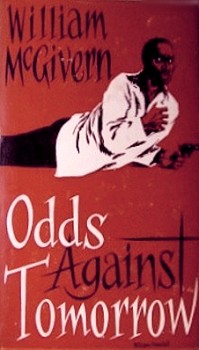
Noir Poets: William P. McGivern

New York, 1957

Earl Slater – the white man:

Earl limped about pointlessly examining the junk on top of the mantel, studying the sturdy old beams and floor boards, pausing once to frown at the broken radio on the table. I’ll never see any of this again, he thought. Never see this room again in my life. Why should that bother him? he wondered. It was a cold, stinking dump. No man in his right mind would want to see it again. But leaving it reminded him of the other places he had left. He stood fingering the glass, while a dizzying succession of rooms and barracks and Army camps flashed through his mind. He was always the guy who had to leave, he thought. Everybody else stayed put, cozy and snug, while he hit the road. He never went back anywhere. There was no place on earth that called out to him, no stick or stone or blade of grass that belonged to him and nobody else.

Was it because he was dumb? Because he couldn’t feel what other people felt? The confident peace he had known after talking with Ingram had deserted him; he was uncertain again, worried and tense, afraid of the shadows in his mind.

Talking with Ingram he had licked this feeling. Or thought he had. Everybody was alone. Not just him, everybody. But what the hell did that mean? How did knowing that help you? he wondered.

Johnny Ingram – the black man:

A state trooper in a blue drill uniform was staring curiously at Ingram’s tear-filled eyes. “What have you got to cry about?” he said. “You’re not hurt.”

“Never mind,” a voice cut in quietly. Ingram recognized the voice of the big sheriff in Crossroads. “Let him alone.” The authority in the sheriff’s voice was unmistakable, but so was the understanding; the trooper turned away with a shrug, and Ingram wept in peace.

Later he was taken outside on a stretcher. The rain had stopped but a sprinkling of water from the trees mingled with the blood and tears on his face. Far above him he saw a single star shining in the sky. Everything was dark but the star, he thought. In his mind there was a darkness made up of pain and fear and loneliness, but through it all the memory of Earl blazed with a brilliant radiance. Without one you couldn’t have the other, he realized slowly. Without the darkness there wouldn’t be any stars. It was worth it then. Whatever it cost, it was worth it. . . .

Noir Poets: Ira Wolfert

All the things a man has to go through to get to live here, thought Leo, the things, the things, thousands and millions and millions of dirty things to hurt people and hurt himself.  The street seemed drowned in stone. It looked narrow and drowned, a thing emptied of life and walled with swollen, stone bones. The feeling of costly desolation was heavy in Leo. This costly desolation was splendor, but Leo did not think of it as splendid. Yet he tried to be faithful to the rich. He tried to think of the costly desolation as good for sleep. Only the rich could afford to buy quiet like this in the heart of the city, he told himself. He felt suddenly that only a man who had made himself rich could become barren enough to want and be comfortable in this desolation.

–  Ira Wolfert, ‘Tucker’s People’ (aka ‘The Underworld’), NY, 1943, p. 71

Abraham Polonsky’s and Ira Wolfert’s screenplay for Force of Evil (1948) was based on Wolfert’s novel.

John Alton: The Amazing Mr X (aka The Spiritualist 1948)

capturing bits of light at rest on things of beauty – John Alton *

John Alton: Noir Filmography as Cinematographer

1947

  • T-Men Directed by Anthony Mann Eagle-Lion (Edward Small Production) 96 minutes
  • The Pretender Directed by W. Lee Wilder Republic 68 minutes

1948

  • The Spiritualist (The Amazing Mr. X) Directed by Bernard Vorhaus Eagle-Lion 79 minutes
  • Raw Deal Directed by Anthony Mann Eagle-Lion (Edward Small Production) 78 minutes
  • He Walked by Night Directed by Alfred Werker Eagle-Lion (Bryan Foy Production) 80 minutes
  • Hollow Triumph (The Scar) Directed by Steve Sekely Eagle-Lion 83 minutes

1949

  • The Crooked Way Directed by Robert Florey United Artists (Benedict Bogeaus Production) 80 minutes
  • Border Incident Directed by Anthony Mann MGM (Nicholas Nayfack Production) 92 minutes
  • Reign of Terror (The Black Book) Directed by Anthony Mann Eagle-Lion 89 minutes

1950

  • Mystery Street Directed by John Sturges MGM 92 minutes
  • Witness to Murder Directed by Roy Rowland United Artists (Erskine Productions) 81 minutes
  • Devil’s Doorway Directed by Anthony Mann MGM 84 minutes

1950

  • The People Against O’Hara Directed by John Sturges MGM 101 minutes

1955

  • The Big Combo Directed by Joseph H. Lewis Allied Artists (Sidney Harmon Production) 86 minutes

1956

  • Slightly Scarlet Directed by Allan Dwan RKO (Benedict Bogeaus Production) 91 minutes

_______
* John Alton, ‘Painting with Light’ (Macmillan, NY, 1949), p. xli

The Noir City: Underworld

Abraham Polonsky’s and Ira Wolfert’s screenplay for Force of Evil (1948) was based on Wolfert’s 1943 novel ‘Tucker’s People’ (aka ‘The Underworld’).  I have been unable to find an attribution for this brilliant cover.

Femme Fatale: Moscow Cafe

that sinister bloodcurdling, deep-probing, lashing look. It was a hangman’s look, a look like the contact of sexual organs

– M. Ageyev, Novel With Cocaine, 1929 (?) translated from the Russian by Michael Henry Hein (Picador 1985)

Noir Poets: Philip Marlowe

Who am I cutting my throat for this time? A blonde with sexy eyes and too many door keys? A girl from Manhattan, Kansas? I don’t know. All I know is that something isn’t what it seems and the old tired but always reliable hunch tells me that if the hand is played the way it is dealt the wrong person is going to lose the pot. Is that any of my business? Well, what is my business? Do I know? Did I ever know? Let’s not go into that. You’re not human tonight, Marlowe. Maybe I never was or ever will be. Maybe I’m an ectoplasm with a private license. Maybe we all get like this in the cold half-lit world where always the wrong thing happens and never the right.

Raymond Chandler, The Little Sister (NY 1941)

More than the Director: The Noir Writer

Dark Passage (1944) is one of the few Bogart pictures that disappoints.   Bogart goes through the motions of an escaped con on the run in Frisco trying to clear himself of a murder charge.  Bacall looks great, but for a thriller the whole affair is flat. While the screenplay by director Delmer Daves – from a story by David Goodis – relies on too many implausible coincidences, there is a particularly effective scene where Bogart hops a taxi late at night.

Bogart: Head down the hill. I’ll tell you where to go from there.

Cabbie: Mind a little speed?

I like speed.

Nice looking suit you’re wearing.

Thanks, and I don’t feel chatty.

Some fares like to talk.

I don’t.

You always that way?

Yeah, that’s why I don’t have many friends.

You know, it’s funny about friends.

It’s funny you can’t take a hint.

Brother, you never drove a cab. You got no idea how lonely it gets.

What’s lonely about it? You see people.

Sure, you’re right there. You should see the character I had for a fare yesterday. Picked him up at the Ferry Building.Standing on the curb with a big goldfish bowl in his arm, full of water. Two goldfish. Climbs in the back of the cab, sits down and puts the goldfish bowl in his lap. Where do you think he wants to go? To the ocean. Clean from the Ferry Building to the Pacific Ocean. But he doesn’t know that there’s seven hills. Seven steep hills in between. So we start off. Up the first hill, slippity slop, down the hill, slippity slop. Water all over the back seat, the goldfish on the floor. He picks them up, puts them back in the bowl… up we go again, slippity slop, water all over the… You never saw such a wet guy in your life when we got to that ocean. And two tireder goldfish. But I like goldfish. I’m going to get a couple for the room. Dress it up a little bit, it adds class to the joint. Makes it a little homey.

I thought you said you got lonely.

That’s right. I pick people up and take them places, but they don’t talk to me. I see them get out and go in spots, have fun… then I pick up another load coming out… and I hear them telling about all the fun they had. But me, I sit up here all alone, and it gets lonely.

That’s tough. You’re in a bad way.

You said it. Where are we going?

If I tell you, you’ll ask me why I’m going there… and what am I going to do there, and am I gonna have fun.  A guy gets lonely driving a cab,remember?

That’s right, brother. Lonely. And smart.

Smart in what way?

About people. Looking at them. Faces.

What about faces?

It’s funny. From faces I can tell what people think, what they do… sometimes even who they are. You, for instance, you’re a guy with plenty of trouble.

I don’t have a trouble in the world.

Don’t tell me, buddy. I know. She gave you plenty of trouble, that dame. So you slugged her…  Not now, not here, too many cops around. Don’t try to hit me in the back of the head… or I’ll run this crate up into one of those hotel lobbies.

I’ll give you $500.

Don’t give me nothing. Where do you want to go?

You might as well make it the police station.

Don’t be like that. You’re doing all right. You’re doing fine.

If it was easy for you to spot me, it would be easy for others.

That’s where you’re wrong.  Unless you’d be happier back in Quentin.

Sure, that’s why they sent us up there, to keep us happy.

I see what you mean. Let’s go up here and talk. Did you really bump your wife off?

No, I didn’t.

I don’t figure it that way. I figure you slugged her with that ashtray because she made life miserable for you. I know how it is. I live with my sister and her husband. Now, they get along fine. So fine, that one day he threw a bread knife at her. She ducked. That’s the way it goes. Maybe if your wife had ducked… there’d be no trial, no Quentin, no on the lam.

That’s life.

Smoke?

All right.

Light?  What was she like?

She was all right.  Just hated my guts.  For a long time I tried to find out why, then I didn’t care anymore.

I know. Nice, happy, normal home. I almost got roped in a couple of times myself. If you find the right girl, it’s okay.

What’ll I do?

You won’t listen.

I’ll listen. I want ideas.  That’s what I want more than anything else. I didn’t kill her.  Why should I go back to San Quentin for the rest of my life if I didn’t kill her?

I wonder what he could do with your face?

Who?

A friend of mine. Knows his stuff.

How much would he want?

How much you got?

$1,000. That’s all I’ve got.

He’d take $200.

And keep after me from then on.

No, he’s a friend of mine.

What’s your charge?

Nothing. I’ve seen him work.  He’s great.  I wouldn’t know my own mother after he got through with her.

How long would it take?

Maybe a week, if he doesn’t have to touch your nose.  I don’t think he will.  Just a little around the eyes and here and there.  Got a place to stay? We’re right near the place.

A friend.

Dependable?

The only close friend I’ve ever had.

Let’s see, it’s 2:00 a.m. Now. I’ll go up and see the doc and make a date for you for 3:00 a.m.

Nice safe hour.

Noir Poets: Raymond Chandler

Farewell My Lovely (1975)

It got darker. I thought; and thought in my mind moved with a kind of sluggish stealthiness, as if it was being watched by bitter and sadistic eyes. I thought of dead eyes looking at a moonless sky, with black blood at the corners of the mouths beneath them. I thought of nasty old women beaten to death against the posts of their dirty beds. I thought of a man with bright blond hair who was afraid and didn’t quite know what he was afraid of, who was sensitive enough to know that something was wrong, and too vain or too dull to guess what it was that was wrong. I thought of beautiful rich women who could be had. I thought of nice slim curious girls who lived alone and could be had too, in a different way. I thought of cops, tough cops that could be greased and yet were not by any means all bad, like Hemingway. Fat prosperous cops with Chamber of Commerce voices, like Chief Wax. Slim, smart and deadly cops like Randall, who for all their smartness and deadliness were not free to do a clean job in a clean way. I thought of sour old goats like Nulty who had given up trying. I though of Indians and psychics and dope doctors.

Raymond Chandler, Farewell, My Lovely, 1940, ch.34 par.3