In the opening minutes of 1944’s film noir classic Double Indemnity, sultry Barbara Stanwyck crosses her shapely legs and in one sexy move sends poor Fred MacMurray careening toward his inevitable doom.
A small ankle bracelet has caught his eye, and the mere sight of the bauble is enough for him to toss whatever good sense he has into the heart of the black widow’s web.
“That’s a honey of an anklet you’re wearing,” he growls lasciviously.
Stanwyck demurely tussles the hem of her blue dress, covering the jewelry. But it’s too late. MacMurray’s trapped, a willing pawn who will obey every treacherous word as she hatches a plot to kill her abusive husband, then make his death appear an accident so she can cash in on a secret life insurance policy. She has MacMurray by the neck –or an anatomical ZIP code a bit farther south –and in the nasty game of premeditated murder, there’s no letting go.
Moments later, he inquires whether she’ll be at home the next time he comes calling: “Same chair, same perfume, same anklet?”
“I wonder if I know what you mean,” she answers with feigned innocence.
“I wonder if you wonder.”
He might as well turn himself over to the coppers. He’s a goner.
All because of an anklet.
Raging tension

That bit of raging sexual tension is just one of the terrific moments that makes Double Indemnity easily one of the best American movies ever made. With its taut script co-written by Raymond Chandler and director Billy Wilder (based on the potboiler novel by James M. Cain), and a career-topping supporting performance by Edward G. Robinson, there’s not a second that’s anything less than perfection.
The film is just one of the delicious high points of the Northwest Film Center’s “Killer Ladies” series, which begins Friday at the Whitsell Auditorium of the Portland Art Museum. Running four consecutive weekends, it’s a showcase of 10 must-sees from the golden age of film noir, all of them featuring femmes fatales the likes of which should send men both brave and cowardly running in the opposite direction.
With the exception of Fritz Lang’s obscure Woman in the Window, all of the films are readily available on DVD. But seeing these moody black-and-white gems on the big screen is a rare treat. With noir, demons lurk in shadows and shades of mysterious gray that even the finest home theater systems can’t distinguish.
And there are shades of feminine deceit you may pick up only by catching these movies side by side.
Double-header
Take the opening weekend double-header of Mildred Pierce and The Manchurian Candidate. At once, they have nothing and everything to do with each other. 1945’s “Pierce” stars Joan Crawford, who won an Oscar for her performance as a working woman who will do anything for her spoiled daughter. “Candidate” from 1962, is a political thriller about a secret assassination plot involving brainwashed Korean War veterans.
What makes the two films kindred spirits is their portrayal of warped motherhood. In “Candidate,” Angela Lansbury is a scheming harridan with a lust for power so intense she makes Lady Macbeth seem as threatening as a meadow of petunias.
“We have come almost to the end,” Lansbury says to her patsy son as she sends him off on a bloody assignment. “One last step. And then when I take power, they will be pulled down and ground into dirt for what they did to you. And what they did in so contemptuously underestimating me.

Compare those viper’s fangs with Crawford’s tortured martyr complex in “Pierce.” She’s a total doormat for her daughter Veda, and one of Mildred’s chums doesn’t like what she sees: “Personally, Veda’s convinced me that alligators have the right idea. They eat their young.”
Yet when gunfire erupts, Mildred shows that no one should underestimate her, either.
A repeat victim
Moms aren’t the only women with a deadly streak in this series. Home wreckers, hussies and harlots also prove lethal, with Robert Mitchum a repeat victim. In 1947’s Out of the Past, a gangster’s mistress sends him careening out of control. Then in 1952’s Angel Face, lives hang in the balance because of Mitchum’s obsession with a young woman.
The art of seduction takes a lot more than a pretty face. In many of these films, the femme fatale is dressed in wildly elaborate gowns just as the pistol is drawn, juxtaposing the brutality of the gun with the beauty of beads and spangles. It’s as if the director has taken the movie’s costume designer aside: “This is when she pulls a gun. That dress you have her in? Make it 10 times more gaudy!”
Another recurring theme is the feline analogy. In several films, house cats pop up symbolically to hint at conniving games of cat and mouse. It’s never more overt than in 1955’s gripping Kiss Me Deadly, a hard-boiled detective story played out against the paranoid canvas of the Cold War. Cats are everywhere – on a secretary’s desk, sleeping on top of a telephone operator’s panel, in an old maid’s apartment.
“You have the feline perceptions that all women have,” one bad guy barks at a murderous gal, before learning that there are also claws that go with those perceptions.
A wild bobcat
If Kiss Me Deadly’s femme fatale is a housecat, Gun Crazy‘s Annie Starr is a wild bobcat. She’s a carnival sharpshooter whose bullets are so accurate they can light a cigarette held in an assistant’s clenched teeth. When she meets a man who’s just as good a shot, a Bonnie and Clyde-like crime spree ensues. First they’re knocking off gas stations and liquor stores, but their targets get progressively bigger. It’s a rampage out of control but rooted in a fella’s lust for a cute lady in a cowgirl suit.
Through history, men have committed crimes for far less. The ancients went to war over stolen glances. Empires have fallen because of whispers in the night. Who wouldn’t go over the edge because of a cowgirl hat tilted just the right way?
Or a golden anklet on a golden gam?
It did Fred MacMurray in. Don’t let it be your undoing.”

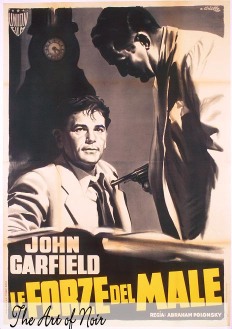
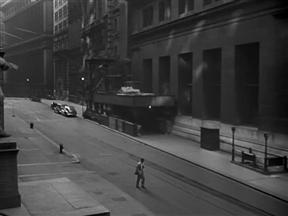
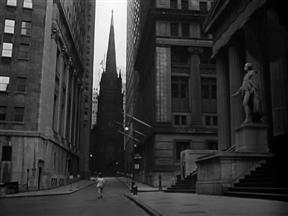
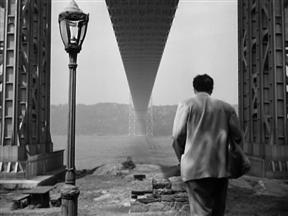
 was the first film that Polonsky directed, and the assurance displayed in its construction is breathtaking: from the lighting and camera-work, to the editing and pacing. The hard-edged and almost jazz score by David Raksin is used to brilliant effect.



 last night. This cult classic from Robert Aldrich owes more to surrealism than to film noir: it is a totally weird yet compelling exploration of urban paranoia from the pen of Micky Spillane.
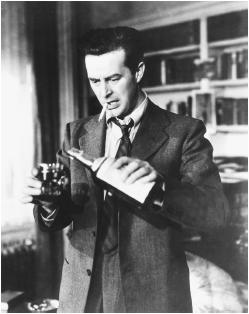
 an alcoholic descends into the the nether world of New York to satisfy his craving. Ray Milland earned his first Oscar in this break-through role.
 FilmsNoir.Net - all about film noir