Blog Feed

Charles McGraw: Biography of a Film Noir Tough Guy

The Narrow Margin (1952): B plus

Charles McGraw: Biography of a Film Noir Tough Guy
Alan K. Rode
ISBN 978-0-7864-3167-0
228pp
Hardcover (7 x 10) 2008
US$45

To be published mid-October.
Pre-order from Amazon.

Charles McGraw appeared in many classic noirs including The Killers (1946) and The Narrow Margin (1952). The author, film historian and journalist Alan K. Rode, is a director of the Film Noir Foundation.

From the publisher:

Whether portraying tough cops or sadistic killers, McGraw brought a unique authenticity to the screen. Emphasizing his impact on the film noir style, this comprehensive biography examines McGraw’s lengthy career against the backdrop of a changing Hollywood. Through numerous personal interviews with his surviving intimates, close acquaintances and co-workers, his tumultuous personal life is detailed from his earliest days to his bizarre, accidental death. Also included are an extensive critical filmography of McGraw’s feature film career, a complete list of television appearances and previously unpublished film stills and personal photos.

From James Ellroy:

A spellbinding account of the great noir heavy…and a must-have addition to all film-noir libraries. Deft biography and overall wild tale.

The book has also been reviewed on TCM.

American Cinema: Film Noir and the Detective Film

The Modern Art Museum of Fort Worth is offering a free four-part lecture and film noir series taught by Dr. David E. Whillock, Professor and Associate Dean of the College of Communications at Texas Christian University. This series is an abbreviation of a full course offered through the TCU Master of Fine Arts program. Each lecture will be followed by a film screening and a question-and-answer session . The text used for the series is Film Noir: The Dark Side of the Cinema by Foster Hirsch.

Wednesday, September 5, 6–8:40 pm
Literary Influences: The Hard Boiled Detective Novel
Screening: Murder My Sweet (1944, directed by Edward Dmytryk)

Wednesday, September 26, 6–8:40 pm
Visual Styles of Film Noir: Iconography
Screening: Out of the Past (1947, directed by Jacques Tourneur)

Wednesday, October 10, 6–8:40 pm
Literature and Film: Problems of Adaptation
Screening: The Big Sleep (1946, directed by Howard Hawks)

Wednesday, November 7, 6–8:40 pm
Women in Film Noir: The Virgin and the Femme Fatale
Screening: Body Heat (1981, directed by Lawrence Kasdan)

Roadblock (1951)

Roadblock (1951)

A competent b-noir from the RKO factory. While dated and rarely going beyond what its low budget allowed, Joan Dixon as the reforms-too-late femme-fatale leaves you wondering why her career as an actress went nowhere, and the more than competently shot doomed escape by car at the end is one of the best car chases from the period. The final scene is elegantly composed by stalwart noir photographer Nicholas Musuraca.

Roadblock (1951)Roadblock (1951) Roadblock (1951)
Roadblock (1951)

[piclens-lite-link]

Noir Review Finds

Gun Crazy

Richard von Busack on MetroActive reviews Gun Crazy (1949):

Joseph H. Lewis’ berserk film noir classic ‘Gun Crazy’—the story of a sexy sharpshooter and a sensitive gun nut… we’ve seen some smooth, pale and impassive actresses, but none is as genuinely skull-faced as Peggy Cummins… Cummins’ Annie Laurie Starr has a down-turned mouth and the lockjaw of a woman smothering an English accent. She is pocket-size but a crack shot with the pistol, and her eyes have the gleaming calm of a rabid animal waiting to decide who to bite first…

The French Connection

Nicolas Rapold of the New York Sun on The French Connection (1971):

The French Connection hits the sweet spot of urban grit, perhaps by virtue of its early entry in the grimy ’70s sweepstakes. This New York is indeed broken-in, featuring a magnificently dilapidated warehouse, but it doesn’t wallow, stagger, and vomit like the squalid and bankrupt Gotham of Martin Scorsese’s 1976 milestone Taxi Driver. Nor does Popeye’s dispute with a federal agent attached to the case carry grimly satisfying anti-establishment overtones. Perhaps screenwriter Ernest Tidyman split the difference between his work on the glam attitude of “Shaft” (which made its debut the same year) and later in the deep-cover flick “Report to the Commissioner…

Film Noir: Critical Origins

Thomas Leitch of the University of Delaware, in his book, Crime Films: Genres In American Cinema (Cambridge University Press, 2004), gives a nice introduction to the critcal origins of film noir (my emphasis):

The term film noir was first coined by French reviewer Nino
Frank when the end of the wartime embargo brought five 1944
Hollywood films – The Woman in the Window, Laura, Phantom
Lady, Double Indemnity, and Murder, My Sweet – to Paris in the same
week in 1946
. All five films seemed to take place in a world marked by
menace, violence, and crime and yet distinct from the world of the
gangster cycle of the 1930s. In christening the young genre, Frank was
thinking not so much of earlier movies as of earlier novels. The label
film noir was adapted from Marcel Duhamel’s Série noire translations
for Gallimard of British and American hard-boiled novels. The private-eye
stories of Dashiell Hammett and of Raymond Chandler, whose gorgeously
overwrought prose made him the most obvious stylistic patron
of noir, had broken the decorum of the formal detective story
from Conan Doyle to Agatha Christie. But an even closer analogue was
to be found in the breathless suspense novels of James M. Cain (The
Postman Always Rings Twice, 1934; Double Indemnity, 1936) and Cornell
Woolrich (The Bride Wore Black, 1940; Phantom Lady, 1942), which
trapped their heroes in a nightmarishly claustrophobic world of evil.

Except for their common breeding ground in anonymous, claustrophobic
cities that dramatized postwar alienation and disillusionment,
noir heroes could not have had less in common with their gangster
forebears. The principals of this new breed of crime films were not
promethean challengers, or even professional criminals, defying the
repressive institutions of their worlds, but hapless, sensitive, often
passive amateurs who typically were seduced into criminal conspiracies
through their infatuations with the sultry, treacherous heroines,
femmes fatales who had no counterpart in the man’s world of Hollywood
gangster films. Unlike gangster films, which traced the rigidly
symmetrical rise and fall of their outsized heroes, films noirs more often
showed their heroes fatalistically sinking into a pit after the briefest
of come-ons. The heroes of noir often dreamed of dabbling briefly
in crime before returning to their normal lives, or found themselves
trapped in the criminal plots of others despite their own innocence.
In either case, the way back to normalcy was barred; they were so
completely doomed by the slightest misstep, and their doom so openly
telegraphed to the audience from the opening scene, that the very
idea of heroism, even criminal heroism, became hopelessly distant…
(pp. 126-127)

The Narrow Margin (1952): B plus

The Narrow Margin (1952): B plus

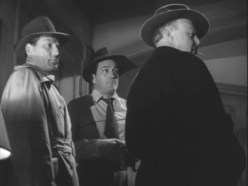
A very enjoyable B thriller from a crew with strong film noir credentials. Director, Richard Fleischer, is ably supported by cameraman, George E. Diskant, and the movie features a strong cast of b-liners, with the tough Charles McGraw and the exciting Marie Windsor in the leads. A nice plot twist propels the tension to the end. From the dramatic opening credits of a train screeching through the night, The Narrow Margin, has you hooked.

One of the best on-a-train thrillers, this movie starts off in noir mood but develops into a smart thriller with few noir pretensions. The direction is sharp, the dialog snappy, and the cast top-notch. The early night scenes before the action switches to a train trip from Chicago to LA, are brilliantly filmed and edited, with stark lighting and shadows, and low angles.

The Narrow Margin (1952): B plus The Narrow Margin (1952): B plus

On the train, tension is heightened by judicious cuts to the steaming train running aggressively from right to left across the screen. There is a nice piece of montage worthy of Eisenstein half-way through the trip which gives a cut to the train even added tension: the action cuts from Marie Windsor frantically filing her nails to the churning wheels of the steam engine.

The Narrow Margin (1952): B plus the n

For me this film is all about Marie Windsor as the dame in trouble scrapping with her cop protector. She dominates every scene with her aura of sex, excitement, and nervous fear. Her great lines are delivered flawlessly with great rolling of her incendiary eyes and almost always with a cigarette in her mouth or hand. You don’t want this vixen to leave the screen.

The Narrow Margin (1952): B plusThe Narrow Margin (1952): B plus

She is brutally bumped off towards the end, and to my exasperation is never alluded to again. This cheapens the rest of the story for me, because she is the one character who is exposed to the most danger, and merits the greatest kudos. To be simply forgotten is almost misogynistic.

This weakness aside, the closing scenes are classic compositions which accentuate the escape from the claustrophobia of the train while remaining on the “straight and narrow”:

The Narrow Margin (1952): B plus The Narrow Margin (1952): B plus

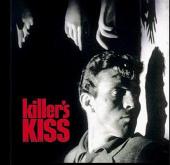
Killer’s Kiss (1955): Early Kubrick

Killer’s Kiss  -1955

Killers Kiss (1955), an early B noir from Stanley Kubrick has been reviewed by Cinepinion.

There is another review of Killer’s Kiss on the Noir Files, and other great articles on these films noir:

FILM NOIR
The Letter (1940)
Double Indemnity (1944)
Detour (1945)
The Lady From Shanghai (1948)
Niagara (1953)
Criss Cross (1949)
The Asphalt Jungle (1950)
The Bad & the Beautiful (1952)
The Big Heat (1953)
Pickup On South Street (1953)
Killer’s Kiss (1955)
The Killing (1957)
Touch of Evil (1957)

NEO-NOIR
Vertigo (1958)
The Killers (1964)
Seance on a Wet Afternoon (1964)
Un Flic (1972)
American Gigolo (1980)
Body Heat (1981)
Dance With A Stranger (1985)
House of Games (1987)
Bitter Moon (1992)
Noir, Now & Then (2001): feature book review

Boomerang (1947): Not Noir

Boomerang (1947)

Boomerang, an early movie from director, Elia Kazan, is famous for its then innovative quasi-documentary style. Based on a true story, it is a sharp and well-acted film where a small-town DA in a novel reversal of role determines the innocence of a troubled WW2 vet wrongly charged with murder. The movie feels dated but the story of integrity in the face of political corruption and police expediency remains strong.

How others have classified this picture as a noir has me stumped. Yes, the accused is a war veteran struggling to catch up in the “parade of life” after 5 years in the army, but this is peripheral and does not a film noir make.

Act Of Violence (1948)

Act Of Violence (1948)

Film Forno has posted a lengthy review of Act Of Violence:

The issues in this film are so real it elevates the story from the genre to a lofty psychological plane. Once it starts I dare you to try and stop watching it! Noir was a B genre, they were made fast, a lot of the conventions of noir , the stylish shots were partly created to save time as for example when you have two characters talking to each other but both facing the camera, this saves the time of doing reverses, moving the camera, relighting, etc…

Philip Marlowe: Screen Adaptations

Film Noir Private Eye

Down these mean streets a man must go who is not himself mean, who is neither tarnished nor afraid. The detective must be a complete man and a common man and yet an unusual man. He must be, to use a rather weathered phrase, a man of honor. He talks as the man of his age talks, that is, with rude wit, a lively sense of the grotesque, a disgust for sham, and a contempt for pettiness.

Raymond Chandler

Beyond The Valley of the Cinephiles has published a wide-ranging article on screen adaptations of Chandler’s detective fiction: Philip Marlowe on the Silver Screen.