Blog Feed

Film Noir: Recommended Reading

BuddBottiecher's Behind Locked Doors (1948)

I came across this interesting Film Noir Recommended Reading List by an Amazon.Com customer and his comments:

Dark City: The Lost World of Film Noir by Eddie Muller

Buy new: $16.47 / Used from: $11.94
Eddie Muller’s Dark City is one of the best books on noir out there.

Dark City: The Film Noir by Spencer Selby

Buy new: $30.00 / Used from: $29.98
A great “list” book. Noirheads use this one to keep track of what they’ve seen and what they want to see.

Film Noir: An Encyclopedic Reference to the American Style, Third Edition

by Alain Silver
Buy new: $25.55 / Used from: $14.35
Another excellent “List” book. Not much in the way of photos, but this is probably the most comprehensive list of film noir out there.

A Panorama of American Film Noir, 1941-1953 by Raymond Borde

Buy new: $11.53 / Used from: $6.95
This is the book that started it all. A must for film fans.

Death on the Cheap: The Lost B Movies of Film Noir by Arthur Lyons

Buy new: $17.50 / Used from: $9.00
The ultimate reference of all B-film noir. The book is entertaining and really digs deep trying to find some forgotten gems (and more than a few stinkers).

Early Film Noir: Greed, Lust and Murder Hollywood Style by William Hare

Buy new: $37.95 / Used from: $35.00
A collection of essays on great film noir.

The Noir Style by Alain Silver

Buy new: $48.00 / Used from: $17.99
A enjoyable coffee-table sized book with images from film noir.

Art of Noir: The Posters And Graphics From The Classic Era Of Film Noir

by Eddie Muller
Buy new: $34.65 / Used from: $25.00
This one goes great with Noir Style. A collection of colorful film noir movie posters in coffee-table-book size.

Painting With Light by John Alton

Buy new: $19.77 / Used from: $11.99
The famed movie-maker’s book on lighting. A must for noir fans and film makers. The book references The Amazing Mr. X.

New DVD Set: Film Noir: Five Classics from the Studio Vaults

They Made Me a FugitiveScarlet Street

A new DVD set has just been released by KINO with some interesting and obscure titles, including a pristine HD transfer of the Fritz Lang classic, Scarlet Street:
Film Noir: Five Classics from the Studio Vaults – Scarlet Street/Contraband/Strange Impersonation/They Made Me A Fugitive/The Hitch-Hiker

The Hitch-Hiker

Each movie in the Set was reviewed today by Grady Hendrix in the The New York Sun: Ladies Of the Dark

Details courtesy of Amazon.com:

SCARLET STREET (1945) – A FILM BY FRITZ LANG – WITH EDWARD G. ROBINSON, JOAN BENNETT & DAN DURYEA – A box-office hit in its day (despite being banned in three US states), Scarlet Street is perhaps legendary director Fritz Lang’s finest American film. But for decades, Scarlet Street has languished on poor quality VHS tape and in colorized versions. Kino’s immaculate new HD transfer, from a 35mm Library of Congress vault negative, restores Lang’s extravagantly fatalistic vision to its original B&W glory. When middle-aged milquetoast Chris Cross (Edward G. Robinson) rescues street-walking bad girl Kitty (Joan Bennett) from the rain slicked gutters of an eerily artificial backlot Greenwich Village, he plunges headlong into a whirlpool of lust, larceny and revenge.

CONTRABAND (AKA Blackout) (1940) – A FILM BY MICHAEL POWELL – WRITTEN BY EMERIC PRESSBURGER – WITH CONRAD VEIDT & VALERIE HOBSON – Contraband is a comedy thriller in the vein of Hitchcock’s The Thirty-Nine Steps and The Lady Vanishes. The film is an early treasure from the writer-director team of Emeric Pressburger and Michael Powell (The Red Shoes), who have been hailed by critics as jewels in the crown of British cinema. Set in England during the early days of WW II, Contraband stars Conrad Veidt and Valerie Hobson as a Danish sea captain and his enigmatic passenger who are kidnapped by a cell of Nazi spies operating from a basement in London’s Soho. In evocatively Hitchcockian fashion, the plot progresses as a chase that puts the characters in one peculiar set of surroundings after another.

STRANGE IMPERSONATION (1947) – A FILM BY ANTHONY MANN – WITH BRENDA MARSHALL & LYLE TALBOT – Hard-boiled film noir masquerading as a women’s melodrama, Strange Impersonation is a twisted tale of jealousy, murder, revenge and facial disfigurement from director Anthony Mann (T-Men, Raw Deal).

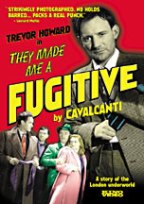
THEY MADE ME A FUGITIVE (AKA I Became A Criminal) (1947) – A FILM BY CAVALCANTI – STARRING TREVOR HOWARD & SALLY GRAY – Alberto Cavalcanti (Dead of Night), one of the key figures in French and British cinema for several decades, turns his sights on the London underworld in the engrossing Brit Noir gangland drama They Made Me a Fugitive. Set in unsettled postwar England where crime is on the upsurge, Fugitive is a suspenseful genre film which uses the picturesque Soho district as background to brilliant effect. The brooding and atmospheric cinematography of cameraman Otto Heller (Funeral in Berlin) is in the noir visual tradition, while the film’s authenticity is due to the director’s command of documentary technique. The London pubs, alleys, and back bedrooms turn into the poetry of urban realism.

THE HITCH-HIKER (1953) – A FILM BY IDA LUPINO – STARRING EDMOND O BRIEN, FRANK LOVEJOY & WILLIAM TALMAN – The only true film noir ever directed by a woman, this tour-de-force thriller (considered by many, including Lupino herself, to be her best film) is a classic, tension-packed, three-way dance of death about two middle-class American homebodies (Edmond O’Brien and Frank Lovejoy) on vacation in Mexico on a long-awaited fishing trip. Suddenly their car and their very lives are commandeered by psychopathic serial killer Emmett Myers (William Talman). The striking light/dark contrasts, the stunning compositions (such as the two kidnap victims separated by a narrow stream from a gun-cradling madman with a lazy eye) and the spatial integrity of a determining sense of locale (the pitiless topography of a rockbound, horizonless Mexico over which hovers an ever-present doom) all contribute mightily to this fascinating character study.

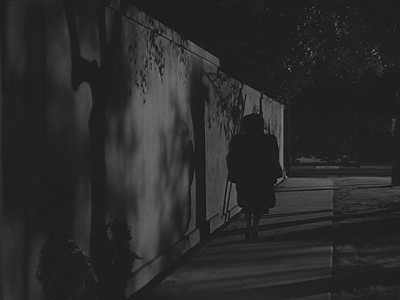
Cat People (1942): Another sound – the panther – it screams like a woman

Cat People (1942)

“Even as fog continues to lie in the valleys, so does ancient sin cling to the low places, the depressions in the world consciousness.”
– Opening Credits

The first of a string of B horror classics from RKO, this haunting tale of a cat-woman is an expressionist tour-de-force. Directed by Frenchman Jacques Tourneur, filmed by the Italian cinematographer Nicholas Musuraca, and produced by Russian-born Val Lewton, from a screenplay by DeWitt Bodee. Later in 1947 Tourneur and Musuraca teamed again to make Out of the Past.

Tourneur uses stark lighting and moody night shots to suggest horror and foreboding in scenes that are rendered completely only in the viewers’ imaginations.

Simone Simon portrays the woman doomed from birth with understated intensity, and her engaging performance gives the erstwhile demon a fragile humanity.

This highlights another connection to film noir. The cat woman is not just a captive of her accursed fate, but imprisoned by her very sexuality, which can be expressed only by unleashing her demonic self.

From the closing credits:

But black sin hath betrayed to endless night
My world, both parts, and both parts must die.

Holy Sonnets, V. – John Donne.

A visual feast and a multi-layered literate tale of darkness.

This slideshow requires JavaScript.

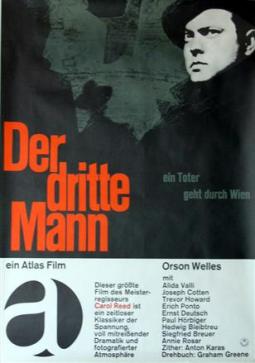
The Third Man (1949): Sublime

The Third Man (1949)

A not-too-smart hack novelist, Holly Martins, blunders onto the streets and dives of post-war Vienna to solve the riddle of how his shady friend, Harry Lime, died…

The Third Man ranks up there with Citizen Kane, Casablanca, The Maltese Falcon, and The Grapes of Wrath as one the great English-speaking films: a multi-faceted jewel of a picture.

From the innovative opening credits, introduced by the haunting zither rendition by Anton Karas of the movie’s theme, you are hooked.

With great performances from Joseph Cotton, Alida Valli, Orson Welles, and Trevor Howard, with a strong supporting cast in an adaptation by Graham Greene of his own novel, director Carol Reed and cinematographer Robert Krasker together define a dark and intriguing filmic universe that renders the city of Vienna as important as the the story which is played out on its streets and below.

The strength of the story is more than the engaging cavalcade of characters in a true human comedy, but the deep analysis of love and friendship, and the imperatives of conscience. Is loyalty out of passion stronger and more genuine than the loyalty of friendship, where the object of affection is amoral and commits despicable acts?

The following kaleidoscope of frames from the film convey the film’s atmosphere:

This slideshow requires JavaScript.

The Stranger (1946): Jungian Noir

The Stranger (1946)

Nazi war criminal is stalked in a sleepy Connecticut town…

A strong thriller with Orson Welles directing and playing the lead in a screenplay by Victor Trivas. Edward G Robinson is solid – as always – as the investigator, with the beautiful Loretta Young perfect as the innocent and loyal wife. Welles’ deft direction and the camera-work of Russell Metty transform an over-the-top thriller into a moody and intelligent noir, where Jungian concepts of the unconscious are woven with a taut psychological study of the deranged mind of a desperate man.

Strong expressionist lighting make the visuals so compelling that dialog is not needed to propel the story at all – the essence of film art that was largely lost when the talkies arrived. This feat is achieved with particularly strong performances by the leads:

  • Robinson’s mannerisms and the clever use of his pipe as a prop,
  • Welle’s controlled demeanour with all the emotion subtly expressed facially, and
  • Young an emotional powerhouse portraying kinetically the full range of emotions from the joyous innocence of a bride-to-be to the hysteria of a woman clinging to her last shred of faith in the man she loves.

The Stranger (1946) The Stranger (1946)

The Noir Of War

War: Vietnam 1967

Many write of the “existential dread” in the aftermath WW2 as the catalyst for film noir.

A very young Bob Dylan’s Masters of War in 1961 put the focus back on to war itself:

Come you masters of war
You that build all the guns
You that build the death planes
You that build the big bombs
You that hide behind walls
You that hide behind desks
I just want you to know
I can see through your masks

You that never done nothin’
But build to destroy
You play with my world
Like it’s your little toy
You put a gun in my hand
And you hide from my eyes
And you turn and run farther
When the fast bullets fly

Like Judas of old
You lie and deceive
A world war can be won
You want me to believe
But I see through your eyes
And I see through your brain
Like I see through the water
That runs down my drain

You fasten the triggers
For the others to fire
Then you set back and watch
When the death count gets higher
You hide in your mansion
As young people’s blood
Flows out of their bodies
And is buried in the mud

You’ve thrown the worst fear
That can ever be hurled
Fear to bring children
Into the world
For threatening my baby
Unborn and unnamed
You ain’t worth the blood
That runs in your veins

How much do I know
To talk out of turn
You might say that I’m young
You might say I’m unlearned
But there’s one thing I know
Though I’m younger than you
Even Jesus would never
Forgive what you do

Let me ask you one question
Is your money that good
Will it buy you forgiveness
Do you think that it could
I think you will find
When your death takes its toll
All the money you made
Will never buy back your soul

And I hope that you die
And your death’ll come soon
I will follow your casket
In the pale afternoon
And I’ll watch while you’re lowered
Down to your deathbed
And I’ll stand o’er your grave
‘Til I’m sure that you’re dead

Copyright © 1963; renewed 1991 Special Rider Music

The Lady From Shanghai (1947): “Then the beasts took to eating each other”

The Lady From Shanghai (1948)“Do you know…
once, off the hump of Brazil…
I saw the ocean so darkened with blood it was black…
…and the sun fainting away over the lip of the sky.
We´d put in at Fortaleza…
and a few of us had lines out for a bit of idle fishing.
It was me had the first strike.
A shark it was.
Then there was another.
And another shark again.
Till all about, the sea was made of sharks…
and more sharks still.
And no water at all.
My shark had torn himself from the hook…
and the scent or maybe the stain it was, and him bleeding his life away…
drove the rest of them mad.

Then the beasts took to eating each other.
In their frenzy…
they ate at themselves.
You could feel the lust of murder like a wind stinging your eyes.
And you could smell the death reeking up out of the sea.
I never saw anything worse…
until this little picnic tonight.
And you know…
there wasn´t one of them sharks in the whole crazy pack that survived.
l´ll be leaving you now.

George, that´s the first time..
anyone ever thought enough of you to call you a shark.
If you were a good lawyer, you´d be flattered.”

The Lady From Shanghai (1948)The Lady From Shanghai (1948)

A brilliant jigsaw of a film noir from Orsone Welles, with a femme-fatale to die for, and a script so sharp and witty, you relish every scene. You can watch it again and again, and find something new each time.

The long yacht voyage is used to both develop the characters and as a homage to Hayworth’s beauty and the eternal feminine in the flesh and in nature.

The Lady From Shanghai (1948)The Lady From Shanghai (1948)The Lady From Shanghai (1948)The Lady From Shanghai (1948)

The climactic confrontation and shootout at the end in an amusement park mirror-maze is breath-taking. The restored print available on the DVD is so sharp that it is hard to believe the picture was shot 6o years ago.

The Lady From Shanghai (1948)The Lady From Shanghai (1948)

To be savoured with patience and your full attention.

Visions of Light: Noir Cinematography

Most film analysis favours the auteur approach, where the creative credit is focused on the director.

The 1992 documentary on great cinematographers from the silent era to the 80’s, Visions of Light: The Art of Cinematography, shifts the spotlight to those who actually wielded the camera.

Orson Welles in recognition of this creative contribution, in the credits for Citizen Kane (1941), shared direction credit with his collaborator and director of photography, Gregg Toland:

Citizen Kane (1941)

The following slideshow features 32 great examples of the “black” light of film noir featured in Visions of Light. Director of Photography credits are list at the end of the post.

This slideshow requires JavaScript.

Mildred Pierce (1945) – Ernest Haller
The Killers (1946) – Woody Bredell
Out of The Past (1947) – Nicholas Musuraca
The Naked City (1948) – William Daniels
Young Man with a Horn (1950) – Ted McCord
The Big Combo (1955) – John Alton
The Night of the Hunter (1955) – Stanley Cortez
Sweet Smell of Success (1957) – James Wong Howe
Touch of Evil (1958) – Russell Metty

The Naked Kiss (1964): Pulp Noir

The Naked Kiss (1964): Pulp Noir

discomfited staggering between camp, noir, and grotesque melodrama, might be more a result of studio tampering than Fuller’s misdirection. It is also difficult to discern just what sort of censorship the studios achieved, for whatever they did was austerely permeated by social taboos the likes of abortion, prostitution, child molestation, and murder.

IMBD Comment from jeanpesce

Samuel Fuller, writer, director, and producer of The Naked Kiss, apparently disclaimed this film after alleged re-editing ordered by studio bosses before its release.

I found the film largely emotionally distant, but the story of a prostitute who tries to remake her life in the face of social prejudice and male misogyny is perversely involving. A noir sensibility pervades, but it is not really a film noir as the anti-hero is a woman who is punished for being good: though her violent actions may be justified in a closed sense, they are not necessarily the only reasonable responses.

The best scene is when the text of a newspaper headline is flashed across the screen: it is a veritable punch to the stomach.

Fuller was a pulp director who tried to understand women and support their empowerment, unlike directors like Quentin Tarantino, who seek to debase the feminine.

Something different.

Anthony Hopkins: Influenced by Film Noir

Anthony Hopkins in an interview with Cinema Blend about his new film, Slipstream, which he not only wrote and directed, but in which he also stars and wrote the music, says of his influences:

Our existence is beyond our explanation… I believe that everything is illusory, because we can’t grasp anything… The films that I really like were the film noir movies […] Those film noir things just got to me as a kid. A film that’s non-linear, Burt Lancaster in The Killers

thekiillers01.jpg