Blog Feed

The Long Goodbye (1973): Redefining Philip Marlowe

The Long Goodbye (1973)

The House of Mirth and Movies blog has posted an excellent review of Robert Altman’s The Long Goodbye (1973). An extract from The Long Goodbye: Recreating Noir:

The Long Goodbye maintains the thematic associations of noir, while altering the physical environment. The location remains much the same, as the conventional noir, as the film is set in Los Angeles, and the urban setting plays heavily into creating mood and atmosphere. The most apparent change is no doubt the shift from black and white to colour. The added choice to expose the undeveloped film negative to additional pure light in post production, until the colours were softened and the darks faded, further differentiate the look with the genre’s original stylistic trademark. Instead of the high contrast, low key lighting that characterizes film noir, the film is almost washed away. This technique works at creating a similar atmosphere as the traditional noir model despite being so different. Life and existence lack all vibrancy, and the uniform shade of grey that seems to pervade every scene emphasizes the moral ambiguity of all those who inhabit the city. There is little difference between black and white, so everyone is living in a perpetually grey and faded environment, living between the traditional models of good and evil instead of clearly on one side or the other…

This blog also has an interesting post on The Big Sleep (1946): Thinking about The Big Sleep and Howard Hawks.

Armored Car Robbery (1950): Solid B-Noir

Armored Car Robbery 1950Director, Richard Fleischer, teams with B-movie stalwart, Charles McGraw, in a tight 67 minutes of classic b-noir mayhem. A daring heist goes wrong and the criminal mastermind tries to shoot his way out, with a final take-out on an airport runway. A police procedural firmly grounded in the steets of LA with dark noir atmospherics. Recommended.

Fliescher and McGraw teamed again in The Narrow Margin (1952).

The Noir City: Imagining Gotham

Hugh Ferriss: Gothic Noir in Gotham

The nonist blog has a fascinating article on (and including images from) the reprint of a 1929 book by Hugh Ferriss titled The Metropolis of Tomorrow: “Ferriss was the preeminent architectural draftsman of his time who through his moody chiaroscuro renderings of skyscrapers virtually inventing the image of Gotham…”

Ferriss’ gothic renderings of modern architecture have an uncanny affinity with the noir city of the classic film noir cycle.

The Fight Movie and Film Noir

The Set-Up 1949

The Set-Up (1949)

Film-maker David Mamet, in an interesting piece in today’s New York Times on his new film, Redbelt, about a movie fight director, has written eloquently on the fight movie and film noir:

Fight films are sad. There is nobility in effort, in discipline and, if not in suffering, in trying to live through suffering and endeavour to find its meaning… the fight film is a celebration of submission, which is to say, of loss. As such, it finds itself on the outskirts of my beloved genre of film noir. The punch-line of drama is “Isn’t life like that. …” But its elder brother, tragedy, is the struggle of good against evil, of man against the gods. In tragedy, good, and the gods, are proclaimed winners; in film noir, which is tragedy manqué, the gods still win, but good’s triumph gets an asterisk… The true story of any true fight must be sad. As Wellington said, “Nothing except a battle lost can be half so melancholy as a battle won.”

Mamet explores this thesis that “All fighters are sad” by analysing the scenes featuring real-life fighters playing fighters in Jules Dassin’s Night And the City (1950) and Stanley Kubrick’s The Killing (1956), and goes on to explore it more deeply in Kurosawa’s The Seven Samurai (1954).

Surprisingly, Mamet does not mention two other films noir: Robert Rossen’s Body and Soul (1947), or Robert Wise’s The Set-Up (1949). The wrestlers in Night and the City and The Killing are not central characters, while in Body And Soul and The Set-Up, a boxer is the central character, and the tragedies played-out in these two movies more strongly evoke the existential angst of the ‘fight’. Indeed, The Set-Up as a real-time evocation of one fight, brilliantly confronts Mamet’s theme of the melancholy duality of winning and losing. Robert Ryan, also once a real-life boxer, as the aging fighter, “Stoker” Thompson, refuses to throw the fight and by winning loses when the heavies, who paid his trainer for the fall, cripple him in a dark back-alley outside the stadium.

Crime Wave (1954): On The Streets of LA

Crime Wave 1954

An ex-con trying to stay clean is sucked into a bank heist when a former cell-mate turns-up at his apartment after a late night gas-station smash and grab goes wrong and a cop is killed.

Andre de Toth’s Crime Wave (1954) gives star billing to Sterling Hayden as the LAPD homicide detective hunting down the killers, but all major players in this police procedural have equal presence. From the gas-station attendant to the crooked vet who patches up wounded hoods on the run, and the aging parole officer woken in the night by a call from one of his ‘boys’, each character is deeply drawn.

A very tight story of 74 minutes played out on the streets of LA, has a feel so authentic, you think it happened yesterday and for real. The noir theme of an inescapable past propels the drama at a personal level in the claustrophobic constraints of an apartment, while out on the streets and in police headquarters the camera observes the manhunt with detachment and precision.

A masterwork.

Crime Wave 1954  Crime Wave 1954

Crime Wave 1954   Crime Wave 1954

New Book on Maverick Film-Maker Samuel Fuller

Shock Corridor 1963
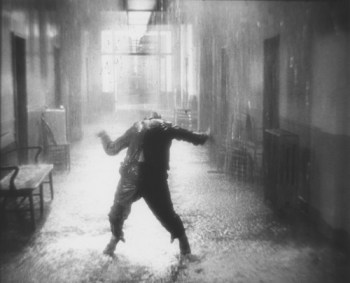
Shock Corridor (1963)

Professor of film studies Wesleyan University, Lisa Dombrowski has just published The Films of Samuel Fuller: If You Die, I’ll Kill You!.

In a press release Dombrowski said of Fuller:

His films are inherently fascinating. They’re designed to reach out and grab you. They’re provocative; they want you to respond emotionally and intellectually and sometimes even physically in an instinctual manner, as if someone has punched you in the face. He accomplished his goals in different ways. In the content, he discussed controversial issues of the time, race, gender, violence, critiques of America. Also, through their narrative structure, they emphasize conflict and contradictions, with dramatic tonal shifts that are jarring.

A book-signing and discussion of Fuller by Dombrowski will be held Thursday 24 April 2008 at 7:30 p.m. at the Goldsmith Family Cinema, 301 Washington Terrace, on the campus of Wesleyan University in Middletown, Connecticut. The signing will be held in conjunction with a screening of the 1955 Fuller thriller House of Bamboo.

Reviews of Samuel Fuller noirs on filmsnoir.net:

Pickup On South Street (1953)
The Crimson Kimono (1959): Little Tokyo Rift
The Naked Kiss (1964): Pulp Noir

Review of Fritz Lang’s M

M 1931

US novelist David Schleicher, has posted a very worthy review of Fritz Lang’s M (1931) on his blog.

Murder, My Sweet (1944): A face like a Sunday school picnic

Murder My Sweet (1944)It was a nice little front yard.
Cozy, okay for the average family…
only you’d need a compass
to go to the mailbox.

The house was all right, too,
but it wasn’t as big as Buckingham Palace.

I had to wait
while she sold me to the old folks.
It was like waiting to buy a crypt
in a mausoleum.

Watching Murder, My Sweet (aka Farewell My Lovely – 1944) , is the most fun you will ever have with a film noir. Raymond Chandler’s hard-boiled prose crackles in this screen adaption by John Paxton, with moody noir direction by Edward Dmytryk.

Inhabiting a plot about a rich dame’s stolen jade necklace almost as convoluted as The Big Sleep (1946), the cast is superb. Dick Powell has a comic edge that brings a lightness to the shenanigans, and is a superb foil to the camp turn by Claire Trevor as the putative femme-fatale. Anne Shirley is as cute a 40’s starlet as ever graced the screen. The bad guys are bigger than life and truly entertaining, and rub each other out without ceremony or prevarication. It looks like a film noir, but the bad guys and gals are truly bad, and the good guy and gal are incorruptible.

Look out for the innovative “purple haze” sequence, after PI Marlowe is drugged by a crooked quack.

Murder My Sweet (1944)

The Bridge and the City Motif in Film Noir

The bridge motif has powerful symbolism in film noir. These poignant shots from the final fatal scenes of three films noir attest to this:

Night And the City 1950
Night and the City (1950)

Force Of Evil 1948
Force of Evil (1948)

roadblock4.jpg
Roadblock (1951)

[piclens-lite-link]

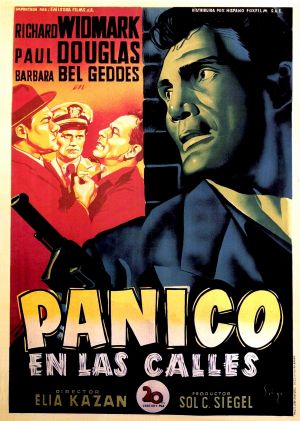
Panic In the Streets (1950): Neo-Realist Noir

Panic In The Streets (1950)


Local authorities track down violent hoods infected with a virulent infection.

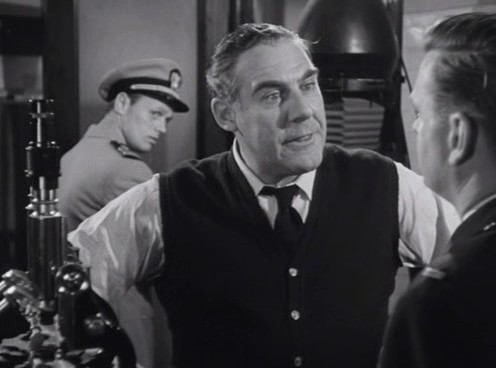
Panic In the Streets (1950) is an interesting documentary-style noir set on the docks of New Orleans: a fast-paced on-the-streets thriller with little time or inclination for deep characterisation. The movie picked up the Venice International prize in 1950, and an Oscar for Best Writing in 1951. Tautly directed by Kazan and with strong street cred: the climax on a ship’s mooring rope is elegantly metaphoric.

Richard Widmark is cast against (then) type as the local health official pushing the cops to track down the killers of an illegal alien who has infected the hoods with pneumonic plague. Paul Douglas is well-cast as the reluctant cop who heads the police task force. Jack Palance and Zero Mostel are strong as the hoods, with a certain tension between them: Palance is focused and brutal, while Mostel is nervous and obsequious. Cinematographer, Joe MacDonald, who did similar work in The Dark Corner (1946), has filmed the night scenes with moody noir atmospherics.

Panic In The Streets (1950)

Given Kazan’s tendency for emotional distance and the cinema-verite approach, there is a strong social dimension to the picture. The working people in the docks milieu distrust the cops and are uncooperative, and the cops and local bureaucrats are reluctant partners. The mood is of dysfunction and the trajectory is that it is only the doggedness of Widmark and Douglas that saves the day.

All this points to Kazan’s complexity and contradictions. While those on the edge of criminal society are fairly portrayed, there is the feeling that they are stubborn and boorish, and need to be bullied by authority. At the same time, public institutions are seen at logger-heads and can only function effectively if commandeered by strong personalities.

Conventionally, Widmark and Douglas develop a grudging respect for each other and by the end of the story are friends. Strangely, this relationship for me is the core of the film, and comes not only from what happens on the screen, but also from a backward almost nostalgic perspective. Both these actors invest their roles with an essential integrity: they are not perfect, struggle financially, and their personal lives have their share of bewilderment and angst, but they are thoroughly decent men doing tough jobs, for lousy pay, and little social recognition or thanks. These guys inhabit a lost black and white world of simpler times when normal lives seemed to have greater decency. Perhaps also this perception is colored for me by Paul Douglas, a wonderful actor who always came across as a totally solid guy that you would love to have as your friend.

Panic In The Streets (1950)