Blog Feed

The Dark Mirror (1946 ): On the other side

The Dark Mirror (1946)

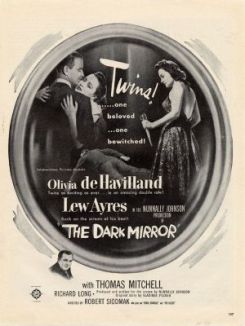
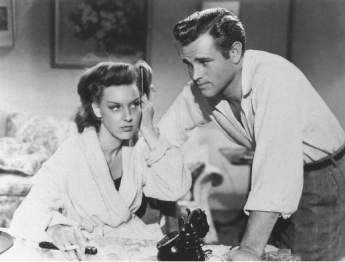
Robert Siodmak’s The Dark Mirror (1946 ), for Republic Pictures, is one of the early psychological noir thrillers. The story of two attractive young women, identical twins, implicated in a murder explores the extremes of personality – the dark side, the wraith in the mirror.   A theme of the entrapment of the disturbed mind and it’s insatiable demands add a decidedly noir feel to the film. A crisp script from Nunally Johnson, the solid camera-work of  Milton Krasner, and a Dimitri Tiomkins score provide competent support.  The original story by Vladimir Pozner received an Oscar nomination.

Siodmak’s direction is workman-like with some flair reserved only for the opening scene and the climactic scenes towards the end. The fluid opening scene sees the camera pan from a cityscape at night to a building in the foreground, through a window into a darkened room, up to a smashed mirror, and then down to a man dead on the floor. The smashed mirror is also a book-end in the film’s closing scene – the dark reflection has to be destroyed.  As the drama heightens towards the denouement, the insanity of one of the protagonists is melodramatically rendered in a darkened room at night, where key lighting focuses attention on the crazed eyes of a psychopath.

The picture is carried by an elegant and accomplished performance from Olivier de Havilland in the double role of the twin sisters. As their personalities diverge with the story’s progression, so her performance strengthens. By the climax, she is breathtaking.  Thomas Mitchell is entertaining as the cop investigating the murder.

Interesting use of a psychologist’s tool-set, Rorschach inkblots, word association, and a polygraph, carry the centre of the film to its dramatic conclusion.

Worth seeing for de Havilland’s subtle performance alone.

The Lost Weekend (1945): “I can’t take quiet desperation”

The Lost Weekend (1945)

In the seminal August 1946 article which coined the expression ‘film noir’, French film-critic Nino Frank referred to five Hollywood movies as noirs: The Maltese Falcon (1941), Double Indemnity (1944), Laura (1944), Murder, My Sweet (1944), and The Lost Weekend (1945).  By coincidence in the same month, expatriate German cultural critic, Siegfried Kracauer, who had moved to America because of WW2, in Commentary magazine argued that Hollywood films like Shadow of a Doubt (1942), The Lost Weekend (1945), and The Stranger (1946), displayed a certain decadence.

In the first book on film noir, A Panorama of American Film Noir, 1941-1953, published in France in 1955, the authors, Raymond Borde and Étienne Chaumeton, say that The Lost Weekend was only superficially a film noir, because “strangeness and crime were absent”.  In Andrew Spicer’s Film Noir (2002), The Lost Weekend does not rate a mention, and it does not merit an entry in Silver and Ward’s Film Noir: An Encyclopedic Reference (1992).

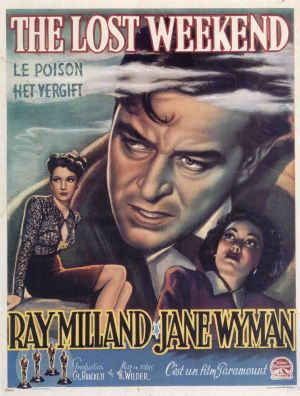
To my mind Billy Wilder’s The Lost Weekend is unequivocally a film noir. The film has a definite noir sensibility and explores the dark themes of existential angst and entrapment. While the story arc is about an alcoholic’s weekend bender which spirals out on to the edge of desperate criminality, and the portrayal of alcoholic addiction was strong enough for the liquor industry to offer Paramount a cool five million dollars to bury the picture, the underlying theme is the angst of failure, of being trapped in a life without purpose or meaning. Ray Milland is Don Birnam, a failed writer, hanging on a thread like the bottle of Rye hidden and hanging on a cord outside his bedroom window, and nothing can more powerfully express his life than when he tells his girl, Helen, why he drinks (and this excerpt from the script is testimony to the power of the screenplay penned by Wilder and long-time collaborator, Charles Brackett):

DON:
A writer. Silly, isn’t it? You see, in college I passed for a genius. They couldn’t get out the college magazine without one of my stories. Boy, was I hot. Hemingway stuff. I reached my peak when I was nineteen. Sold a piece to the Atlantic Monthly. It was reprinted in the Readers’ Digest. Who wants to stay in college when he’s Hemingway? My mother bought me a brand new typewriter, and I moved right in on New York. Well, the first thing I wrote, that didn’t quite come off. And the second I dropped. The public wasn’t ready for that one. I started a third, a fourth, only about then somebody began to look over my shoulder and whisper, in a thin, clear voice like the E-string on a violin. Don Birnam, he’d whisper, it’s not good enough. Not that way. How about a couple of drinks just to put it on its feet? So I had a couple. Oh, that was a great idea. That made all the difference. Suddenly I could see the whole thing – the tragic sweep of the great novel, beautifully proportioned. But before I could really grab it and throw it down on paper, the drink would wear off and everything be gone like a mirage. Then there was despair, and a drink to counterbalance despair, and one to counterbalance the counterbalance. I’d be sitting in front of that typewriter, trying to squeeze out a page that was halfway
decent, and that guy would pop up again.

HELEN:
What guy? Who are you talking about?

DON:
The other Don Birnam. There are two of us, you know: Don the drunk and Don the writer. And the drunk will say to the writer, Come on, you idiot.
Let’s get some good out of that portable. Let’s hock it. We’ll take it to that pawn shop over on Third Avenue. Always good for ten dollars, for another drink, another binge, another bender, another spree. Such humorous words. I tried to break away from that guy a lot of ways. No good. Once I even bought myself a gun and some bullets. (He goes to the desk) I meant to do it on my thirtieth birthday. (He opens the drawer, takes out two bullets, holds them in the palm of his hand.)

DON:
Here are the bullets. The gun went for three quarts of whiskey. That other Don wanted us to have a drink first. He always wants us to have a drink first. The flop suicide of a flop writer.

WICK [Don’s brother]:
All right, maybe you’re not a writer. Why don’t you do something else?

DON:
Yes, take a nice job. Public accountant, real estate salesman. I haven’t the guts, Helen. Most men lead lives of quiet desperation. I can’t take quiet desperation.

To complete the potent formula you have the cinematography of the great John F. Sietz, art direction by the brilliant Hans Dreier, and a deeply evocative score from Miklós Rózsa. Sietz’ fluid and lengthy takes, and moodily lit interior shots add depth to the ‘caged’ mise-en-scene of Don’s apartment: evoking a sense of desperation when Don ransacks the place searching for a bottle of Rye; and then terror at night when the DT’s take hold. On the streets of Manhattan, Sietz’ camera is in deep focus on harsh sun-lit streets of empty desperation where a staggering Don searches for an open pawn shop on Yom Kippur. Drieir elegantly furnishes Don’s tenement apartment with bookcases, sofas, lamps, and wall-hangings that disguise the places where he hides his booze. Rózsa’s score is persistent and dramatic, and he innovatively uses the early electronic instrument, the theremin, to produce an eerie and sinister motif for Don’s affliction.
The Lost Weekend (1945)

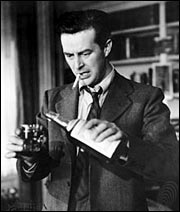
Milland’s performance is masterful and he carries the picture.  Cast against type, his tranformation from a clean-shaven everyman to a dishevelled drunk hallucinating in a darkened room, where his eyes betray the depth of his obsessed decline,  is fully dramatic in it’s intensity. Jane Wyman as Helen, only comes into her own in the finale after she has lost a leopard-skin coat and her hair is wet and loose after being in the rain. Minus the coat and her perm she is a sensual and liberating influence. To Wilders’ and Brackett’s credit, the ending while positive remains open-ended: a relapse is just as likely as Don actually writing the great unfinished novel.  A solid contribution is made by b-actors Howard Da Silva and Doris Dowling.  Da Silva plays a sympathetic bartender who is a father-confessor figure ironically dispensing shots of rye instead of  Hail Maries. Dowling, who played the murdered wife in The Blue Dahlia (1946), is particularly engaging as a b-girl who is soft on Don. Veteran noir supporting actor, Frank Faylen, has a short but memorable appearance as a male nurse in a hospital drunks clinic. This harrowing sequence is shot in true noir style and with a frankness that works brilliantly to enlarge the drama from the particular to the social. The only weakness is a wooden portrayal of Don’s straight-laced brother.

This brings me to a particularly intriguing element in The Lost Weekend. Don is not a lecherous drunk: his desire for booze sublimates all other appetites, but interestingly Wilder weaves a stunning sexual frankness into the photoplay. The b-girl Gloria works out of Stan’s bar, and the nature of her work is up-front and personal. The male nurse, Bim, in the detox clinic is clearly gay, and his sermonising on the evils of drink has a surreal even sinister quality.

Early in the movie in an interlude told in flashback  Wilder’s sardonic humor takes center stage.  Don is at the Opera, and all on stage are drinking  champagne.  The whole sequence plays as a liquor ad tempting Don to leave the performance and try and grab hold of  a bottle of rye in the pocket of his checked-in overcoat.

A great Hollywood picture and a true noir.

One-Two Punch: Pulp Writers on Film Series

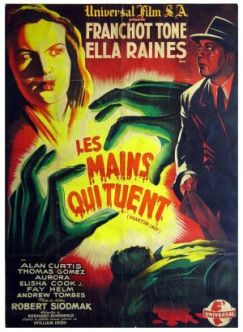
Phantom Lady (1944)
Phantom Lady (1944)

Thanks to Dark City Dame for this news.

The University of California Berkeley Art Museum and Pacific Film Archive (BAMP/PFA) will from February 13, 2009 to February 28, 2009  screen a series of movies adapted from the works of four great pulp writers: Fredric Brown, Jim Thompson, Charles Willeford, and Cornell Woolrich

Friday, February 13, 2009
6:30 pm Crack-Up
In this hallucinatory noir based on a Fredric Brown story, Pat O’Brien is an expert in forged paintings with a tenuous grasp on the boundary between real and fake—in art and in life.

8:30 pm The Kill-Off
Maggie Greenwald captures Jim Thompson’s dismal vision of an off-season resort. “A nasty, claustrophobic little gem.”—Paper

Thursday, February 19, 2009
6:30 pm Miami Blues
Introduced by Don Herron. Fred Ward plays Charles Willeford’s detective Hoke Moseley, in pursuit of sociopath Alec Baldwin and collegiate call girl Jennifer Jason Leigh. “A pungent, blithely violent thriller.”—New Yorker

8:45 pm Black Angel
Introduced by Elliot Lavine. Dan Duryea and June Vincent in a booze-drenched B-movie version of the Cornell Woolrich novel.

Saturday, February 21, 2009
6:30 pm Phantom Lady
Robert Siodmak swathes a Cornell Woolrich mystery in Expressionist shadow.

8:30 pm Série noire
Introduced by Dennis Harvey. Patrick Dewaere is the perfect fall guy in “the darkest, daffiest, and downright dazzlingest adaptation of a Jim Thompson novel ever.”—S.F. Bay Guardian

Saturday, February 28, 2009
6:30 pm Screaming Mimi
Anita Ekberg goes from the madhouse to El Madhouse, a nightclub run by Gypsy Rose Lee, in this lusciously lurid psychodrama based on a novel by Fredric Brown.

8:15 pm The Woman Chaser
Introduced by Don Herron. A conniving used-car salesman turns his talents to the movie biz in this neon-drenched neo-noir, adapted from Charles Willeford’s novel.

Full details from BAMP/PFA

Vera: No Detours

Detour (1945)

Dedicated to Ann Savage

“Come on, come on
Put your hands into the fire
Explain, explain
As I turn and meet the power
This time, This time
Turning white and senses dire
Pull up, pull up
From one extreme to another”
– Into the Fire by 13 Senses

standing by the highway
alone against eternity
one last chance
to make it – big time

your dyin’ babe
lungs can’t hold out too long
against the rising tide
choking blood

you need a ride
booze
a shower
wash the lizard’s skin from your nails

he offers
okay
what the hell!
maybe this time

another loser
lost
so stupid
he thinks fate did it

make it happen
he’s a goner
one last chance
do it

you need love babe
I need dough more
this guy’s a ticket
to blow before I split

booze
makes me sad
lonely
love me

just one time
before I go

Film Noir Reviews Preview

The Dark Mirror (1946)

These are the films noir I have lined up for review on FilmsNoir.Net over the next few weeks (not necessarily in order):

The Lost Weekend (1945)
Dir: Billy Wilder
Cast: Ray Milland, Jane Wyman

The Strange Love of Martha Ivers (1946)
Dir: Lewis Milestone
Cast: Barbara Stanwyck, Van Heflin, Lizabeth Scott, Kirk Douglas

Brute Force (1947)
Dir: Jules Dassin
Cast: Burt Lancaster, Hume Cronyn

The Dark Mirror (1946)
Dir: Robert Siodmak
Cast: Olivia de Havilland, Lew Ayres

Nora Prentiss (1947)
Dir: Vincent Sherman
Cast: Ann Sheridan, Kent Smith

The Naked City (1948)
Dir: Jules Dassin
Cast: Barry Fitzgerald, Howard Duff, Dorothy Hart

Port of New York (1949)
Dir: László Benedek
Cast: Scott Brady, Richard Rober, K.T. Stevens, Yul Brynner

Macao (1952)
Dir: Josef Von Sternberg
Cast: Robert Mitchum, Jane Russell, William Bendix, Thomas Gomez, Gloria Grahame

The Night of the Hunter (1955)
Dir: Charles Laughton
Cast: Robert Mitchum, Shelley Winters, Lillian Gish

From the Shadows: Alexander Coleman and Dark City Dame

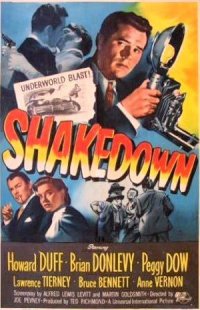
Shakedown (1950)

This January will be the Darkest Month in Coleman’s Corner.

For the month of January,  Alexander Coleman, from Coleman’s Corner in Cinema will be the guest of  Dark City Dame at  Noirish City, where he will be talking noir and selecting noirs for review on his blog.

This event will be a fitting lead-up to the Noir City 7 Film Noir Series in San Francisco from January 23 to February 1, which will have a newspaper theme –  visit the Noir City site for full details.  Alexander will don fedora and trench-coat to report direct from Noir City for Dark City Dame.

Ann Savage: Postcript

Detour (1945)

I have come across two interesting video clips on YouTube. The first features a short interview with Ms Savage about Detour from a documentary on the film’s director Edgar G. Ulmer.  The second is the official trailer for My Winnipeg.  Of interest also is Eddie Muller‘s book Dark City Dames: The Wicked Women of Film Noir which has a chapter on Ms Savage based on a mid-90s interview.

The Reckless Moment (1949): “we want to liquidate our stock while the market is high”

The Reckless Moment (1949)

The Reckless Moment (aka The Blank Wall) (1949)

Columbia Pictures 82 mins
Directed by Max Ophuls

Cinematography by Burnett Guffey
Screenplay by Henry Garson and Robert W. Soderberg
Adapted by Mel Dinelli & Robert E. Kent
from Elisabeth Sanxay Holding’s story, ‘The Blank Wall’

Cast:
Lucia Harper – Joan Bennett
Martin Donnelly  – James Mason
Ted Darby – Shepperd Strudwick
Nagle – Roy Roberts
Sybil – Francis Williams

After concealing her daughter’s accidental killing
of a man a housewife is blackmailed by a hood

The Reckless Moment, Max Ophuls’ last Hollywood picture is a great film. It is a brilliant example of the dynamics of the auteur working inside the studio system. Ophuls’ takes a basic blackmail story and through his long and fluid takes and subtle mise-en-scene infuses it with a complexity and subtlety rarely matched in film noir.  Joan Bennett as the threatened middle-class housewife, Lucia Parker, and James Mason as the Irish blackmailer Donnelly, are both impeccable, but it is Joan Bennett as the wife and mother plunged into a noir world of criminality that carries the drama forward. She struggles to defend an idyllic domesticity against a rising tide of darkness that would engulf her family. Veteran noir cinematographer, Burnett Guffey, smoothly establishes the impending entrapment within mobile tracking shots that move from light to dark, from unruffled clarity to shadows and unsettling movement, from the beguiling every-day to  menacing disturbance.  The Reckless Moment is richly rewarding and its richness is best savored over repeated viewings.

The Reckless Moment (1949)

After viewing the movie and starting my research, I became more and more perturbed. Reviews by many respected critics were scathing at worst or damning by faint praise in their dismissal of the film.  Bosley Crowther in the New York Times on the film’s opening, rather smugly concluded “a feeble and listless drama with a shamelessly callous attitude”, and Variety said “a tense melodrama projecting good mood and suspense… matter-of-fact technique used in the script and by Max Ophuls’ direction doesn’t permit much warmth to develop for the characters”.  Many books on film noir ignore it or mention it only in passing.

Finally, I came across an article by the film critic Robin Wood, where my feelings about the film were confirmed, and alas I was also made starkly aware of my signal failings as a writer on film. The article is titled, Plunging Off the Deep End into the Reckless Moment’, and appeared in the Spring 2002 edition of the CineAction film journal. The Deep End is  a 2002 remake of Ophul’s film by Scott McGhee and David Siegel, which beside the Ophuls original, Wood says, “dwindles into insignificance”.  In his erudite article in a shot-by-shot analysis of a particular early scene in Ophuls’ work, Wood perceptively draws out Ophuls’ mastery and his purpose, with flair and passion:

If [Ophuls] had directed The Reckless Moment in complete freedom the film would certainly have been different; it would not necessarily have been better. The film’s richness of meaning derives from its being ‘a Hollywood film’ as well as ‘an Ophuls film’: it is nourished by a whole system of generic convention and highly developed methodology (which Ophuls everywhere modifies, inflects and enriches). I personally find it a denser, more complex, ultimately more rewarding film than La Ronde, a film generally thought of as ‘pure Ophuls’. The richness derives largely from the interaction between two major Hollywood genres, usually regarded as incompatible: the woman’s melodrama and film noir. Its structure is built upon an alternation between the domestic world and the noir world, represented by Lucia’s upper middle-class home near a small town, and Los Angeles. The film opens with Lucia ‘invading’ Los Angeles to confront Ted Darby [an older man Lucia’s daughter is seeing played by Shepperd Strudwick], which is answered by Donnelly’s invasion of the home; in the second half the pattern is repeated by Lucia’s step by step descent (bank, loan office, pawn shop) into the noir world in her efforts to raise the blackmail money… The second shot is the sequence’s longest and most elaborate long take with camera movement (just over two minutes without a cut). Lucia completes her entry into the dining room; the table is laid for the family dinner; there is a window in the background, darkness outside, where Lucia and Donnelly will end their negotiations, the sequence as a whole leading Lucia from the apparent security of the brightly lit dining room into a world of darkness and shadows, the Donnelly world of film noir…  Perhaps the most remarkable aspect of this extremely complex, marvellously controlled shot is Ophuls’ treatment of space, its effect almost subliminal. On the one hand we have been given, in unbroken movement, a tour of the entire open plan layout of the downstairs of the house, the exact relation of kitchen to dining room, dining room to living room, the various exits and possible entrances, all clear if we concentrate. At the same time, however, the continuous reframings, the camera’s turns and returns, become so disorienting that all our confidence in knowing exactly where we are, in what direction we are facing, is undermined. It’s an extraordinary effect, at once establishing and destroying our sense of the well-designed security of the bourgeois home corresponding, we may feel, to Lucia’s growing sense of anxiety and dread, her sense that the secure existence (her own, her family’s, the household’s) she has so carefully (and at such personal cost) striven to build and preserve is crumbling around her. The effect is underlined by the two most obvious decisions evident in Ophuls’ mis-en-scene: Lucia’s stasis, as if paralysed, contrasted with Donnelly’s constant restless movement about the room? the tracking camera and its continuous reframings that consistently favour Donnelly, bringing him into the foreground, his dark overcoat dominating the image, Lucia reduced often to long shot or excluded from the frame altogether…

I recommend the full article to readers of FilmsNoir.Net – but only if you have seen the movie, which came out on DVD in 2006.

Ann Savage Dead at 87

Ann Savage - Detour (1948)
“Say who do you think you’re talking to – a hick? Listen Mister, I been around,
and I know a wrong guy when I see one. What’d you do, kiss him with a wrench?

Ann Savage, who played the dark dame, Vera, in Edgar G. Ulmer’s cult noir Detour (1945), has died aged 87.

Her Hollywood career had largely been over since the mid-1950s, but she had a resurgence over the past year with a starring role in Canadian cult filmmaker Guy Maddin’s My Winnipeg. Starting with her 1943 debut in the crime story One Dangerous Night, Savage made more than 30 films through the 1950s, including the Westerns Saddles and Sagebrush and Satan’s Cradle, musicals  such as Dancing in Manhattan and Ever Since Venus, and wartime stories like Passport to Suez (AAP).

When announcing her passing,  Savage’s manager, Kent Adamson said of her performance in Detour:

It’s actually a showcase role… [Tom] Neal and Savage really reversed the traditional male-female roles of the time. She’s vicious and predatory. She’s been called a harpy from hell, and in the film, too, she’s very sexually aggressive, and he’s very, very passive. It’s very unusual for a 40s film to have a woman come on that strong.

The Time Out Film Guide says of Detour:

Neither pure thriller nor pure melodrama (though it has its true complement of doomed lovers, dead bodies, and a cruel sexual undertow), on an emotional level it most resembles the wonderful purple-pulp fiction of David Goodis. Passion joins with folly to produce termite art par excellence.

Detour is in the public domain, and can be viewed below.

[veoh]http://www.veoh.com/videos/v9268445jrF3f3C[/veoh]


Ruthless (1948): “Not a man, a way of life”

Ruthless (1948)

I am ambivalent about Ruthless. The king of B-pictures, Edgar G. Ulmer, was given a bigger-than-usual budget for this Eagle-Lion melodrama. Technically accomplished with a solid cast and a compelling story of an amorally ambitious man, the film never quite achieves an intensity of purpose that would make it truly memorable.

In a scenario reminiscent of  Orson Welles’ Citizen Kane, Zachary Scott plays Horace Vendig, an investment  tycoon who ruthlessly pursues wealth as some sort of revenge against a deprived early childhood. The story is told in flashback sequences triggered by events at a gala reception at his mansion, where he has invited all those he has wronged to announce a benevolent fund for peace, which may be an act of contrition but is more likely a tax dodge.  He claims his act is selfless, but his unrepentant arrogant sense of entitlement is exposed in the closing scenes, which precipitate a suitably noir finale.

Two guests are the initial catalysts for the flashbacks.  The film opens with a middle-aged man of means and a young attractive woman being driven to the reception. The guy is Vic Lambdin (Louis Hayward), a childhood friend of Vendig’s who broke with him after a dispute over Vendig’s callous business practices.  The girl is Mallory Flagg, Vic’s rather mysterious and elegant fiance, who has an uncanny resemblance to a childhood sweetheart of  both men.  It is Mallory’s presence that drives the drama at the reception though she is more a bystander at the finale. Mallory is intriguing and for me upstages all the other protagonists:  you never quite understand her motivation or her loyalty until the very end. She is played with such intelligence and wit by b-actress, Diana Lynn, that she is a joy to watch, and Ulmer certainly thought so – her glittering eyes, her classic profile and elegant movement are lavishly indulged in all her scenes. Strange and sad that her career  never moved beyond b-movies and television.

Ruthless (1948)

Worth watching.