Noir Poet – Kenneth Fearing: “appeals urged across kitchen tables and the fury that shouts them down”

The Asphalt Jungle (1950)

Pantomime

She sleeps, lips round, see how at rest
how dark the hair, unstrung with all the world
see the desirable eyes, how still, how white, sealed
to all faces, locked against ruin, favor, and every
risk

Nothing behind them now but a pale mirage
through which the night-time ragman of the street
below moves in a stiff and slow ballet
rhythmic from door to door, hallway to curb and
gutter to stoop, bat’s eyes bright, ravenous,
ravenous for the carrion found and brought by
tireless fingers to unreal lips

Her hand relaxed beside the enchanted head, mouth red,
small
see how at peace the human form can be, whose
sister, whose sweetheart, daughter of whom,
and now the adorable ears, coral and pink
deaf to every footfall, every voice
midnight threats, the rancor stifled in rented bed-
rooms, appeals urged across kitchen tables and
the fury that shouts them down, gunfire,
screams, the sound of pursuit
all of these less than the thunderous wings of a moth
that circles here in the room where she sleeps

Sleeps, dreaming that she sleeps and dreams.


-From ‘Dead Reckoning’, A Book of Poetry by Kenneth Fearing (Random House, NY, 1938)


Jigsaw (1949): “like the last act of Hamlet”

Jigsaw (1949)

Jigsaw is a rollicking thriller so camp you forgive the preposterous plot and thank the heavens for bringing it your way. A weirder movie you could not imagine. Franchot Tone is a NY special prosecutor pursuing a murky underground hate group with tentacles in the highest echelons of the city’s elite government and business circles. Tone’s delicious turn has shades of his acerbically ironic portrayal of a PI in the excellent I Love Trouble from the year before.

But the dames steal the picture. Winifred Lenihan, an actress who only ever appeared in this movie and another obscure picture from 1931, is a delight as a middle-aged socialite with a hidden agenda, while another stringer Jean Wallace (Kiss Me Deadly) has you enthralled as a sexy – and intelligent – blonde cabaret singer with sinister connections.

Jigsaw in more ways than one. The only movie made by production company Tower Pictures Inc., this b-picture was made by a bunch of journeymen, who through the quirky finger of fate came together to pack into 77 minutes an entertainment set in a Manhattan so darkly baroque, it seems almost self-consciously noir. From the opening panoramic shots of an isolated city street to the seamless and exciting climax in a darkened art gallery at night, impenetrable shadows haunt the streetscape of a city almost subterranean in its ambience. Add out-of-left field tracking shots that harken to the craft of Max Ophuls, director Fletcher Markle, who co-wrote the screenplay, and his DP Don Malkames, fashion a mise-en-scene of real panache. The script is both corny and intelligent, with a disarming amorality. A crusading journalist killed by the bad-guys is still warm when Tone makes a move on the widow who is also more hot than cold.

To add to the puzzle, you have a bunch of A-listers in uncredited bit parts. Names like Marlene Dietrich, Henry Fonda, John Garfield, Marsha Hunt, Burgess Meredith, and Everett Sloane.

It takes a while to get moving, but once it kicks in, look out. A must-see.

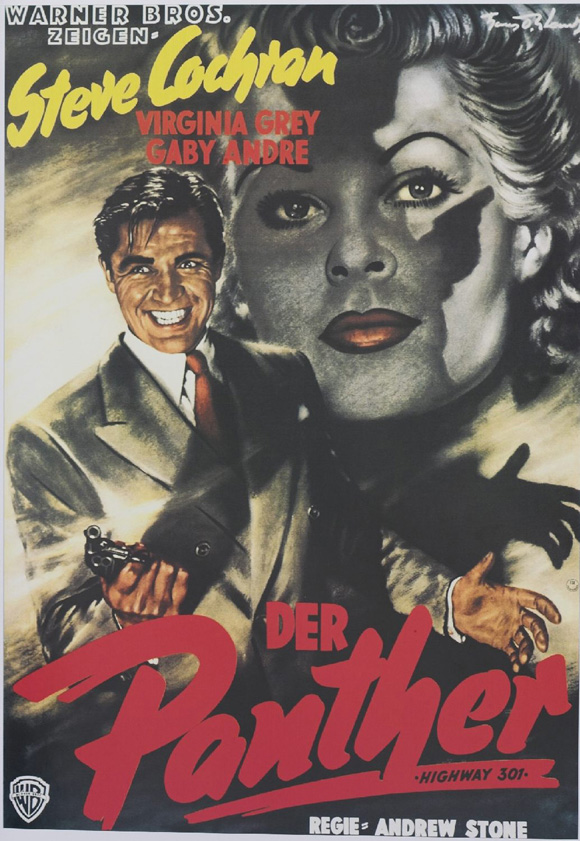
Highway 301 (1950): “a straight exercise in low sadism”

The demonic protaganist features in this German poster for Highway 301
The demonic protagonist features in this German poster for Highway 301

In 1950 New York Times film critic Bosley Crowther was “disturbed” and “depressed” by Highway 301, a dark gangster flick from Warner Bros.  He was emphatic in his dismissal: “the whole thing, concocted and directed by Andrew Stone, is a straight exercise in low sadism”.  Glen Erikson in his review of the DVD, described the relentlessly violent trajectory thus: “Imagine White Heat shorn of its rich characterizations and reduced to little more than its basic violent content: no complexity, just action and suspense scenes”.

Get it? A police procedural stripped back to its unardorned essence: violent hoods on the rampage. In deep focus and on the streets of  L.A.

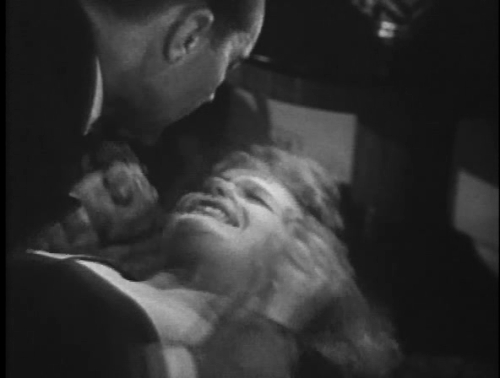
In the way of the burgeoning police procedurals of the 1950’s, the movie is prefaced by homilies from not one but three State governors, each attesting to the veracity of the story and the lessons it holds for those contemplating similar escapades. The Tri-State Gang led by a remorseless “pretty boy” killer played menacingly by Steve Cochran, are heist specialists who find time to have settled relationships with women. One is even married to a totally amoral yet passive woman – unnervingly portrayed by Virginia Grey. A dame not offended by her better-half’s style of life, and who finds solace on those long  lonely nights with a portable radio that goes with her everywhere. Cochran early on dispatches his talkative erstwhile girlfriend by shooting her in the back.  He then latches on to the French Canadian girlfriend of another member of the gang, after he checks out when a heist goes wrong. Trouble is “Frenchy” finds out too late the trap she has fallen into. There is real terror here, and most strongly delivered in an extended sequence where Cochran pursues the girl on dark city streets after she tries to cut loose. The gang is eventually picked-off  by the law in increasingly bloody encounters.

Don’t look for ambivalence or redemption. This is a brutal modern take on the police procedural: uncanny in that the picture sets off rather than ends the late cycle segue on film noir.

Marlowe: “I was neat, clean, shaved and sober, and I didn’t care who knew it.”

The Big Sleep

“It was about eleven o’clock in the morning, mid October, with the sun not shining and a look of hard wet rain in the clearness of the foothills. I was wearing my powder-blue suit, with dark blue shirt, tie and display handkerchief, black brogues, black wool socks with dark blue clocks on them. I was neat, clean, shaved and sober, and I didn’t care who knew it. I was everything the well-dressed private detective ought to be. I was calling on four million dollars.”

– Raymond Chandler, first paragraph of  The Big Sleep (Published 1939)


Jean Valjean in the Shadows

Les-Miserables-1934-Jean-Valjean
Harry Baur as Jean Valjean, just released from prison, in the epic 1934 French film adaption of Victor Hugo’s Les Misérables directed by Raymond Bernard.

“At times he did not rightly know himself what he felt. Jean Valjean was in the shadows; he suffered in the shadows; he hated in the shadows; one might have said that he hated in advance of himself. He dwelt habitually in this shadow, feeling his way like a blind man and a dreamer. Only, at intervals, there suddenly came to him, from without and from within, an access of wrath, a surcharge of suffering, a livid and rapid flash which illuminated his whole soul, and caused to appear abruptly all around him, in front, behind, amid the gleams of a frightful light, the hideous precipices and the sombre perspective of his destiny.

The flash passed, the night closed in again; and where was he? He no longer knew. The peculiarity of pains of this nature, in which that which is pitiless–that is to say, that which is brutalizing–predominates, is to transform a man, little by little, by a sort of stupid transfiguration, into a wild beast; sometimes into a ferocious beast.

Jean Valjean’s successive and obstinate attempts at escape would alone suffice to prove this strange working of the law upon the human soul. Jean Valjean would have renewed these attempts, utterly useless and foolish as they were, as often as the opportunity had presented itself, without reflecting for an instant on the result, nor on the experiences which he had already gone through. He escaped impetuously, like the wolf who finds his cage open. Instinct said to him, “Flee!” Reason would have said, “Remain!” But in the presence of so violent a temptation, reason vanished; nothing remained but instinct. The beast alone acted.”

– Victor Hugo, Les Misérables (1862) – Excerpt from Isabel Florence Hapgood’s 1887 translation.

Note: Read about the 1934 French film adaptation of Les Misérables in a post on film critic Leonard Maltin’s blog: Discovering Another ‘Les Misérables

New FilmsNoir.Net Trailer

Check out the new FilmsNoir.Net Trailer ( It looks even better on YouTube.)

Cinematic Cities: New York – The Noir Years

New York in the 1940s in noir guise. From the previously unpublished archives of Life Magazine.   Full size photos can be viewed on the Time-Life web archive.

nyc_thenoiryears_1949
1944 Photo: Andreas Feininger – Time & Life Pictures/Getty Images
nyc_thenoiryears_1947
1947 Photo: Herbert Gohr – Time & Life Pictures/Getty Images
nyc_thenoiryears_1946_2
1946 Photo: Andreas Feininger – Time & Life Pictures/Getty Images
nyc_thenoiryears_1946_1
1944 Photo: Andreas Feininger – Time & Life Pictures/Getty Images
nyc_thenoiryears_1946
1946 Photo: Andreas Feininger – Time & Life Pictures/Getty Images
nyc_thenoiryears_1944
1944 Photo: Andreas Feininger – Time & Life Pictures/Getty Images
nyc_thenoiryears_1942
1942 Photo: Alfred Eisenstaedt – Time & Life Pictures/Getty Images


La Bionda (The Blonde – Italy 1992)

An amnesiac femme-fatale the titular blonde is fate’s doleful instrument in this little known neo-noir from Italian writer/director Sergio Rubini.  Dark destiny takes an innocent young man with a limp and throws him onto a nocturnal autostrada littered with blood and a burst suitcase full of cash, with a woman running screaming into the night.  A tragedy of gothic proportions played first as an unlikely love story takes you inexorably where so many noirs have taken us before.  A blameless life and an accepting obscurity are not enough to protect the mild protagonist from a wild furiously indifferent universe.

Who are we? Are we the sum of our experiences? Or a persona that can be discarded through accident or design but never entirely or without consequences? Natasha Kinski is the blonde, suffering from amnesia after she runs into the path of a car and is knocked over. The driver (played by Rubini) a young man from the rural South struggling to keep afloat in a Milan of dark elegance. A city where deep shadows seep from the classroom where he hunches over a desk learning the skills of a watchmaker, and out into the streets. La bionda needs help and crashes in his apartment. She gives him focus and a strange purpose through a hesitant yet compelling obligation.   For a few short days they float in a maelstrom of doubt tempered by a softening dependency and growing intimacy. She searching for who she is, and he glimpsing what he could be.  But reality intervenes, she remembers, and he is abandoned. He searches for her, finds her, but she is not the girl she was for those few short days. She is hard-bitten enough to know that he can’t be a part of that dark and sordid existence.  He, oblivious, naively pursues a chimera of his own making, drawn on into a catastrophe with a brutally visceral and operatic climax.

Director Rubini is not passive. He takes his camera and literally spins it around scenes and events. Colors have a brightness and profundity that fuel both the emotional intensity of the protagonists, and telegraph the dangers that will entrap all the players in the end.  Kinski when she returns to her erstwhile existence is embodied in red – lips, dress, and her car. Dark and vengeful destiny pursues her in black, and the hapless anti-hero stumbles along in white – ignoring Fate’s little hurdles that more than once give him a chance to escape.

Patience with an early slow pace more concerned with characterisation than narrative drive is amply rewarded in a dénouement of almost unbearable hysteria.


Hudson, NY: Scenes from Odds Against Tomorrow Then and Now

Robert Wise’s classic film noir Odds Against Tomorrow – see my review here – was shot on location in New York City and in the Hudson river town of  Hudson, NY. Noir aficionado and film-maker Ray Ottulich visited Hudson this month and has kindly allowed me to publish his photographs of locales used in Odds Against Tomorrow matched to actual frames from the movie. I have taken some liberties with the montages to present them here, cropping and super-imposing shots to hopefully make the comparisons more dynamic.  Ray’s creative talent and invaluable contribution to film noir history is to be applauded.  After all, as the years roll on, the odds are against these locales remaining as they are. Great work Ray!

Hudson is where the heist, which is the dramatic focus of the movie, takes place, and a fair amount of screen time is spent observing the central characters as they wait out the day of the heist which goes down that night.

Wicked Women: “transforming sexist into sexy”

The Justice & Police Museum in Sydney is hosting an exhibition of original paintings by Australian artist Rosemary Valadon Wicked Women features portraits of contemporary Australian women inspired by pulp fiction and film noir.  Valadon’s paintings are promoted as both embracing and subverting  the genre’s stereotypes – sexist becomes sexy.

Tara Moss, Rachel Ward, Skye Leckie, Imogen Kelly, Sonia Kruger, Ros Reines, Larissa Behrendt, Antonella Gambotto-Burke, Margaret Cunneen, Essie Davis, Annette Shun Wah, Kara Shead, each chose a classic film poster or book cover for their sitting.

The paintings are indeed a cheeky and edgy feminist response to the motif of the dangerous femme deftly portrayed, and with a real feel for noir archetypes.

The exhibition runs from Saturday 20 October 2012 to Sunday 28 April 2013.