Bodyguard (1948): “I keep meat warm”

A suspended cop is framed for the murder of his former boss after he takes on a job as the bodyguard for a meat-packing heiress.

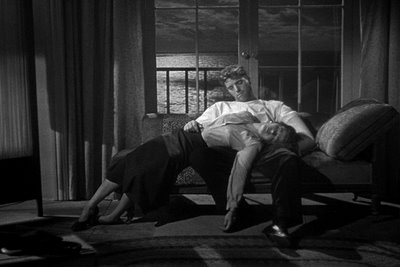
An RKO programmer of 75 minutes, Bodyguard is an entertaining mystery thriller that harks back to the hard-boiled pulp published in the 20s and 30s by Black Mask magazine.  The writers include a young Robert Altman.  While it never presumes to go beyond its b-origins, as an early feature  from director Richard Fleischer, better known for later b-noirs such as Follow Me Quietly (1949), Armored Car Robbery (1950) and The Narrow Margin (1952), the movie has some nicely conceived scenes that place it above the ordinary.  Solid turns by tough-guy Lawrence Tierney as a framed ex-cop and the cutest girl-next-door Priscilla Lane as his girl, complete the package.

Fast-paced and breezy, and aided by snappy dialog, the picture is all about entertainment. No angst or femme-fatales, just a a good old yarn about the corrupt rich and their criminal machinations.  The mystery is sustained with just the right hints so that when the bad guys are found out you are rewarded with having your half-held suspicions confirmed.  The climax at the meat-packing plant  has some ‘cute’ mis-en-scene involving a hog-saw and and a meat cleaver.  Great fun.

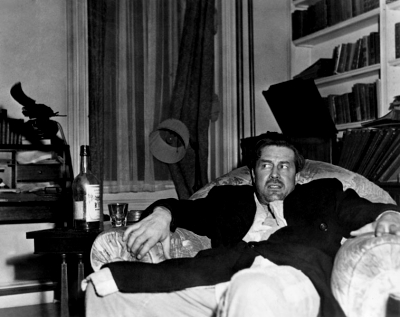
These shots from the movie attest to its visual panache.

The Big Clock (1948): “the wrong people always have money”

The Big Clock opens with the dark silhouette of skyscrapers against a New York night with bordello jazz on the soundtrack. After a pan tensely edging right across the screen, the camera rests on and zooms into the mezzanine level of a modernistic office building with the signage ‘Janoth Publications’. An anxious man in a suit narrowly avoids a security guard as he sneaks into the mechanism of a large clock that dominates the foyer below. His voice-over relates the circumstances of a dire predicament and events flashback to the previous morning.

But this is about as noir as it gets. The guy inside the clock is a suave Ray Milland, a family guy working for a dictatorial publishing tycoon as the editor of Crimeways magazine. His boss is a gargoyle in a suite sporting a Hitler moustache, and with the nervous habit of sliding his flabby forefinger across his bushy upper lip. A man who knows the cost of everything and the value of nothing. Charles Laughton occupies the suit and the executive suite in a building of apt fascist modernist lines fashioned by the film’s art director, Hans Drier.

Director John Farrow and DP John Seitz infiltrate this place with smooth and flowing steps that despite their elegance somehow render the whole space rather flat. Office space is sterile at best, and the result is a ponderous unraveling of a story that borders on the tedious. But such spaces can be rendered with atmosphere. Look at how – and this is indeed ironic – the same Dreier and Seitz under the direction of Billy Wilder make an insurance office look interesting in Double Indemnity (1944).

To cut to the chase, Milland is being framed for a murder by murderer Laughton, who doesn’t know the true identity of the guy he is trying to frame. It sounds better than it plays out. The whole scenario is played too lightly and with no atmosphere. The source novel by Kenneth Fearing has lost something in Jonathan Latimer’s screenplay. Though the tycoon’s final misstep as he escapes into his personal elevator is savagely noir.

Thankfully the affair is saved by an uproarious turn from a supporting actress in a part that occupies less than seven minutes of screen time. British-born character actor Elsa Lanchester – Laughton’s wife and Mrs Frakenstein in the camp classic Bride of Frankenstein (1935) – is a zany bohemian painter, who by chance gets tangentially mixed-up with Milland and proceeds to steal the picture – there is a pun here you will recognise if you have seen the movie or watch the clip below. She keeps turning up and closes the movie with a neat scene of comic irony.

This is her story. She first appears in an antique shop where she and a drunken Milland in the company of the tycoon’s girlfriend haggle over a rather grotesque painting.

Summary Noir Reviews: Desperate Suspense and a Fallen Sparrow

Desperate (1947)

An uber cool Anthony Mann noir. Raymond Burr dominates as an avenging hood. Brilliant chiaroscuro lensing and crazy angles satisfy.

Mann’s Desperate marks the beginning of a prolific three year arc for the director which saw the production of five iconic noirs: Desperate (1947), Railroaded! (1947), T-Men (1947), Raw Deal (1948), and Border Incident (1949).  While his legendary collaboration with master cinematographer John Alton did not begin until T-Men, DP George Diskant with Desperate can together with Mann take the kudos for the most stunning scene of the classic noir cycle, when a hapless trucker is given a going over in Burr’s dark  hideout, where the only light source is a swinging room lamp put in motion by the victim’s body as it is pummeled across the room. The scene has been described by Carl Macek as “a stunning example of American expressionist film-making” (Film Noir: An Encyclopedic Reference, 1979).  A clip of the scene was recently featured at filmsnoir.net here.

In Desperate a trucker is duped into a fur heist by a gang led by Burr, which goes wrong when Burr’s trigger-happy kid-brother kills a cop after the trucker flashes his truck’s headlights in a desperate attempt to alert the patrolman and the kid is left behind in the scramble to escape.  The brother is caught, and soon after the trucker escapes his captors.  The trucker, now pursued by the cops and Burr, hightails it with his pregnant wife.  The script and direction are taut but the plot is less then plausible as the pursuit drags on.  But the denouement played out on a tenement stairwell is classic Mann and is worth waiting for, and prefigured by a suspenseful sequence featuring a loudly ticking alarm clock.

Suspense (1946)

Monogram’s costliest feature a melodrama on ice only fires at the end when the absurd plot is put on ice. Olympic ice-skater Belita is hot!

Suspense directed by Frank Tuttle (This Gun for Hire (1942), Gunman in the Streets (France 1950), and Hell on Frisco Bay (1955)) features strong performances from the two leads: Barry Sullivan (Framed (1947), The Gangster (1947), Tension (1949), and Cause for Alarm! (1951)) as an ambitious homme-fatale, and Belita as the iconic blonde in a fatal love quadrangle.  The plot revolving around a follies-on-ice venue is novel, as are the extended musical numbers featuring the very nubile Belita.  But the story has a preposterous twist that stretches the suspension of incredulity.  Burdened by this very real weakness, the picture just about comes apart.  The movie is salvaged at the end after a murder propels the protagonists into a vortex of guilt, paranoia, and revenge.  Director Tuttle and veteran DP Karl Struss, who won an Oscar for Dr. Jekyll and Mr. Hyde in 1931, and worked on The Great Dictator (1940) and Journey Into Fear (1943), in the final scenes, reach a richly expressionist synergy.

The Fallen Sparrow (1943)

An anti-fascist thriller featuring a frenetic performance from John Garfield as a vet from the Spanish civil war battling post-traumatic stress and a Nazi spy ring. Compelling.

Garfield delivers a wonderfully nuanced portrayal as a guy suffering post-traumatic stress disorder after being captured and tortured by Nazis during Spain’s civil war.  He returns to New York from a convalescent farm when he learns his best friend has been killed in suspicious circumstances.  He thinks it is murder, and suspects a sinister pair of Austrian refugees, who have ingratiated themselves in a liberal and wealthy social set.  The screenplay by Warren Duff, from a source novel by Dorothy B. Hughes, who wrote the stories for Ride the Pink Horse (1947) and In a Lonely Place (1950), is tight and works on the level of a thriller while deftly weaving Garfield’s psychological entrapment into the plot, by linking recurring hallucinations with the search for his friend’s killers.  The dialog is snappy, and scenes between Garfield and a socialite girlfriend are nicely barbed and risqué.  The lovely Patricia Morison who plays the ex is lusciously sexy and engaging – check out the gown she is wearing in her first scene – production code censor Breen must have been asleep to let that one through!  The luminous Maureen O’Hara plays a diaphanous femme-fatale-cum-mata-hari.  Her performance is so elegant that by the end of the film her true feelings still remain a tantalizing mystery.   Director Richard Wallace (Framed (1947) and Tycoon (1947)) and  noted noir DP Nick Musuraca fashion an accomplished mise-en-scène of fluid and flowing takes, moody lighting, and angled shots, ably assisted by Roy Webb’s evocative score, which received an Oscar nomination. There is a memorable peroration towards the end to cement the film’s political intent.

Prefiguring Postmodernism: Flashback in Film Noir

I am currently reading a fascinating book on the career of activist Hollywood writer and producer,  Adrian Scott,  ‘Caught in the Crossfire: Adrian Scott and the Politics of Americanism in 1940s Hollywood’,  by Jennifer E. Langdon (2008 Columbia University Press),  which focuses on the production by Scott of three seminal RKO noirs, Murder, My Sweet (1944), Cornered (1945), and Crossfire (1947).

In a chapter on the making of Crossfire, Langdon relates that one of the most radical changes Scott and screenwriter John Paxton made in the adaptation of Richard Brook’s source novel, ‘The Brick Foxhole’, was the use of flashback.  Langdon goes on to expound a profoundly interesting take on the nature of the flashback in film noir:

flashbacks are a key narrative strategy in film noir, contributing to the genre’s existential exploration of truth and falsehood.  Historian William Graebner, suggesting the ways in which film noir prefigured postmodernism, explains, “By interrupting a traditional, linear narrative, the flashback challenged the form strongly identified with progress: the story with a beginning, a middle, and an end, and open to all possibilities.” Explicitly connecting the ruptured narrative strategies of film noir to the pervasive postwar sense of contingency and doubt, he argues:  “In the context of a military victory that seemed to have been won at the cost of demonstrating the inhumanity of humankind, and of a cold war that called for eternal vigilance, the ability of a cultural text to produce a conclusion consistent with, and implied in, everything that had gone before—what literary scholar Frank Kermode calls ‘the sense of an ending’ —withered and died.” * (p 85)

More on Langdon’s book in a future post.

________
* William Graebner, The Age of Doubt: American Thought and Culture in the 1940s (Boston: Twayne, 1981), 54, 145.

Dead Reckoning (1947): “Sorry gorgeous I didn’t see what you looked like…”


Dead Reckoning
(1947 Columbia 100min)

It is as if at a meeting at Columbia Pictures in early 1946 it was decided to make a ‘film noir’. John Cromwell’s Dead Reckoning (1947) is so noir it is a parody of noir: they threw the then non-existent book at the film and produced a glorious pastiche of rip-offs and knowing references not only to earlier noirs but contemporary and future noirs.  The picture which was completed on September 22, 1946 – it was released on January 22, 1947 – would have been in production when Nino Frank coined the term ‘film noir’ in his seminal article, A New Kind of Policier: the Criminal Adventure, in Paris in August 1946.

The credentials.  John Cromwell went on to direct the important noirs, The Racket (1951), Caged (1950), and The Company She Keeps (1951), but he had no track record in noir in 1946, and the team of writers behind the screenplay doesn’t amount to the usual suspects to any degree – but for one exception. The script was adapted from a story by Sidney Biddell and Gerald Adams.  Adams went on to script The Big Steal (1949) and Armored Car Robbery (1950), and wrote the story for His Kind of Woman (1951 uncredited).  Allen Rivkin who wrote the film treatment, later scripted Gambling House (1950) and Tension (1949).  The screenplay was a joint effort of Oliver H.P. Garrett and Steve Fisher. Garrett has no other noir credits, so the perp has to be Fisher who had form. Fisher wrote the stories for I Wake Up Screaming (1941) and Johnny Angel (1945), and scripted Berlin Correspondent (1942) and Lady in the Lake (1947).

Veteran DP Leo Tover with no other noir credits establishes a strong expressionist cred, and the rococo costume designer Jean Louis squeezes femme-fatale Lizabeth Scott into some seriously flamboyant gowns.

It may be all down to serendipity, but I smell a rat.

The references. Great maxi rip-offs of The Maltese Falcon (1941), High Sierra (1941), Double Indemnity (1944), Murder My Sweet (1944),  The Big Sleep (1946),  Gilda (1946), Out of the Past (1947),  and The File on Thelma Jordan (1950) – I know – I am in some cases talking rip-offs of future noirs – so sue me!

The story.  Bogart is a war-hero turned hard-boiled amateur PI – he ran a fleet of cabs before the war – tracking down the mysterious death of an army buddy, who it turns out joined-up to escape a murder rap. Enter Lizabeth Scott as the dead guy’s glamorous but shifty girlfriend. Add a gambling den, hoods, and suspicious cops, and you get a noir – of sorts – the deal is not earnest and too knowing to be taken too seriously. But what fun! Bogie’s lines are classic wise-ass. To a bartender: “Come here sweet-heart”.

The lowdown.  The movie opens with Bogart being pursued down a city street at night in the rain, with the wet asphalt glimmering. He loses the pursuers after hiding in a church. He way-lays a padre in the gloom and tells his story in flash-back.  Vets Bogart and his buddy are on their way to Washington to get war decorations, but his buddy jumps the train after a press photo is taken. Bogart heads off to find him and find out why the guy has gone AWOL.  Bogart traces him to a university town that looks like Chandler’s LA – the guy has been killed in an auto accident.   The intrepid Bogie in mufti tracks down the girlfriend, Scott, an ex-chanteuse in a casino fronting as a cabaret, who after reprising her recent chart-hit and making an impression, introduces Bogie to the casino-operator, a suave foreigner engagingly played by Morris Carnovsky, and his sadistic henchman (a great camp turn by Marvin Miller).  Well one drink leads to another – the last one spiked – and Bogie wakes up with a heavy hangover in his hotel-room and a stiff in the other twin-bed for company.  You get the picture? Then all proceeds apace as Bogie endeavors to find out who killed his buddy and why. There is a double and later a triple-cross, with Bogie falling hard for Scott.  The femme-fatale smells of jasmine not honey-suckle, and she just happens to be the casino guy’s wife! The final shoot-out is Out of the Past out of The Big Sleep. I don’t know how Bogie kept a straight face with the almost verbatim rip of the lines from The Maltese Falcon as he drives with Scott soon to hold a gun on him:

Bogart: Then there’s Johnny. When a guy’s pal is killed, he ought to do something.
Scott: Don’t you love me?
Bogart: That’s the tough part of it, but it’ll pass. Those things do, in time…

The final scene is an angelic Thelma Jordan on a hospital trolley, with death a parachute jump down the High Sierras. “Geronimo”

Noir Poets: The Judas Cradle

When I Was Little I Used to Write Letters to God

I’ll die with this pen in my hand if I have to
I will not call out your name one more time
Destroy everything and set fire to every lie has ever been told to you
So lets dance tonight and leave this world to burn
It only takes five fingers to make a fist
I will not pray for dreams to come true or spend more days on my knees in search of you
This is my life and I take back everything I have ever asked for
I’ll burn myself clean
You were never right and I was never wrong
I have no time for heroes and no space for saviors

–  The Judas Cradle (2004)

No Way Out (1950): Is it a question or an answer?

Edie – Edie Johnson / Mrs. John Biddle (Linda Darnell)
Dr – Dr. Dan Wharton (Stephen McNally)

Edie – Look, if you don’t mind, I gotta get dressed now.

Dr – Are you going to work?

Edie – I work nights.

Dr – At what?

Edie – I’m a carhop in a drive-in. Anything wrong with that?

Dr – No, nothing at all.

Edie – It’s none of your business what I do. It’s a respectable job, and I pay my own way.

No Way Out (1950)

Dr – And you’re not living in Beaver Canal anymore.

Edie – Yeah, I’ve come up in the world. I used to live in a sewer. Now I live in a swamp. How do those babes do it in the movies? By now I oughta be married to the governor… and paying blackmail so he don’t find out I once lived in Beaver Canal.

Dr – The point is you got out.

Edie – Five blocks away.

Dr – Five million blocks – what’s the difference? You hate Beaver Canal. You hate what it stands for.

Edie – You talk like I was a poet or a professor. I found an open manhole, and I crawled out of a sewer. Wouldn’t anybody?

All concerned with the Joseph L. Mankiewicz’s No Way Out (Fox 1950), should have been justly proud of this ground-breaking movie. The story of a young black intern’s struggle against the prejudice of a deranged criminal confronts the issue of race head-on. This said, there are weaknesses. The otherwise great script by Mankiewicz and his collaborator Lesser Samuels veers too often towards melodrama, and racism is portrayed as largely a phenomenon of the white lumpenproletariat. Institutionalised prejudice – the wider cause of racial disadvantage – is ignored. Within these constraints a strong cast delivers an emotionally intense and harrowing depiction of race hatred at the level of the personal. Sidney Poitier in his first major film role is convincing as the young doctor, and he shows a wide emotional range. Richard Widmark as the foul-mouthed off-the-wall bigot is searing and dominates all his scenes. Stephen McNally as the chief resident of a city hospital and Poitier’s mentor is solid. But to my mind, the film’s acting plaudits must go to the beguiling Linda Darnell as the divorced wife of Widmark’s brother in crime, and the uncredited black actress Amanda Randolph as McNally’s housekeeper. What a terrible irony: a black actress who has a not insignificant role is not even credited!

Gladys – Dr. Wharton’s Housekeeper (Amanda Randolph uncredited)

Edie – Gladys, what do you do on your day off, like today?

Gladys – Oh, go sit in the park. Maybe go to church, maybe to a movie. Come suppertime, I go somewhere and cook.

Edie – Where?

Gladys – Friends. I fix ’em a good supper.

Edie – Some day off.

Gladys – [Chuckles] I like it. I’m a good cook. It’s somethin’ I can do better than other people. It makes me a somebody. Gives me a reason to be alive. Everybody gotta have that.

Edie – Or a reason not to be.

‘No Way Out’ is a very noir title informing the recurring noir motif of entrapment, and in this movie we have this motif woven seamlessly with three different threads: the young doctor struggling to find a way to save his career after he is accused of killing Widmark’s brother during a spinal tap procedure; Widmark trapped within his own paranoid bigotry; and Darnell in the face of Widmark’s venomous manipulation, desperately trying to keep the small advancement she has achieved after escaping her deprived social origins. Poitier’s struggle is the stuff of melodrama with his salvation assured, and tangentially noir. Widmark’s hood is mentally unhinged and full of hate, but even he in his pain-addled rantings at the climax is given a shot at justification, and his fate is pathetically cathartic, with Poitier sadistically applying with unbridled hate a tightening tourniquet around Widmark’s bleeding leg. The mis-en-scene of this closing scene is heavily symbolic: the makeshift tourniquet is fashioned from Darnell’s scarf and is tightened using Widmark’s gun after it has been emptied of bullets.

The overwhelming noir theme is Darnell’s redemption. A redemption she surely owns but that is equally owed to the decency of Randolph as the black housekeeper, and to Poitier’s demonstration of a morality that goes beyond vengeance and personal hatred. A white woman is redeemed by her decent self opening to the other: black people who show her a path to a life of decency free of prejudice and self-loathing. A great movie and a great noir.

Luther – Dr. Luther Brooks (Sidney Poitier)
Ray – Ray Biddle (Richard Widmark)

Edie – You all right?

Luther – [Wounded] My arm. Maybe my shoulder. I can’t tell.- It’s not so bad.

Ray – [Gasping] My leg! [Crying ] It tore. Somethin’ tore in my leg. [Crying Continues] It’s- It’s bleedin’. It’s bleedin’ hard. Please!

Edie – Let it bleed.

Ray – [Groaning ]

Edie – Tear it some more. Let it bleed fast.

Luther – You’ll have to help me.

Edie – To do what?

Luther – Whatever I can to keep him alive.

Edie – Why? What for? A human being’s gotta have a reason for bein’ alive. He hasn’t got any. He’s not even human. He’s a mad dog. You kill mad dogs, don’t ya?

Luther – Don’t you think I’d like to? Don’t you think I’d like to put the rest of these bullets through his head?

Edie – Then go ahead.

Luther – I can’t.

Edie – Why not?

Luther – Because I’ve got to live too.

Edie – Then give it [gun] to me.

Luther – You’ve got to live.

Edie – I will, believe me – happy as a bird with him dead.

Luther – Please help me. No. Look, he’s sick. He’s crazy. He’s everything you said. But I can’t kill a man just because he hates me.

Edie – What do you want me to do?

Luther – Take your scarf off. Put it around his thigh. There. And tie a knot. Not too tight.

Ray – [Groans]

Edie [to Luther] – You sure you’re all right?

Luther – Thanks.

Edie – [Siren Wailing In Distance] They took their time gettin’ here.

Luther – Don’t cry, white boy. You’re gonna live.

Ray – [Sobbing]… [Sobbing Continues]

Not all prisons have walls

The Lost Weekend (1945)
Ray Milland in Billy Wilder’s The Lost Weekend (1945)

The floor is strewn with empty bourbon bottles.  You’re shaking.  You stare at the bottom of the empty glass and see only a vision of hell – your face.  Your insides are aching and your throat is burning.  You need a drink.  Water won’t put out this fire.

Tarantulas tip-toe on the ceiling and red-eyed rats scurry across the wall.

An insane voice screams inside your head.  It won’t stop until you get a drink.  The same voice at other times is smooth almost dulcet:  “just one more”.   But it never is just one more, and then there is no more. The hidden bottle is lost – smashed against the wall by a demon you know and don’t know.

Stumbling and crashing against the furniture, you struggle to put on the fetid pair of pants lying on the bed or once was. Now it is a stinking stained crumpled mess that would make you retch if you could.

You careen down dark sordid stairs, the grime-ridden banister holding you upright.  You’re short of breath and the remaining stairs are a dizzying spiral you want to shut your eyes against.  Raving mad eyes that have only a single purpose  – same as your legs –  get you to the bar downstairs.

Noir Poets: John Huston and W.R. Burnett

Mister… What does it mean when a man crashes out?
Crashes out? That’s a funny question for you to ask now, sister. It means he’s free.
Free… free

High Sierra (1941)
Screenplay by John Huston and W.R. Burnett based on the novel by  W.R. Burnett

Summary Noir Reviews: Party Girl Across the Lake

Knock on Any Door (1949 – US)

Nick Ray directs Bogart as a lawyer with a social conscience, but the closing sermon to jurors is hammered and too late. A young John Derek impresses as a hood on a murder rap.

Bogart is disengaged in this minor Ray, which could have been great. Unusually for a noir, this picture attempts to portray the social origins of criminality, and how social disadvantage and a traumatic event in a young man’s life sew bitterness and rebellion. The movie fails by focusing on the lawyer who engages only at the end when he has to defend the hood after a cop is killed, with the young criminal remaining an enigma, despite some high melodrama that results in a girl’s tragic suicide. Visually pedestrian, the one ‘cinematic’ highlight is the placement of the camera in the court in the closing scenes.


A very imaginative poster for Party Girl (1958)

Party Girl (1958 – US)

30s Chicago mob lawyer Robert Taylor falls for a gorgeous Cyd Charisse in Nick Ray’s Metrocolored Cinemascope, but Taylor is wooden. Thankfully Lee J. Cobb chews up the scenery as an off-the-wall Mafioso.

A lot of money and wide-screen Metrocolor fail to infuse this rather dour film with any vitality. Ray’s direction is almost off-hand and the terrible acting of Taylor flattens any impact. Cyd Charisse is a great dancer and looks appealing, but her portrayal as the love interest lacks flair. Taylor who has built his career and wealth as a lawyer and fixer for the Mob, tries to go straight after falling for Charisse, who challenges his crooked life, with predictable consequences. Over-rated.

The House Across the Lake (aka Heat Wave) (1954 – UK)

Toff rip-off of J.M. Cain. A hack novelist falls for ice-cold blonde wife of English country gent played by Sid James.

This movie from English writer/director Ken Hughes, who specialised in Anglo-noirs with a Hollywood feel, is better than it sounds, as there are nuances that add some resonance. A Double Indemnity like scenario is given a cross-over treatment. Expat b-player Alex Nicol as an American writer of pulp novels attracts the perilous attention of the platinum-blonde wife of a wealthy English squire. She is a classic femme-fatale and is played to steely perfection by English actress Hillary Brooke, though the act comes unstuck in a too-melodramatic denouement. What is interesting is that the femme-fatale actually does ‘shove’ when push-comes-to-shove in her spider’s stratagem of seducing the hack into a murderous complicity, and that the hack’s capitulation comes not so much from greed or sexual obsession but from an existential ennui.

Manèges (aka The Wanton 1950 – France)

A cynical, dark and savage history of a femme-fatale and the sucker she destroys. But fate has the final say.

This very dark noir from the director of the superb Une si jolie petite plage (1949 – France), Yves Allégret, has the same essential plot-line as a later film from Julien Duvivier, Voici le temps des assassins… (aka Deadlier Than the Male – France 1956). A mother and daughter team of grifters are out to fleece a poor mug with dough. This time the chump is a naïve middle-aged petit-bourgeois, who runs a horse-riding academy for the local gentry. A young Simone Signoret plays the femme-fatale to the infatuated Bernard Blier. But this picture made straight after Une si jolie petite plage does not match the earlier film. The pace is laborious and the use of iris transitions and a weird sieve wipe to telegraph flashbacks is hackneyed. What is most disturbing is the strident misogyny of the story. All the women in the film are venomous, haughty, or stupid, while even a gigolo on the make has some redeeming virtue. Indeed Allégret hates everything and everyone. Nothing escapes his caustic condemnation: aristocrat, bourgeois, or worker. Even children are targeted: when an instructor is severely injured by a kick from a horse two young girl students observe “workers are always complaining”. The ending is as downbeat and vengeful as you will ever see.