Out of the Fog (1941): “throw away the books”

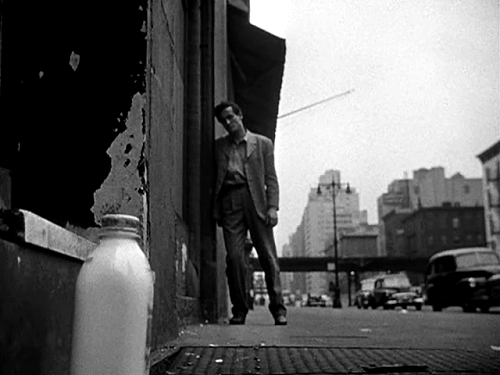
Out of the Fog (1941), the screen adaptation by Robert Rossen and Irwin Shaw of Shaw’s play, The Gentle People, written for The Group Theater in New York in 1939, wears it’s lefist heart on it’s sleeve and has dated badly. Anatole Litvak’s direction is workman-like only, and while James Wong Howe’s camera suitably renders a fog-laden set as the Brooklyn wharf-side, it is to little avail.  Not even John Garfield as the cheap protection racketeer and Ida Lupino as the ‘ordinary’ girl to Garlfield’s homme-fatale, can save the enterprise.  Studio hacks so diluted the trenchant play’s down-beat critique of capitalism and anti-fascist intent, that the contrived ending is played for laughs and the heroes come out looking as amoral as their victim.  This moral ambivalence and the dark photography give the movie a noir tendency.

The film has one bright spot in a  Russian sauna when two rocking-chair revolutionaries hatch their plot to kill the racketeer.  George Tobias as a bankrupt store-keeper delivers a riveting background monologue on his fate. The writing brilliantly employs decidedly Jewish humor in a witty critique that runs to the core of the story, and is totally subversive of the melodrama played out in the foreground.

Out of the Fog (1941), the screen adaptation by Robert Rossen and Irwin Shaw of Shaw’s play, The Gentle People, written for The

Group Theater in New York in 1939, wears it’s lefist heart on it’s sleeve and has dated badly.

Anatole Litvak’s direction is workman-like only and while James Wong Howe’s camera suitably renders a fog-laden set as the

Brooklyn wharf-side, it is to little avail. Not even John Garfield as the cheap protection racketeer and Ida Lupino as the

‘ordinary’ girl to Garlfield’s homme-fatale, can save the enterprise.  Studio hacks so diluted the trenchant play’s down-beat

critique of capitalism that the contrived ending is played for laughs and the heroes come out looking as amoral as their

victim. This moral ambivalence and the dark photography give the movie a noir tendency.

The film however has one bright spot when the two rocking chair revolutionaries hatch their plot to kill the racketeer in a

Russian sauna. George Tobias as a bankrupt store-keeper delivers a rivetting background monologue on his fate. The writing is

brilliantly employs decidely Jewish humor in a savage critique runs to the core of the story, and is totally subversive of the

cheap melodrama played out in the foreground.  The scene is featured in the following edited clip.

Noir Poets: Philip Marlowe

Who am I cutting my throat for this time? A blonde with sexy eyes and too many door keys? A girl from Manhattan, Kansas? I don’t know. All I know is that something isn’t what it seems and the old tired but always reliable hunch tells me that if the hand is played the way it is dealt the wrong person is going to lose the pot. Is that any of my business? Well, what is my business? Do I know? Did I ever know? Let’s not go into that. You’re not human tonight, Marlowe. Maybe I never was or ever will be. Maybe I’m an ectoplasm with a private license. Maybe we all get like this in the cold half-lit world where always the wrong thing happens and never the right.

Raymond Chandler, The Little Sister (NY 1941)

Subversive Poet: John Alton on the Border

Border Incident (1949) is perhaps the one film of the remarkable late 40s collaboration among cinematographer John Alton, director Anthony Mann, and writer John C. Higgins, where Alton’s imagery is wholly subversive.  Ostensibly a police procedural about the trafficking of illegal farm workers from Mexico for the farms of Southern California, Alton’s rendering of the desert landscape with a haunting natural light elevates the exploitation of the ‘braceros’ to the realm of tragedy, and from tragedy to a damning political indictment.

Morover, the scene where the undercover agent Jack is murdered by the furrowing blades of a tractor, is one of the most horrific in film noir.  As noted in my Dec 2008 post, Noir Citizenship and Anthony Mann’s Border Incident, Professor Jonathan Auerbach observes that the American  immigration agent “gets ground into American soil by the monstrous machinery of US agribusiness… [this is] a purely noir moment of recognition that reveals the terrifying underbelly of the American farm industry itself in its dependence on and ruthless exploitation of Mexican labor”.  Plus ca change plus la meme chose.

I put forward these frames from Border Incident in support.

Sidney Falco checks out: Vale Tony Curtis (1925-2010)

Tony Curtis’ best role has to be the sleazy publicist Sidney Falco in Alexander Mackendrick’s acid noir Sweet Smell of Success (1957).   Burt Lancaster’s manipulative NY celebrity columnist enlists  the amoral Falco to destroy his younger sister’s suitor. These guys are as bracing as vinegar and cold as ice: ambition stripped of all pretense.   The chemistry between Lancaster as the sinister chat columnist  and Tony Curtis as the ruthless publicist is palpable.  It is also DP James Wong Howe’s sharpest picture –  the streets of Manhattan have never looked so real.

The Noir Vignette: “Don’t forget – your dead father was a ‘lousy foreigner’”

In The Glass Wall (1953), the protagonist is an Hungarian war refugee,  Peter Kaban (Vittoria Gassman), who jumps ship after his quest for entry into the US is rejected. A stowaway and without sufficient evidence of  his assisting the US war effort by helping a wounded GI, the young man’s deportation is imminent. Kaban’s only chance is to find the GI.  All he knows about the vet is that his name is Tom, that he is from New York, that he plays the plays the clarinet, and that he talked about the wonder of a place called  ‘Times Square’. Kaban’s search has him roaming the teeming streets of Manhattan and visiting venues with jazz bands playing.  These scenes of Kaban amongst the crowds on the streets of NY are documentary, and the central noir motif of individual alienation in the anonymity of the city is dramatically evoked – a cold glass ‘wall’.

But in his jump from the ship Kaban has injured a rib and his search for Tom becomes more desperate as his injury progressively weakens him. After getting help from Maggie (Gloria Grahame), a young woman on the skids, they are separated after he escapes arrest on a crowded subway platform.  By now his photo is plastered on the front page of the evening papers.

Back on the streets he hears jazz from a burlesque dive and enters from back-stage. A show is in progress with a stripper on stage. Kaban is visible at the curtain as he peers at the clarinetist – no luck. His appearance attracts the attention of the rowdy patrons, and the stripper is not amused. She yells to the stage manager: “Throw that bum out. He’s lousing up my act.” Kaban is pitched out the back of the theater and stumbles into the back-seat of an empty cab at a taxi rank.

The scenario is now set for the vignette, which in terms of the plot, has only a single purpose: to inform Kaban of the existence of the UN and its humanitarian charter, and that it is in NY, the ‘glass wall’ of the title. However, the scenario evocatively reinforces the film’s central theme of personal obligation and social responsibility, with such a deep humanity and charm that it leaves an indelible imprint on your memory. The dialog and the acting are pitch perfect.

The stripper Bella Zakoyla, who goes under the stage-name of Tanya, is played by bit player Robin Raymond. Her performance is really impressive.  She is not young, on the cusp of middle-age, and when we first see her on stage, she fills the frame, and the sincerity of her ‘act’ is striking. She has a joyous grace. When she finishes work she enters the same cab still parked back-stage and hails the driver from a news-stand. The cab heads for her apartment and she discovers Kaban asleep next to her. She recognizes him from his photo in an early edition on the front page of the day’s newspaper. She has spunk and jokes with the cab-driver after asking him to detour to a police station on the way to her apartment. At the precint station, she leaves Kaban asleep in the cab and enters the station.  After a while she returns. We have been played by a neat little conceit in the script: she wanted to check if the guy was on the level before taking him home! By this time, Tom the clarinetist, who also saw Kaban’s photo in the newspaper, has confirmed his story with the authorities, and now they  only want to locate Kaban to tell him and process him as displaced person.

The cab arrives at Tanya’s tenement building, where as a single mother she supports her own widowed mother, an Hungarian immigrant, her two young children, and a brother, who is not in regular employment  – he is a huckster for poker sharps.  She puts Kaban in the bed she shares with her two kids while she waits for her mother to serve the supper she has prepared. The old lady is suspicious of  Kaban at first, but is persuaded that he is kosher and needs their help. Then the brother turns up flush with dough he has ‘earned’ that night. It is clear that this boy is a disappointment after being put through school by Tanya.  He blows up when he finds out Tanya is harboring Kaban, and threatens to throw him out. We cut to Kaban anxiously overhearing the argument in the closed bedroom with the kids, who are now awake, intrigued and smiling. He hears about how Tanya intends to go to the UN in the morning. Back in the living room, the argument continues, and ends only after Tanya’s mother slaps her son across the face for a racist outcry.

Tanya goes to the bedroom to rouse Kaban for supper, and finds he has left after leaving a note thanking her for her kindness and saying that he did not want to make trouble for her.  Tanya is mortified not only for him, but for herself – a lonely woman struggling to raise her kids alone. It is all established without a word. Raymond’s acting is that good. Tanya returns to the living room and slaps here brother across the face.  Kaban was –  if only momentarily – not the protagonist but an observer of someone else’s story.

Great writing, great acting, great craft.  This is how Hollywood even in the decline of its golden period could still fashion great cinema from simple human stories without melodrama and without pretense.

The Glass Wall (1953)

Columbia Pictures 82 min
Directed by Maxwell Shane
Screenplay – Ivan Shane, Maxwell Shane, and Ivan Tors
Cinematography by Joseph F. Biroc

Cast:
Vittorio Gassman – Peter Kaban
Gloria Grahame – Maggie Summers
Robin Raymond – Tanya aka Bella Zakoyla
Joe Turkel – Freddie Zakoyla (as Joseph Turkel)
Else Neft – Mrs. Zakoyla

Awards:
Locarno International Film Festival – 1953 – Maxwell Shane for Artistic Achievement

More than the Director: The Noir Writer

Dark Passage (1944) is one of the few Bogart pictures that disappoints.   Bogart goes through the motions of an escaped con on the run in Frisco trying to clear himself of a murder charge.  Bacall looks great, but for a thriller the whole affair is flat. While the screenplay by director Delmer Daves – from a story by David Goodis – relies on too many implausible coincidences, there is a particularly effective scene where Bogart hops a taxi late at night.

Bogart: Head down the hill. I’ll tell you where to go from there.

Cabbie: Mind a little speed?

I like speed.

Nice looking suit you’re wearing.

Thanks, and I don’t feel chatty.

Some fares like to talk.

I don’t.

You always that way?

Yeah, that’s why I don’t have many friends.

You know, it’s funny about friends.

It’s funny you can’t take a hint.

Brother, you never drove a cab. You got no idea how lonely it gets.

What’s lonely about it? You see people.

Sure, you’re right there. You should see the character I had for a fare yesterday. Picked him up at the Ferry Building.Standing on the curb with a big goldfish bowl in his arm, full of water. Two goldfish. Climbs in the back of the cab, sits down and puts the goldfish bowl in his lap. Where do you think he wants to go? To the ocean. Clean from the Ferry Building to the Pacific Ocean. But he doesn’t know that there’s seven hills. Seven steep hills in between. So we start off. Up the first hill, slippity slop, down the hill, slippity slop. Water all over the back seat, the goldfish on the floor. He picks them up, puts them back in the bowl… up we go again, slippity slop, water all over the… You never saw such a wet guy in your life when we got to that ocean. And two tireder goldfish. But I like goldfish. I’m going to get a couple for the room. Dress it up a little bit, it adds class to the joint. Makes it a little homey.

I thought you said you got lonely.

That’s right. I pick people up and take them places, but they don’t talk to me. I see them get out and go in spots, have fun… then I pick up another load coming out… and I hear them telling about all the fun they had. But me, I sit up here all alone, and it gets lonely.

That’s tough. You’re in a bad way.

You said it. Where are we going?

If I tell you, you’ll ask me why I’m going there… and what am I going to do there, and am I gonna have fun.  A guy gets lonely driving a cab,remember?

That’s right, brother. Lonely. And smart.

Smart in what way?

About people. Looking at them. Faces.

What about faces?

It’s funny. From faces I can tell what people think, what they do… sometimes even who they are. You, for instance, you’re a guy with plenty of trouble.

I don’t have a trouble in the world.

Don’t tell me, buddy. I know. She gave you plenty of trouble, that dame. So you slugged her…  Not now, not here, too many cops around. Don’t try to hit me in the back of the head… or I’ll run this crate up into one of those hotel lobbies.

I’ll give you $500.

Don’t give me nothing. Where do you want to go?

You might as well make it the police station.

Don’t be like that. You’re doing all right. You’re doing fine.

If it was easy for you to spot me, it would be easy for others.

That’s where you’re wrong.  Unless you’d be happier back in Quentin.

Sure, that’s why they sent us up there, to keep us happy.

I see what you mean. Let’s go up here and talk. Did you really bump your wife off?

No, I didn’t.

I don’t figure it that way. I figure you slugged her with that ashtray because she made life miserable for you. I know how it is. I live with my sister and her husband. Now, they get along fine. So fine, that one day he threw a bread knife at her. She ducked. That’s the way it goes. Maybe if your wife had ducked… there’d be no trial, no Quentin, no on the lam.

That’s life.

Smoke?

All right.

Light?  What was she like?

She was all right.  Just hated my guts.  For a long time I tried to find out why, then I didn’t care anymore.

I know. Nice, happy, normal home. I almost got roped in a couple of times myself. If you find the right girl, it’s okay.

What’ll I do?

You won’t listen.

I’ll listen. I want ideas.  That’s what I want more than anything else. I didn’t kill her.  Why should I go back to San Quentin for the rest of my life if I didn’t kill her?

I wonder what he could do with your face?

Who?

A friend of mine. Knows his stuff.

How much would he want?

How much you got?

$1,000. That’s all I’ve got.

He’d take $200.

And keep after me from then on.

No, he’s a friend of mine.

What’s your charge?

Nothing. I’ve seen him work.  He’s great.  I wouldn’t know my own mother after he got through with her.

How long would it take?

Maybe a week, if he doesn’t have to touch your nose.  I don’t think he will.  Just a little around the eyes and here and there.  Got a place to stay? We’re right near the place.

A friend.

Dependable?

The only close friend I’ve ever had.

Let’s see, it’s 2:00 a.m. Now. I’ll go up and see the doc and make a date for you for 3:00 a.m.

Nice safe hour.

Cinematic Cities: New York 1953

The Glass Wall (1953) Dir: Maxwell Shane DP: Joseph F. Biroc | Locale: New York

The Subversive Truth of Noir: The Glass Wall (1953)

I was fed-up I guess

In the still-topical and very off-beat noir, The Glass Wall (1953), about post-war refugees and the nature of true compassion, Gloria Grahame gives a richly delicate performance as a young woman on the skids who helps a desperate asylum-seeker played with obvious sincerity by Vittorio Gassman.  The streets of New York are rendered with a stunning chiaroscuro palette by DP Joseph Biroc. While the direction by Maxwell Shane could have been tighter, he also had a hand in the excellent script.  A gem worth seeking out.

Bogart: “needful yet closed off, cynical and ruefully philosophical”

Andrew Dickos, in his perceptive survey of film noir, ‘Street With No Name: A History of the Classic American Film Noir’ (University Press of Kentucky 2002), from a discussion of the films of Nicholas Ray, has this to say about the noir protagonist and by reference Humphrey Bogart’s portrayal of Dixon Steele in Ray’s In a Lonely Place (1950):

“The world of Nicholas Ray’s noir films so clearly coincides with his vision of the dislocated, violent individual trapped in postwar America that it is fair to say the noir perspective displayed in these films is simply a variant of a vision apparent throughout most of his work. His characters anguish on a personal battleground where social forces structuring human discourse are internally disavowed and raged at and the most formidable opponent finally becomes one’s own conflicted self trying to function in the world… (p. 82)

“In Ray’s world of the angry and spiritually discomfited, Dixon Steele is more tormented by paranoia than any of the others. Certainly the project of screenwriting as an agency of moviemaking challenges one to achieve creative expression only to see the end product so often distorted, mutilated, or made banal by commercial forces. Steele faces this but is, moreover, self-lacerated, as many of Ray’s characters are, by the psychic urge to find meaning in a life personally and routinely bereft of it. This vision, cast in the noir mode and personified by Humphrey Bogart in one of his most intriguing roles, is perhaps better explained by reference to another Ray film, Rebel without a Cause. Victor Perkins described the planetarium sequence, as James Dean and his friends gaze upward at the universe while the narrator comments about gas, fire, and the insignificance of the planet’s impending destruction. “It is against this concept of man’s life as an episode of little consequence”, he wrote, “rather than against society, or his family, that Dean rebels.” * Dixon Steele emerges as a glamorous cultural variant of such rebellion. Violent but not knowing why, provocative but to what end, needful yet closed off, cynical and ruefully philosophical, Steele is, finally, Hollywood’s figure of a troubled man. And who better to personify such a postwar figure than Bogart?” (p. 87)

_______
* Perkins, V.F. ‘The Cinema of Nicholas Ray’,  Movie, no. 9 (1963), pp. 4–10.

Noir Poets: Tupac Shakur

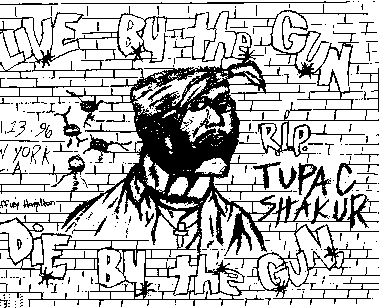
March 1997 Amin and Bunlay (Grade 7/8) Bonaventure Meadows Public School London, Ontario
March 1997 Amin and Bunlay (Grade 7/8) Bonaventure Meadows Public School London, Ontario, Canada

California Love (1995)

Out on bail fresh outta jail, California dreamin
Soon as I stepped on the scene, I’m hearin hoochies screamin
Fiendin for money and alcohol
the life of a west side playa where cowards die and its all ball
Only in Cali where we riot not rally to live and die
In L.A. we wearin Chucks not Ballies (that’s right)
Dressed in Locs and khaki suits and ride is what we do
Flossin but have caution we collide with other crews
Famous cause we program worldwide
Let’em recognize from Long Beach to Rosecrans
Bumpin and grindin like a slow jam, it’s west side
So you know the row won’t bow down to no man
Say what you say
But give me that bomb beat from Dre
Let me serenade the streets of L.A.
From Oakland to Sacktown
The Bay Area and back down
Cali is where they put they mack down
Give me love!