
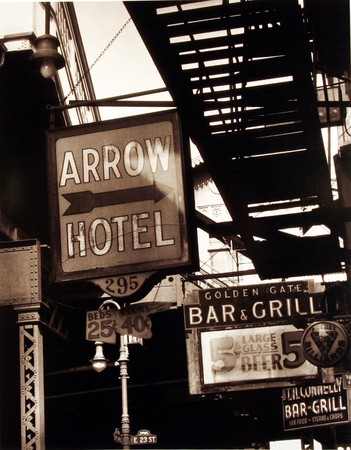
Max Yavno (Los Angeles: Underneath Third Avenue El – 1938)
I am currently reading a very interesting book, Unless the Threat of Death Is Behind Them: Hard-Boiled Fiction and Film Noir (2006 The Johns Hopkins University Press) by John T. Irwin, which studies five novels and the films based on them – The Maltese Falcon, The Big Sleep, Double Indemnity, High Sierra, and Night Has a Thousand Eyes. Irwin’s thesis seems to be that noir is concerned with death metaphysically as life-in-being and death also in an existential sense bred of social alienation. The following excerpts for me express the kind of prose Irwin is concerned with, and are passages from my own reading that have particularly struck me as being relevant.
“I went up to my room, up the dusty stairs of Bunker Hill, past the soot-covered frame buildings along that dark street, sand and oil and grease choking the futile palm trees standing like dying prisoners, chained to a little plot of ground with black pavement hiding their feet. Dust and old buildings and old people sitting at windows, old people tottering out of doors, old people moving painfully along the dark street. The old folk from Indiana and Iowa and Illinois, from Boston and Kansas City and Des Moines, they sold their homes and their stores, and they came here by train and by automobile to the land of sunshine, to die in the sun, with just enough money to live until the sun killed them, tore themselves out by the roots in their last days, deserted the smug prosperity of Kansas City and Chicago and Peoria to find a place in the sun. And when they got here they found that other and greater thieves had already taken possession, that even the sun belonged to the others; Smith and Jones and Parker, druggist, banker, baker, dust of Chicago and Cincinnati and Cleveland on their shoes, doomed to die in the sun, a few dollars in the bank, enough to subscribe to the Los Angeles Times, enough to keep alive the illusion that this was paradise, that their little papier-mache homes were castles. The uprooted ones, the empty sad folks, the old and the young folks, the folks from back home. These were my countrymen, these were the new Californians. With their bright polo shirts and sunglasses, they were in paradise, they belonged. But down on Main Street, down on Towne and San Pedro, and for a mile on lower Fifth Street were the tens of thousands of others; they couldn’t afford sunglasses or a four-bit polo shirt and they hid in the alleys by day and slunk off to flop houses by night. A cop won’t pick you up for vagrancy in Los Angeles if you wear a fancy polo shirt and a pair of sunglasses. But if there is dust on your shoes and that sweater you wear is thick like the sweaters they wear in the snow countries, he’ll grab you. So get yourselves a polo shirt boys, and a pair of sunglasses, and white shoes, if you can. Be collegiate. It’ll get you anyway. After a while, after big doses of the Times and the Examiner, you too will whoop it up for the sunny south. You’ll eat hamburgers year after year and live in dusty, vermin-infested apartments and hotels, but every morning you’ll see the mighty sun, the eternal blue of the sky, and the streets will be full of sleek women you never will possess, and the hot semi-tropical nights will reek of romance, you’ll never have, but you’ll still be in paradise, boys, in the land of sunshine.”
– John Fante, Ask the Dust (1939)
“No feelings at all was exactly right. I was as hollow and empty as the spaces between the stars. . . . Out there in the night of a thousand crimes people were dying, being maimed, cut by flying glass, crushed against steering wheels or under heavy tires. People were being beaten, robbed, strangled, raped, and murdered. People were hungry, sick; bored, desperate with loneliness or remorse or fear, angry, cruel, feverish, shaken by sobs. A city no worse than others, a city rich and vigorous and full of pride, a city lost and beaten and full of emptiness. It all depends on where you sit and what your own private score is. I didn’t have one. I didn’t care.”
– Raymond Chandler, The Big Sleep (1939)
 FilmsNoir.Net - all about film noir
Hi! Tony,
All I wanted to say was…Wow, but what I’am going to say is…two very different views of Los Angeles, by two different men.
I would have used the word…very, but I’am not familiar with writer John Fante. On the hand, I’am very familiar with author Raymond Chandler and his writing style.
Thanks, for sharing!
By the way, Tony, have you read author Lee Horsley’s book The Noir Thriller yet?
DeeDee 😉
LikeLike
Tony,
Nice photograph by Max Yavno.(Los Angeles: Underneath Third Avenue El-1938)
Because it compliment your piece…nicely.
DeeDee 😉
LikeLike
Thanks DeeDee.
Fante is a relatively unknown Italo-American novelist. Find out more about him here: http://www.salon.com/books/feature/2006/03/10/fante/index.html.
The photo was featured in a book of Yavno’s photography featured here: http://phomul.canalblog.com/archives/yavno__max/index.html.
LikeLike
Tony,
This is amazing, but that is the exact Chandler paragraph that summed it all up for me also. Hate to admit it, but I once felt that way myself–and was content about it! No longer, though.
Cheers,
Mike L
Noir Journal http://noirjournal.typepad.com/noir-journal/
New York Journal of Books http://www.nyjournalofbooks.com
LikeLike
Thanks Mike!
LikeLike
Great call on Fante’s Ask the Dust, one of the great novels of the 220th century, and when you frame his prose in terms of LA Noir, I thin their is none better, even James M. Cain, whom I love, pales in comparison. And to think how the depression influenced the idea of Noir is also fascinating, because that sense of existential alienation in Fante seems to have so much to do with his poverty and constant sense of hunger (both physical and spiritual).
LikeLike
Great contribution Jim. Thanks!
LikeLike
That is quite a passage there from “Ask the Dust” Tony, (I like that “even the sun belonged to the others”) and one that indicates these people were doomed before they even started. Destiny, chance and especially fate plays a big part here. Fante was actually a hero to Charles Bukowski, whose story was told in FACTORUM, a film starring Matt Dillon a few years ago, which I thought was reasonably effective. In any case, it should be noted that no less an authority than Robert Towne considered ASK THE DUST as the greatest novel ever written about Los Angeles, and that Italian-American identity was a major theme in Fante’s work, which in this particular instance paints a modern dystopia during the depression in L.A.
Superlative post here.
LikeLike
Thanks Sam.
LikeLike