Film Noir FAQ: A great new book on Film Noir

filmnoirfaq

Film Noir FAQ: All That’s Left to Know About Hollywood’s Golden Age of Dames, Detectives, and Danger (Applause 2013) by David J. Hogan is a great new paperback book on Hollywood noir covering the classic cycle from the 40s and 50s.  A hefty tome it weighs in at 420 pages and covers around 200 movies.  Author Hogan’s prose is snappy and engaging. His down-to-earth Introduction gets you hooked from the get-go.  Noir icon Lizabeth Scott has provided a short but razor-sharp note on the contents page.

The book has seven chapters and a bonus section on neo-noir. Each chapter has a theme, with titles like ‘The War Between Men and Women’ and ‘The Best Laid-Plans’. Within each chapter Hogan reviews a selection of films illustrating the chosen theme, and includes sidebars titled ‘Case Files’ throughout that feature mini-bios of important names in the noir universe.

What I particularly like is the way Hogan approaches the films under discussion.  He avoids spoilers by eschewing laboured plot outlines.  His concerns are thematic, and his focus is on the cinematic experience, with due consideration to not only the stars and directors, but to the writers, cinematographers, and other artisans that were involved in a film’s production. Hogan also aptly quotes dialog from some of the movies, and shares a lot of background on the making of many of the films.

The book is sparingly illustrated in monochrome – what other color would you want for a book on film noir?  – but the chosen frames, stills, and posters are well-chosen and of excellent quality.

While Hogan has a narrower definition of the film noir cannon than some, all the motifs and the essential films are there.

The Film Noir FAQ is must for any film noir fan, and is a great primer for those who want a fast-track to a fuller appreciation of film noir. At US$22.99 the book is a ‘big steal’.

The book can be purchased on-line from Amazon and the publisher. Amazon at the time of writing has only three copies left at the special price of US$13.45.


The Unreliable Narrator: Caligari, Rashomon, and the art of the B-Movie

The-Locket-1946
The Locket (1946)

The producer-added ending to Robert Wiene’s The Cabinet of Dr. Caligari (1920) merged the horrific scenario that went before into an hallucination of the protagonist’s disturbed mind. The savage critique of Germany’s emerging fascism was blunted, but a new dark expressionism survived. States of mind and dreams were irrevocably projected onto the cinema screen. Fetishism and fantastic scenarios ushered in the demonic and the surreal.

The deranged mind in Caligari was revealed through flashback.  Cinema moving backwards and forward in time, a quantum leap that thrust the oneiric engagement of the viewer within the frame of flickering images from passive observer to a participant who must engage actively in constructing a narrative.  The revealed unreliability of the narrative throwing the viewer into an abyss of incomprehension and confusion in movies like Un Chien Andolou.  A fractured kaleidoscope where meaning is continually undone and rewoven before the audience’s eyes.

Akira Kurosawa’s break-through movie Rashomon (1950), uses multiple flashbacks by different narrators to explore the nature of truth.  Truth not as fact, not as concrete events, but truth as competing and self-serving ‘stories’ about the narrator’s experience of a crime as recalled by different protagonists.  Kurosawa based his scenario on a short story by Ryûnosuke Akutagawa, which, unlike Kurosawa’s film, has the differing and conflicting re-tellings of the crime left hanging and unresolved.  Kurosawa on the other hand pursues a contrived moralism by adding a redemptive ending about the adoption of a foundling in swaddling clothes.

The creative influence of German expressionism on the dark Hollywood b-movies known as film noir through a generation of expatriate European directors is well-documented.  One such director is John Brahm, who in the 1946 b-movie The Locket made audacious use of flashbacks from different narrators in a story about a schizophrenic woman who is both a kleptomaniac and a murderer. The woman’s psychosis is revealed through not only a series of flashbacks from different narrators, but at one point, a flashback within a flashback.  I have previously reviewed The Locket here. In this discussion, a quote from  Borde’s & Chaumeton’s  seminal ‘A Panorama of American Film Noir 1941-1953 (1955) is sufficient:  “Never has the device of the flashback been taken so far.  Narratives are jumbled up, parentheses opened, exploits slot one inside the other like those Chinese toys sold in bazaars, and the figure of the heroine gradually comes into focus…”. Also, due credit should be given to Sheridan Gibney and Norma Barzman (uncredited), who wrote the original script. The ending is decidedly downbeat with a dark irony pointing not only to the uncertainty of the anti-hero’s fate, and an ambivalence about her culpability, but overarching doubts about the reliability of each and all the narrators of her story.

The Big Knife (1955): Bore me deadly

The Big Knife (1955)

The Big Knife is labelled a film noir by some.  I don’t see it myself. Rather an overwrought pot-boiler.

A  melodrama about Hollywood that out-melodramas Hollywood.  Cloister an ensemble of A-list actors in a Hollywood bungalow with maverick-director Robert Aldrich, all singing from an operatic song-sheet courtesy of a play from Clifford Odets, with some snappy camera moves, amidst the hot-house boundaries of a posh living room, and the histrionics hit the roof.

Jack Palance a contract actor for an exploitative b-studio was once a young man with ideals.  He is now a middle-aged drunkard and Lothario who still loves his estranged wife – an aging Ida Lupino who at all times seems rather lost and discomfited.  She will only come back if he junks his career by refusing to sign a new contract pushed on to him by literally insane studio boss Rod Steiger.  Wendell Corey a modern-day Iago is spin-artist to Steiger, and a man happy to contrive a murder to keep the lid on a damaging back-story.

Filmed with a flatness and harsh lighting that washes out any nuance or ambivalence, the players are left to strut their stuff with exaggerated gestures and contrived rhetoric.  The picture may just as well have played as a radio soap.  It is hard to conceive that the same director had just completed the great Kiss Me Deadly. One of the rare occasions I can agree with the NY Times’ Bosley Crowther, who on the film’s release saw “a group of sordid people jawing at one another violently”.


Noir Poet – Kenneth Fearing: “appeals urged across kitchen tables and the fury that shouts them down”

The Asphalt Jungle (1950)

Pantomime

She sleeps, lips round, see how at rest
how dark the hair, unstrung with all the world
see the desirable eyes, how still, how white, sealed
to all faces, locked against ruin, favor, and every
risk

Nothing behind them now but a pale mirage
through which the night-time ragman of the street
below moves in a stiff and slow ballet
rhythmic from door to door, hallway to curb and
gutter to stoop, bat’s eyes bright, ravenous,
ravenous for the carrion found and brought by
tireless fingers to unreal lips

Her hand relaxed beside the enchanted head, mouth red,
small
see how at peace the human form can be, whose
sister, whose sweetheart, daughter of whom,
and now the adorable ears, coral and pink
deaf to every footfall, every voice
midnight threats, the rancor stifled in rented bed-
rooms, appeals urged across kitchen tables and
the fury that shouts them down, gunfire,
screams, the sound of pursuit
all of these less than the thunderous wings of a moth
that circles here in the room where she sleeps

Sleeps, dreaming that she sleeps and dreams.


-From ‘Dead Reckoning’, A Book of Poetry by Kenneth Fearing (Random House, NY, 1938)


Jigsaw (1949): “like the last act of Hamlet”

Jigsaw (1949)

Jigsaw is a rollicking thriller so camp you forgive the preposterous plot and thank the heavens for bringing it your way. A weirder movie you could not imagine. Franchot Tone is a NY special prosecutor pursuing a murky underground hate group with tentacles in the highest echelons of the city’s elite government and business circles. Tone’s delicious turn has shades of his acerbically ironic portrayal of a PI in the excellent I Love Trouble from the year before.

But the dames steal the picture. Winifred Lenihan, an actress who only ever appeared in this movie and another obscure picture from 1931, is a delight as a middle-aged socialite with a hidden agenda, while another stringer Jean Wallace (Kiss Me Deadly) has you enthralled as a sexy – and intelligent – blonde cabaret singer with sinister connections.

Jigsaw in more ways than one. The only movie made by production company Tower Pictures Inc., this b-picture was made by a bunch of journeymen, who through the quirky finger of fate came together to pack into 77 minutes an entertainment set in a Manhattan so darkly baroque, it seems almost self-consciously noir. From the opening panoramic shots of an isolated city street to the seamless and exciting climax in a darkened art gallery at night, impenetrable shadows haunt the streetscape of a city almost subterranean in its ambience. Add out-of-left field tracking shots that harken to the craft of Max Ophuls, director Fletcher Markle, who co-wrote the screenplay, and his DP Don Malkames, fashion a mise-en-scene of real panache. The script is both corny and intelligent, with a disarming amorality. A crusading journalist killed by the bad-guys is still warm when Tone makes a move on the widow who is also more hot than cold.

To add to the puzzle, you have a bunch of A-listers in uncredited bit parts. Names like Marlene Dietrich, Henry Fonda, John Garfield, Marsha Hunt, Burgess Meredith, and Everett Sloane.

It takes a while to get moving, but once it kicks in, look out. A must-see.

Highway 301 (1950): “a straight exercise in low sadism”

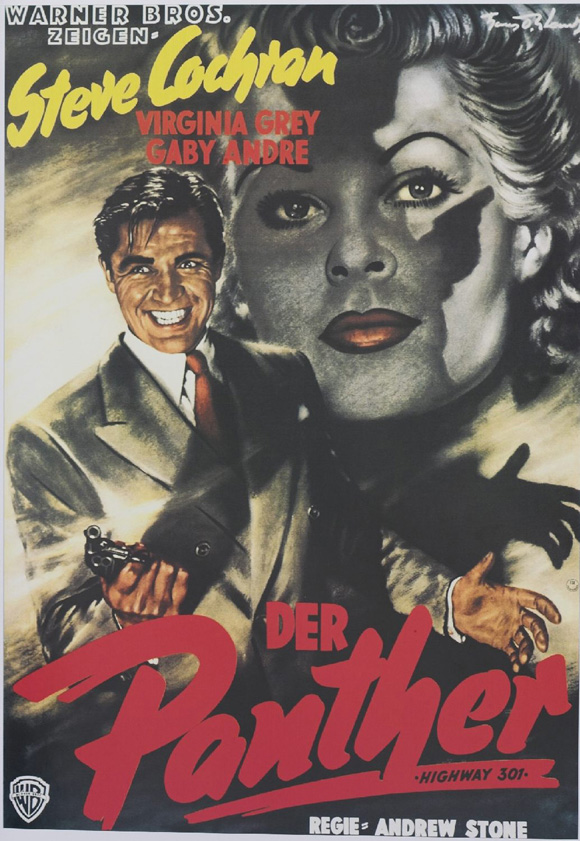
The demonic protaganist features in this German poster for Highway 301
The demonic protagonist features in this German poster for Highway 301

In 1950 New York Times film critic Bosley Crowther was “disturbed” and “depressed” by Highway 301, a dark gangster flick from Warner Bros.  He was emphatic in his dismissal: “the whole thing, concocted and directed by Andrew Stone, is a straight exercise in low sadism”.  Glen Erikson in his review of the DVD, described the relentlessly violent trajectory thus: “Imagine White Heat shorn of its rich characterizations and reduced to little more than its basic violent content: no complexity, just action and suspense scenes”.

Get it? A police procedural stripped back to its unardorned essence: violent hoods on the rampage. In deep focus and on the streets of  L.A.

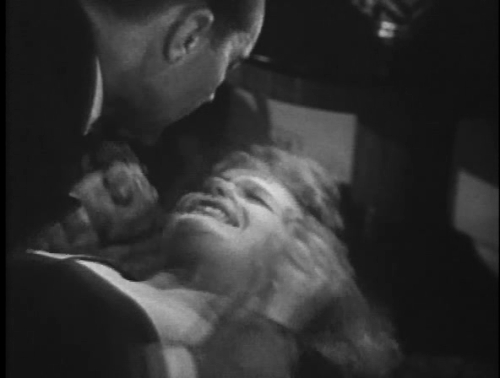
In the way of the burgeoning police procedurals of the 1950’s, the movie is prefaced by homilies from not one but three State governors, each attesting to the veracity of the story and the lessons it holds for those contemplating similar escapades. The Tri-State Gang led by a remorseless “pretty boy” killer played menacingly by Steve Cochran, are heist specialists who find time to have settled relationships with women. One is even married to a totally amoral yet passive woman – unnervingly portrayed by Virginia Grey. A dame not offended by her better-half’s style of life, and who finds solace on those long  lonely nights with a portable radio that goes with her everywhere. Cochran early on dispatches his talkative erstwhile girlfriend by shooting her in the back.  He then latches on to the French Canadian girlfriend of another member of the gang, after he checks out when a heist goes wrong. Trouble is “Frenchy” finds out too late the trap she has fallen into. There is real terror here, and most strongly delivered in an extended sequence where Cochran pursues the girl on dark city streets after she tries to cut loose. The gang is eventually picked-off  by the law in increasingly bloody encounters.

Don’t look for ambivalence or redemption. This is a brutal modern take on the police procedural: uncanny in that the picture sets off rather than ends the late cycle segue on film noir.

Marlowe: “I was neat, clean, shaved and sober, and I didn’t care who knew it.”

The Big Sleep

“It was about eleven o’clock in the morning, mid October, with the sun not shining and a look of hard wet rain in the clearness of the foothills. I was wearing my powder-blue suit, with dark blue shirt, tie and display handkerchief, black brogues, black wool socks with dark blue clocks on them. I was neat, clean, shaved and sober, and I didn’t care who knew it. I was everything the well-dressed private detective ought to be. I was calling on four million dollars.”

– Raymond Chandler, first paragraph of  The Big Sleep (Published 1939)


Jean Valjean in the Shadows

Les-Miserables-1934-Jean-Valjean
Harry Baur as Jean Valjean, just released from prison, in the epic 1934 French film adaption of Victor Hugo’s Les Misérables directed by Raymond Bernard.

“At times he did not rightly know himself what he felt. Jean Valjean was in the shadows; he suffered in the shadows; he hated in the shadows; one might have said that he hated in advance of himself. He dwelt habitually in this shadow, feeling his way like a blind man and a dreamer. Only, at intervals, there suddenly came to him, from without and from within, an access of wrath, a surcharge of suffering, a livid and rapid flash which illuminated his whole soul, and caused to appear abruptly all around him, in front, behind, amid the gleams of a frightful light, the hideous precipices and the sombre perspective of his destiny.

The flash passed, the night closed in again; and where was he? He no longer knew. The peculiarity of pains of this nature, in which that which is pitiless–that is to say, that which is brutalizing–predominates, is to transform a man, little by little, by a sort of stupid transfiguration, into a wild beast; sometimes into a ferocious beast.

Jean Valjean’s successive and obstinate attempts at escape would alone suffice to prove this strange working of the law upon the human soul. Jean Valjean would have renewed these attempts, utterly useless and foolish as they were, as often as the opportunity had presented itself, without reflecting for an instant on the result, nor on the experiences which he had already gone through. He escaped impetuously, like the wolf who finds his cage open. Instinct said to him, “Flee!” Reason would have said, “Remain!” But in the presence of so violent a temptation, reason vanished; nothing remained but instinct. The beast alone acted.”

– Victor Hugo, Les Misérables (1862) – Excerpt from Isabel Florence Hapgood’s 1887 translation.

Note: Read about the 1934 French film adaptation of Les Misérables in a post on film critic Leonard Maltin’s blog: Discovering Another ‘Les Misérables

New FilmsNoir.Net Trailer

Check out the new FilmsNoir.Net Trailer ( It looks even better on YouTube.)

Cinematic Cities: New York – The Noir Years

New York in the 1940s in noir guise. From the previously unpublished archives of Life Magazine.   Full size photos can be viewed on the Time-Life web archive.

nyc_thenoiryears_1949
1944 Photo: Andreas Feininger – Time & Life Pictures/Getty Images
nyc_thenoiryears_1947
1947 Photo: Herbert Gohr – Time & Life Pictures/Getty Images
nyc_thenoiryears_1946_2
1946 Photo: Andreas Feininger – Time & Life Pictures/Getty Images
nyc_thenoiryears_1946_1
1944 Photo: Andreas Feininger – Time & Life Pictures/Getty Images
nyc_thenoiryears_1946
1946 Photo: Andreas Feininger – Time & Life Pictures/Getty Images
nyc_thenoiryears_1944
1944 Photo: Andreas Feininger – Time & Life Pictures/Getty Images
nyc_thenoiryears_1942
1942 Photo: Alfred Eisenstaedt – Time & Life Pictures/Getty Images