Noir vs Tarantino

I recently became embroiled elsewhere in a debate about the films of Quentin Tarantino, which I dislike, finding them ugly and fascist in their violence, misogyny, and concern with the squalid aspects of contemporary America.

Others however, wax lyrical on his “vision”, the “beauty” of his dialog, and his technical re-invention of the exploitation genre of the 70s. This perspective is justified using high language and erudition.

What has this got to do with film noir? Well, it is about film, why films are made, and what makes them of value.

Films are essentially entertainment, Hollywood films anyway, and commodities produced for profit. Somehow, this endeavour has produced and continues to produce films that not only have wide appeal but value as works of art to a lesser or greater degree. The great films noir had both popular appeal and artistic merit because their themes address the human condition and the frailty of normal lives, which at any moment can be plunged into the chasm of chaos, through chance or individual action – innocent or otherwise. How moral ambivalence, lust, love and greed can destroy lives is explored outside the closed romantic realism of mainstream movies.

What do the films of Tarantino offer outside some appeal to a coterie of aficionados who elevate technique over content? Violence, criminality, and baseness as urban cool.

The Left Hand Of Noir

Lloydville of mardecortesbaja.com has posted another interesting and provocative article on the origins of film noir: MORE ON FILM NOIR AND THE DEATH OF GOD:

…certain modern commentators want to see film noir as a phenomenon with essentially political implications – something that’s not hard to argue given the leftist leanings of many of the great masters of the noir tradition, a number of whom were eventually blacklisted. But seeing film noir as essentially political expression I think sells the phenomenon short… If film noir were simply a reflection of the politics of its leftward-leaning makers, it ought to be terribly dated today, after the demystification of Communism and Stalin, those ephemeral shibboleths for which the Hollywood radicals martyred themselves.

Lloydville’s post has prompted some musings of my own.

The concern with existential angst is what attracted me to films noir, and Lloydville’s recent posts have prompted me to look at certain films in new ways. More particularly, I have always dismissed Detour (1945) as an oddity that I didn’t take too seriously, mainly because the protagonist brought his fate upon himself by his own foolishness, and I saw the plot as too contrived. But now after reading Llloydville’s post I feel that perhaps, Al makes disastrous choices because he has lost a defining paradigm for life and his  immaturity. An indifferent universe may have played a stronger role in his downfall, than I previously thought.

I agree that there are elements of the socio-political in many noirs: Dassin, Lang, and Wilder come immediately to mind, but I disagree with some aspects of Lloydville’s analysis of leftism and film noir. Many of the great European film noir directors that landed in Hollywood, fled fascism, and I see no evidence that they had any Stalinist inclinations. We must be careful not to confuse leftism with authoritarian communism.

The leftist critique of the intellectual left of Europe was a response to existentialism and, as Lloydville says, the death of God. For others the response was an inclination to nihilism, and yes, Stalinism. We can see nihilism too in many noirs.

That said, I agree the political is only one element of many in the film noir genre, and placing exclusive emphasis on this element in a director’s oeuvre is invalid and limiting.

I also cannot agree with Lloydville’s view that “Hollywood radicals martyred themselves.”. They were destroyed for the most part because of past associations or beliefs that they in most cases no longer held, and principally for their innate decency and courage when they placed loyalty and morality ahead of self-interest. If they were martyrs, their sacrifice was for the highest ideals not “ephemeral shibboleths”.

Nietzsche and the Meaning of Noir

In A Lonely Place (1950): A Psychic Prison

My proposal, then, is that noir can also be seen as a sensibility or worldview which results from the death of God, and thus that film noir is a type of American artistic response to, or recognition of, this seismic shift in our understanding of the world. This is why Porfirio is right in pointing out the similarities between the noir sensibility and the existentialist view of life and human existence. Though they are not exactly the same thing, they are both reactions, however explicit and conscious, to the same realization of the loss of value and meaning in our lives.

Mark Conard looks at existentialism, definitions and the meaning of Film Noir, in an authorised excerpt from the book The Philosophy of Film Noir: Nietzsche and the Meaning of Noir:Movies and the ‘Death of God’.

The Origins of Noir

Lloydville of mardecortesbaja.com has posted a series of interesting and provocative articles this month on the origins of film noir and a paradigm for classifying noirs:

Lloydville finds the origins of film noir in post-WW2 disillusionment, while I see the origins as more rooted in European existentialism through the post-war influence of directors such as Wilder, Siodmak, Lang, De Toth, Sirk, Ulmer, Dmytryk, Tourneur, Von Sternberg, and others. I also question the usefulness of developing a schema of sub-genres.

Lloydville is a thinker and his posts go beyond plot outlines and arcane trivia. While I don’t agree with all he says, I have found reading the posts stimulating and thought-provoking.

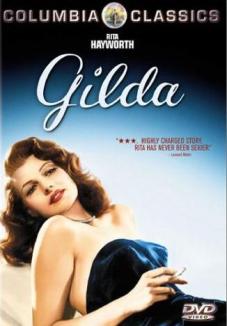
Gilda (1946): Lovely Rita…

Gilda (1946)

“if i had been a ranch, they woud have named me ‘Bar Nothing’ …”

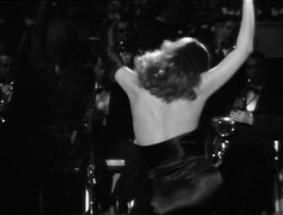
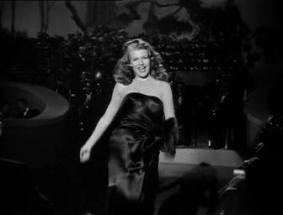
Aptly titled, this film is all about Rita Hyaworth’s Gilda: forget the weak story and the plot holes, just marvel at the beauty and charisma of this woman. She dances, she struts, she pouts, and she acts with passion and flair!

Gilda (1946)Gilda (1946)

And forget it if you are looking for a film noir: it is not. As a film it ranks with flawed gems like Beat The Devil – it just doesn’t add up but you have a helluva time anyway.

The Cabinet of Dr Caligari (Germany 1919)

Caligari

This bizarre and hysterical silent film, an early entry in the horror genre from director, Robert Weine, is seen by many as the genesis of expressionist cinema, which flourished in Germany in the 1920’s, and in turn influenced the stark lighting associated with Hollywood film noir. Fritz Lang had some early involvement with the film, but this was in the planning stages.

The Cabinet of Dr Caligari (Germany 1919)The Cabinet of Dr Caligari (Germany 1919)

But I support the heretical view that the expressionist connection is tenuous. The sets are staged distortions with shadows painted on, and the action filmed using flat internal lighting and a static camera center-stage. The film has little if any relevance to film noir in theme or filmic technique, apart from the use of flashback within a flashback.

711 Ocean Drive (1950)

711 Ocean Drive (1950)

Edmond O’Brien is solid as a LA telephone repairman who goes crooked.

711 Ocean Drive was made to cash in on a then-current national newspaper expose of bookmaking operations. It is a predictable B gangster movie that sits more comfortably with its 1930’s forebears. Definitely not a film noir – the guy goes bad without remorse or regret. You have to wait till the end to get an adrenalin fix, with a slam-bam chase and shoot-out at Boulder (aka Hoover) Dam.

For Edmond O’Brien fans.

71 711 Ocean Drive (1950)

The Dark Corner (1946)

The Dark Corner (1946)

“Save your lipstick, girls, he plays for keeps.” Secretary tries to help her PI boss, who is framed for a murder.

A solid B thriller melodrama, with Clifton Webb reprising his role as the obsessive older lover from the superior Laura (1944). Lucille Ball is entertaining as the wise-cracking secretary with smarts. Mark Stevens is ok as the gumshoe, and William Bendix is great as a hoodlum heavy.

But night scenes and expressionist lighting alone do not give you a film noir. Fun to watch and the soundtrack deepens the ‘night-life’ milieu of the after-dark scenes. Ms Ball looks good smoothing her size-9 nylons over those long legs while making snappy innuendo.

The Dark Corner (1946) The Dark Corner (1946)

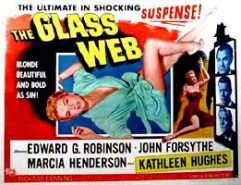
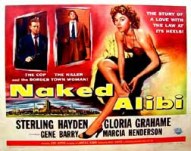
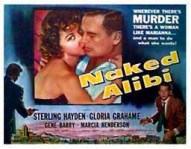
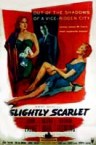
Bad Girls Posters

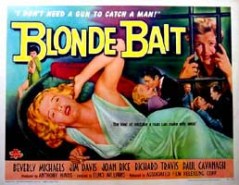
There is a nice collection of vintage film noir posters for sale at Movie Posters Online, including these ‘bad girl’ items:

Blond Bait The Glass Web
Naked AlibiNaked AlibiSlightly Scarlet (1956)

Touch of Evil (1958) – Some Kind of a Movie

Touch Of Evil (1958)

From the breathtaking three minute opening tracking shot, which is featured below , you know you are in the realm of a master film-maker. Yet, there is a hiatus to follow and the portent of this amazing opening is not realised until the last 20 minutes of the film. Welles’ last masterwork is a disconnected emotionally remote study of moral dissipation. The crisp black and white photography of Russell Metty is forensic and can only be truly appreciated in a theatre or from a HD DVD.

The camera angles and lighting that Wells pioneered are abundant but this movie has no soul. Welles delivers an excellent performance as the dissolute sheriff, as does Joseph Calleia as his loyal deputy. Charlton Heston is miscast: a moustaclhe and dark make-up do not a Mexican make. His fractured Spanish is jarring. Marlene Dietrich is nicely enigmatic as the aging whore with soul, and Janet Leigh as the ingenue wife is engaging.

The film works best in the sleazy urban settings, where the contemporary music score adds depth.

This is not a film noir. Wells reprises his Citizen Kane mise-en-scene, but there is nothing in the story that even reaches the proximity of moral ambivalence or an existential dilemma, and it is certainly not populist cinema. It is ultimately a brilliant but flawed work of cinematic ‘art’.

Touch Of Evil (1958)