The Woman in the Window (1944): Over-rated

The Woman in the Window (1944)“The shopworn and superfluous ending has all the impact of a stale peppermint upon a man who has ordered a steak dinner.”
– Motion Picture Herald on the film’s release

Even without the cop-out ending, I find it hard to see Fritz Lang’s The Woman in The Window as other than a minor film noir. Although Freudian symbolism abounds and the noir theme of lives destroyed by chance events and small decisions is deftly handled, the movie is slow and ponderous – like the middle-aged law professor protagonist. Definitely one of Lang’s lesser works. Lang’s similarly-themed Scarlet Street (1945), made a year later with the same leads, is much stronger.

To give it credit the picture was popular with audiences and made money, but producer and screenwriter, Nunnally Johnson, was less than impressed, and it was received coolly by the critics.

In an interview in 1975, Lang justified the ending in these words:

This movie was not about evil… it was about psychology, the subconscious desires, and what better expression of those than in a dream, where the libido is released and emotions are exxagerated… [an] audience wouldn’t think a movie worthwhile in which a man kills two [sic] people and himself just because he had made a mistake by going home with a girl…

The irony of the second part of the quote will not be lost on film noir aficionados.

The Woman in the Window (1944)

Mildred Pierce (1945): “alligators have the right idea… they eat their young”

Mildred Pierce (1945)

“this etched-in-acid film chronicles the flaws in the American dream…”
– Steven H. Scheuer

“Constant, lambent, virulent attention to money and its effects, and more authentic suggestion of sex than one hopes to see in American films.”
– James Agee

Mildred Pierce (1945)

One of the great Hollywood melodramas with an Oscar-winning performance from the luminous Joan Crawford as Mildred. Better than the James M. Cain novel on which it is based, Mildred Pierce under the assured direction of Michael Curtiz, and with stunning film noir photography by cinematographer Ernest Haller, is top-class entertainment.

The story of family tragedy played out against the pursuit of the California dream of wealth and ease through hard-work and ambition destroyed by wastrel conceit and shameless greed, is as strong an indictment of the moral corrosiveness of wealth and privilege as Hollywood has achieved. But it is also a story of profound humanity and the worth of simple decency and personal integrity. Mildred makes tragic mistakes and misplaces her trust and love, but she is always true to herself, and in even in her darkest hour towers above the morass of greed and selfishness that would suck her down.

These frames from the movie illustrate the visual dynamite that explodes on the screen in the film’s most dramatic moments:

This slideshow requires JavaScript.

Fury (1936): On The Threshold of Noir

Fury 1936Director Fritz Lang’s first American film is a sharp terrifying study of mob hysteria as a town tries to lynch an innocent [kidnap] suspect. [Spencer] Tracy survives however, and returns to take revenge.
– Steve H. Scheuer – Movies on TV

After 70 years, Fury, which was co-written by Lang, remains a powerful and still relevant social criticism that telegraphs the recurring theme in Lang’s later Hollywood noirs: the fate of the individual when social institutions fail and injustice destroys innocent lives.

The film’s title is particularly apt with the first half concerned with mob fury, and the second half with the fury of the erstwhile victim seeking revenge. Strong performances from Tracy and Sylvia Sidney hold the narrative together even though their actual screen time is limited. The focus is on how hysteria grips a small town and allows mob rule to destroy social cohesion, and in the aftermath how the operation of the laws that protect freedom are thwarted by community loyalties trying to shield the law-breakers from justice. The irony is profound and convincingly played out in a court-room in the trial of the ringleaders. Lang spares no-one from the forensic gaze of the camera. A camera within a camera is used to indict the defendants when a projector is set-up in the court-room, and newsreel footage of the affray is shown. The newsreel footage is silent, and plays like a silent movie with riotous acts and facial expressions exaggerated for dramatic effect. A modern audience may find this technique dated, but it would have certainly had a strong impact on contemporary movie-goers only a few years after the end of the silent era.

Lang cut his teeth in German silent cinema, and silent movie techniques are also used in the movie’s action. Dramatic sustained close-ups of characters with extremely emotional expressions, and montage in two scenes: in the opening sequence a cut to an ominous roaring steam train disturbs the evening stroll of the two lovers, and later a clucking hen-house cut is a sardonic chorus to the burgeoning female rumor mill that is the build-up to the riot.

While Alain Silver and Elizabeth Ward include Fury, in their book, Film Noir: An Encyclopedic Reference to the American Style, I see the movie as pre-cursor only – not a fully-fledged film noir. The resolution at the end of the film is classic Hollywood, with the lovers re-united and justice morally if not legally served, but the Tracy character remains profoundly marked by his experience and not fully repentant of his attempt at vengeance. This is the territory that film noir would begin to explore a few years later.

Fury 1936

Metropolis Now: Dystopia and Sci-fi Noir

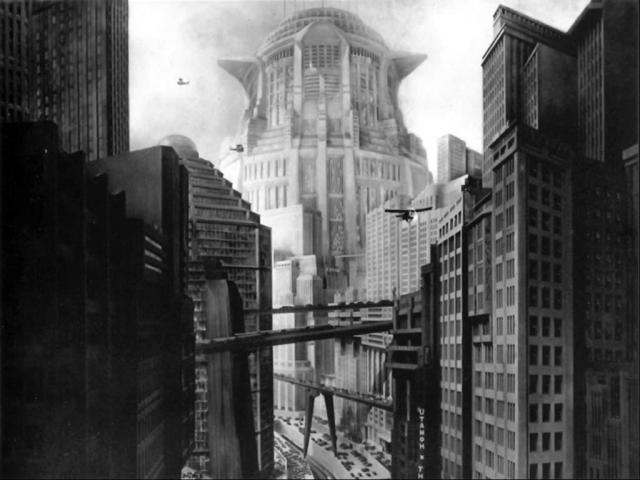
Metropolis (1927) Tower Of Babel

Metropolis (1927) Tower Of Babel

New York Times film critic, A.O. Scott has written a great article in this weekend’s NYT magazine: The Way We Live Now: Metropolis Now, in which he discusses the cinematic prophecies concerning the city as urban space in science fiction and the influence of film noir on the genre:

Architects and planners are by professional inclination both practical-minded and utopian. Their job is to solve problems, to ground their projects in collective hopes for a grander, cleaner, more rational organization of human space. The long-term results of their efforts, however, are typically ambiguous, yielding new problems on top of solutions. For much of the past century, the job of imagining the worst possible outcomes of their good intentions — of assessing the radically dystopian implications of urban progress — has fallen to film directors and production designers. They invent the city of the future not as a model but as a cautionary tale; and their future is the only future we know firsthand…

Scott goes on to discuss Fritz Lang’s Metropolis (1927), the science fiction noir Alphaville (Jean-Luc Godard 1965), and the more recent Blade Runner, Minority Report, and Code 46.

The Devil Thumbs A Ride (1947): A Dark Little Gem

devilthumbsrideThe Devil Thumbs A Ride (1947) made as a B-filler by RKO is a tight thriller that takes only 63 minutes from the first gun-shot to the last. Tough guy actor Lawrence Tierney plays Steve Morgan, a cold-blooded killer on the run.

The leaky plot and B-grade supporting cast add a camp quality to the mix, and there are plenty of high-jinks with crackling dialog and absurd twists that keep you mesmerised: a highlight is when Morgan is on his knees cleaning a spot off a rug after a house has been trashed, and asks for cleaning fluid…

Why a film noir? There is a profoundly tragic element in the needless brutal death of a young female drifter who also thumbs a ride in a morbid turn of fate. The role is nicely played by a Betty Lawford, in her only major role.

Watch it as it was intended – as the first movie in a double-feature.

The Big Sleep (1946): Love’s Vengeance Lost

The Big Sleep 1946

Howard Hawks’ The Big Sleep is one of the truly great Hollywood pictures: the Raymond Chandler novel is brought to the screen with panache and authority, and the chemistry between Bogart and Bacall is unsurpassed.

While the protagonist lovers are good guys and there is no femme-fatale, the movie has a strong noir aura. The darkly lit atmosphere and strong sexual tension shape our response to a grim and dissolute nether world where PI Philip Marlowe doggedly solves an enigma within a mystery, in a plot so convoluted not even the film-makers fully understood it.

The picture is essentially a love story where the lovers must overcome mutual distrust and risk all to escape a brutal nightmare of betrayal and death. The Big Sleep is a lot darker than the earlier Murder, My Sweet (aka Farwell, My Lovely – 1944). The Marlowe of The Big Sleep is tougher, more driven, and morally suspect.

I find the actions of Marlowe in the final reel disturbing. He is almost a proto-Dirty Harry. Clearly shaken by the death by poisoning while he stood by of the small-time hood who leads Marlowe to the final showdown, Marlowe responds with vengeful brutality in the shootout with the goon, Canino, and then in the final scene when he confronts the crooked casino-operater, Eddie Mars.

While the killing of Canino at a stretch can be put down to self-defense, there is no moral justification apart from vengeance in the way Marlowe engineers the death of Eddie Mars – the killing is gratuitous and was not the only way out for Marlowe and Vivian. It is this final scene that marks The Big Sleep as a film noir. Marlowe has survived and got the girl – but at what cost?

8th Annual Palm Springs Film Noir Festival: Rare Screenings

The 8th Annual Palm Springs Film Noir Festival over May 29 – June 1, 2008 features a number of rare and obscure titles only available on the big screen. The festival will screen 12 features at Camelot Theatre, 2300 Baristo Road, Palm Springs Ca. – Telephone (760) 325-6565.

The program is a veritable feast of intriguing movies that have not been available for many years – two are so obscure I couldn’t find a poster:

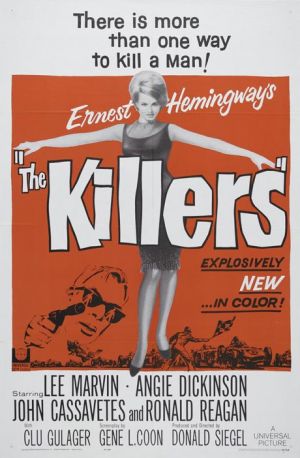
The Killers 1964

Thursday May 29 7:30 pm – OPENING NIGHT
Special Guest: Angie Dickinson
The Killers (1964) 95m.
DIR: Don Siegel
Lee Marvin, Angie Dickinson, John Cassavetes, Clu Galager, Ronald Reagan

Remake of the Siodmak noir based on the Hemmingway short story.

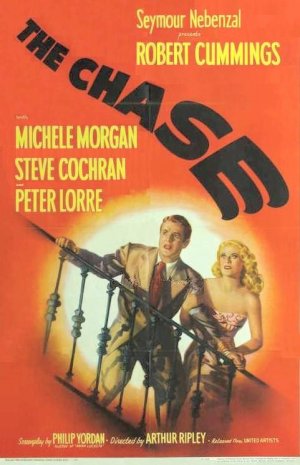
The Chase

Friday May 30 10:00 am
The Chase (1946) 86m.
DIR: Arthur Ripley
Robert Cummings, Steve Cochran, Peter Lorre, Michele Morgan

A down-and-out roustabout (Cummings) is hired by a vicious gangster (Cochran) and quickly gets down-and-dirty with his lovely wife (Morgan). Restored 16mm print.

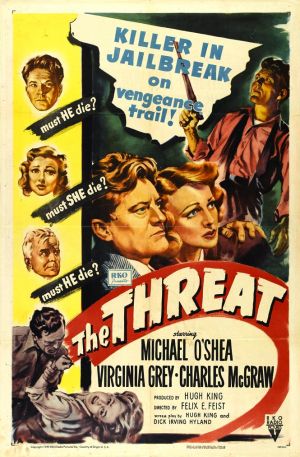
The Threat

Friday May 30 1:00 pm
The Threat (1949) 66m.
DIR: Felix Feist
Charles McGraw, Michael O’Shea, virginia Grey, Julie Bishop

Ruthless killer escapes prison, kidnapping the cop and D.A. who helped jail him while leading a wild escape into the California high desert. The action moves at a breakneck pace; a veritable highlight reel of malicious mayhem courtesy of ultimate noir baddie, CharlesMcGraw.

Friday May 30 4:00 pm
Special Guest: Margia Dean
Treasure of Monte Cristo (1949) 79m.
DIR: William Berke
Glenn Langan, Adele Jergens, Steve Brodie, Margia Dean

A freighter officer, (Langan) a descendant of the Count of Monte Cristo, is framed for murder and tries to puzzle it out. Shot on location in San Francisco and starring the husband and wife team of Langan and Jergens.

Lady in The Lake

Friday May 30 7:30 pm
Special Guest Jayne Meadows
Lady in the Lake (1947) 105m.
DIR: Robert Montgomery
Robert Montgomery, Lloyd Nolan, Audrey Totter, Jayne Meadows

Robert Montgomery offers a terse rendition of Philip Marlowe from an unusual first-person camera perspective via Steve Fisher’s screen adaptation of Chandler’s novel of the same title.

Saturday May 31 10:00 am
Smooth as Silk (1946) 64m.
DIR: Charles Barton
Kent Taylor, Virginia Grey, Jane Adams, MIlburn Stone

Respected attorney (Taylor) concocts a plot of vengeance after learning his sweetheart has jilted him for a wealthy producer.

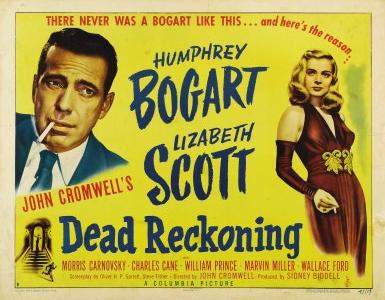
Dead Reckoning

Saturday May 31 1:00 pm
Dead Reckoning (1947) 100m.
DIR: John Cromwell
Humphrey Bogart, Lizabeth Scott, Morris Carnovsky, William Prince

Bogart is a mustered out vet who heads down south searching for a buddy who took a powder on the Medal of Honor. He runs into big trouble with femme fatale Scott and gangster Carnovsky.

Man in The Vault

Saturday May 31 4:00 pm
Special Guest Karen Sharpe Kramer
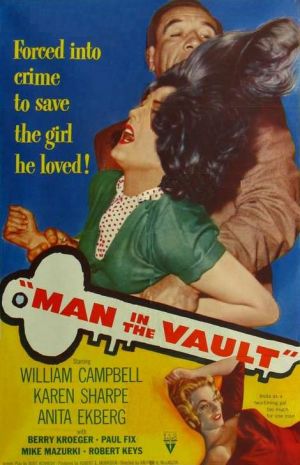
Man in the Vault (1956)
DIR: Andrew V. McLaglen
William Campbell, Karen Sharpe, Anita Ekberg, Barry Kroeger

An innocent locksmith (Campbell) is seduced into participating in a robbery by femme fatale (Sharpe) to his eternal regret.

Bunny Lake is Missing

Saturday May 31 7:30 pm
Special Guest Carol Lynley
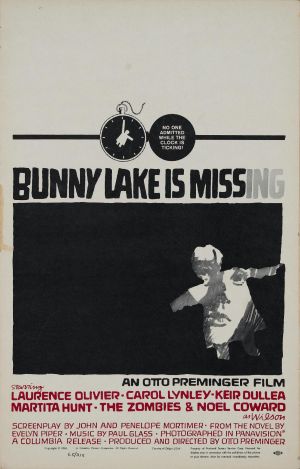
Bunny Lake is Missing (1965) 107m.
DIR: Otto Preminger
Laurence Olivier, Carol Lynley, Keir Dullea, Noel Coward

Lynley and her brother report the apparent disappearance of her daughter from a British preschool. The only problem is Police Supt. Olivier can find no evidence that the girl existed.

Without Warning

Sunday June 1 10:00 am
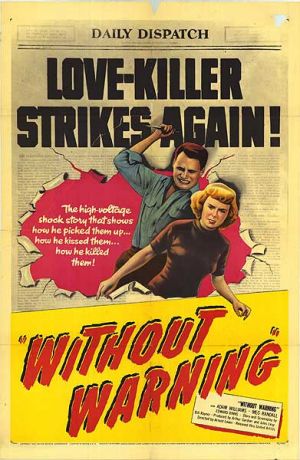
Without Warning (1952) 77m.
DIR: Arnold Laven PRODUCERS: Arthur Gardner and Jules Levy

Professional gardener Carl Martin (Adam Williams) ably portrays a vicious psychopath with a thing for young blondes… and garden shears. One of the first Hollywood send-ups of the redoubtable serial killer, superbly crafted and almost never shown theatrically.

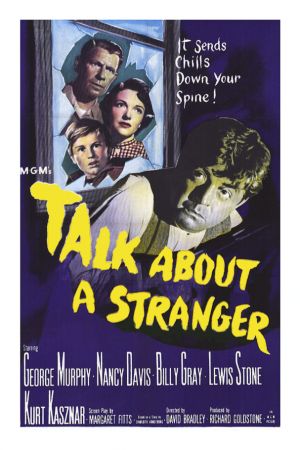
Talk About a Stranger

Sunday June 1 1:00 pm
Special Guest Billy Gray
Talk about a Stranger (1952) 65m.
DIR: David Bradley
George Murphy, Nancy Davis, Billy Gray, Lewis Stone, Kurt Kasznar

A compelling tale about a young boy, convinced his new neighbor poisoned his dog, which launches a quest for justice that careens out of control. Camera work by John Alton.

Night Editor

Sunday June 1 4:00 pm
Night Editor (1946) 66m.
DIR: Henry Levin
William Gargan, Janis Carter, Jeff Donnell, Coulter Irwin

Police detective (Gargan) can’t report a murder he witnessed because it would involve exposing an adulterous affair he was having with a socialite (Carter) with an overactive libido.

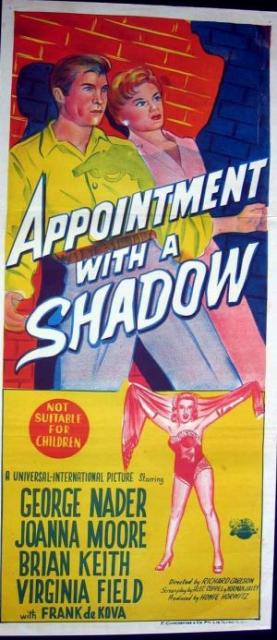
Appointment With a Shadow

Sunday June 1 7:30 pm
Appointment with a Shadow (1958) 73m.
George Nader, Joanna Moore, Brian Keith, Frank DeKova

While trying to score the lowdown on a big story, an alcoholic reporter becomes the target of a diabolical murder plot.

Get full program details from the Palm Springs Festival Film Noir site.

View the full size posters by clicking here: [piclens-lite-link]

New Noir Site: Film Noir Studies

filmnoirstudies.com

The authoritative University of California Berkeley hosted collection of essays by John J. Blaser, No Place for a Woman: The Family in Film Noir, has been re-launched with updated content as Film Noir Studies. While the focus is still on essays, new features include a film noir time-line, a comprehensive glossary, and an open invitation for the submission of new essays. Highly recommended.

Noir America: The Genius of Film Noir

crimsonkimono_tn

This article by Stanley Crouch on Slate.com is one of the best written and most entertaining surveys of film noir I have read: Noir America: Cynics, sluts, heists, and murder most foul. An extract follows:

Noir’s popularity was inevitable. How could American audiences resist the combative stance of an unimpressed hero whose ethos could be reduced to: “Is that so?” How could they fail to be lured by all of the actresses cast as Venus’ flytraps? Everything in film noir takes place at the bottom, in the sewers of sensibility. It holds that the force of the world is not only indifferent to, but obviously bigger than, the individual, which is why personal satisfaction, whether illegal or immoral, is the solution to the obligatory ride through an unavoidably brittle universe.

Offscreen Com: Noir Essays

Man With a Trumpet

The film site Offscreen.com has published an interesting collection of articles on film noir: