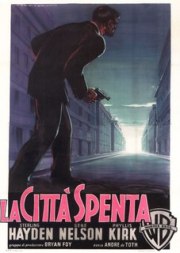
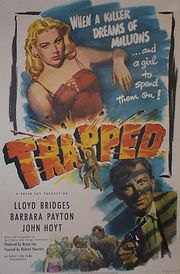
Lloydville of mardecortesbaja.com has posted a good review of these two noirs: Trapped (1949) and Crime Wave (1954)

FilmsNoir.Net – all about film noir
the art of #filmnoir @filmsnoir.net | Copyright © Anthony D'Ambra 2007-2025
Lloydville of mardecortesbaja.com has posted a good review of these two noirs: Trapped (1949) and Crime Wave (1954)

Filmsquich.com has posted an interesting review of the Akira Kurosawa noir Drunken Angel (1948) aka Yoidore Tenshi. Kurosawa’s other noir feature is the excellent High and Low (1963) aka Tengoku To Jigoku. Both movies star the uber cool Toshiro Mifune.
Filmquish has also reviewed another early Kurosawa drama as noir: Stray Dog (1949) also starring Mifune.
Full list Filmsquish noir reviews:
13 Tzameti (2006)
Ace In The Hole (1951)
Angel Face (1952)
Angel Heart (1987)
Big Sleep, The (1946)
Blade Runner (1982)
Drunken Angel (1948)
Element Of Crime, The (1984)
L.A. Confidential (1997)
M (1931)
Man Who Knew Too Much, The (1934)
Man With the Golden Arm, The (1955)
Notorious (1946)
Reckless Moment, The (1949)
Rififi (1955)
Se7en (1995)
Shadow Of A Doubt (1943)
Sin City (2005)
Stage Fright (1951)
Strangers On A Train (1951)
Stray Dog (1949)
The Maltese Falcon (1941)
Third Man, The (1949)
Wrong Man, The (1956)

I caught up with Detour (1945) today, and must say I think director, Edgar G. Ulmer, is taking us for a a ride. The whole affair is hard to take seriously. The story of a guy so dumb he blames fate for the consequences of his own foolishness. Though fun to watch is Ann Savage, asVera, the street-wise dame, who incredulously falls for the sap. A camp oddity, but hardly serious noir.
I am very ambivalent about Detour. I can see the craft and that it is unlike any other Hollywood film of the period, but the story is so sappy that it irks. The story is based on the pulp novel by Martin M. Goldsmith, and the plot is essentially lifted straight from the book, which is pretty naif and while having a certain charm epitomises cheap pulp.
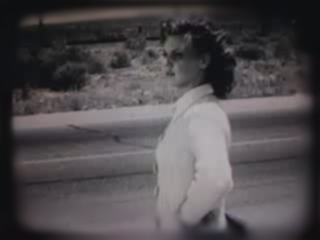
Ann Savage’s portrayal of Vera is memorable . She is no femme-fatale, she is a dame on the skids and desperate for any scheme to get here out of the hole she is in, and by the way she is dying, and knows it. She is not from hell. She is tough but she is also a woman. She does not ‘make’ Haskell but scrapes the skin off his hands with her fingernails when he gets fresh. She is vulnerable and needs love as much as the next dame. Look at when we see her on the highway hitching for a ride, and then in the scene in the hotel room just before she dies. The woman is tainted yes, but she has an integrity that shines through the cheap bravado. My poem for Vera is here Vera: No Detours.
Another issue. To understand Hollywood noir you have to understand b-movies. I love to quote Jean Renoir on this. In the book, The Early Film Criticism of François Truffaut by Wheeler Dixon (Indiana University 1993), there is an interesting section that deals with the obvious influence on Truffaut of Hollywood b-movies, particularly film noir. According to Dixon, Truffaut and even his mentor, Jean Renoir, preferred b-features over a-productions.
In a 1954 interview, Renoir was quite emphatic:
“I’ll say a few words about Val Lewton, because he was an extremely interesting person; unfortunately he died, it’s already been a few years. He was one of the first, maybe the first, who had the idea to make films that weren’t expensive, with ‘B’ picture budgets, but with certain ambitions, with quality screenplays, telling more refined stories than usual. Don’t go thinking that I despise “B” pictures; in general I like them better than big, pretentious psychological films they’re much more fun. When I happen to go to the movies in America, I go see “B” pictures. First of all, they are an expression of the great technical quality of Hollywood. Because, to make a good western in a week, the way they do at Monogram, starting Monday and finishing Saturday, believe me, that requires extraordinary technical ability; and detective stories are done with the same speed. I also think that “B” pictures are often better than important films because they are made so fast that the filmmaker obviously has total freedom; they don’t have time to watch over him.”
This is where the skill and artistry of Ulmer’s Detour are to be found.

San Francisco’s Bay Area Reporter has published a good article, Double-crossed in the City of Lights, on French noir director Herman Melville, centered around his film Le Doulos (1962), playing August 17-23 at the Castro.

I am ambivalent about Pickup On South Street. Somehow the gestalt is off: the whole is not greater than the sum of the parts.
A weak story is propped up by Sam Fuller’s spirited direction and strong performances from the two female leads. Thelma Ritta received a deserved Academy Award Nomination for her role as the bag lady with soul. Jean Peters is great as the gutsy B-girl, and Richard Widmark makes the sparks fly in his scenes with Peters. The repartee in Fuller’s script is great and adds to the enjoyment. But I was left flat by the pat resolution and feel-good ending.
While Pickup On South Street is not readily identifiable as a noir as it does not follow the genre’s conventions, there is a noir sensibility. Flawed characters are portrayed sympathetically and redeemed by their essential humanity. As Fuller said in a 70s interview, he is not really concerned with the wider “reds under the bed” plot, but with how the drama of the lives affected plays out.

But the flaws in the film are there and limit its impact. The strongest scene in the film should have been when the bag-lady, Moe, confronted late at night in her apartment by the commie stooge, goes into a relatively long monologue on her fate. An excellent performance by Thelma Ritta is undermined by an unconvincing delay, as the stooge waits for her to finish her story (which he is patently not interested in) before plugging her.
Recommended but over-rated.

From director, Jules Dassin, whose earlier films included the noirs, Brute Force (1947) and The Naked City (1948), Thieves’ Highway about the struggles of truckers trying to make a buck hauling fruit to the San Francisco produce markets, is great melodrama with a strong social conscience. It tells a story strongly rooted in the southern European migrant experience.
The screenplay was adapted by Albert Isaac Bezzerides from his novel Thieves’ Market (1949). Bezzeridis’ noir credits include Desert Fury (1947), Kiss Me Deadly (1955), On Dangerous Ground (1952), and They Drive by Night (1948). Dassin was blacklisted by the HUAC and left the US before the final cut was made, and word has it the studio axed his original “noir” ending and added a “happy-ending” re-take.
But even with a darker ending, I would not say it is a film noir. The protagonist, a straight-up guy, Nick Garcos, wants to avenge his Greek father’s maiming by a crooked wholesaler and risk his last dime on a freight trip that will give him the stake he needs to settle down with his hometown sweetheart – the perfect role for Richard Conte. The other femme is an Italian good-time girl, played beautifully by Italian actress, Valentina Cortese, who never really wants to hurt him, but is only drawn into the story by the conniving of the wholesaler, Mike Figlia, gleefully played by Lee J. Cobb.
What struck me is how well each of the main characters is drawn, and how the rush to get the load of apples to the market, propels the story, and the character development. The most potent scene is when Nick is pinned under his truck after the changing of a flat tyre goes wrong, just off the busy highway, where a never-ending stream of trucks rip through the night: the world is not going to stop for one poor guy stuck under his truck. Nick does survive after he is rescued by his erstwhile shady partner. This exemplifies a wonderful quality of the film: each character has a chance at redemption – only Figlia and his henchmen are too rotten achieve it.

Filmically it is also a great testimony to all who worked on its production. The atmosphere of the Frisco produce markets is rendered so convincingly, that it has a cinema verite quality.

I feel qualified to say this as this is one of the very rare times, I can directly relate to what is happening on the screen. I grew up in a small corner fruit store run by my immigrant parents in a working-class suburb of Sydney – a big harbour city with a produce market at it’s center. My father is Italian and my late mother was Greek. It was a struggle and we opened 7 days a week. During school vacation my father would wake me at 4am weekdays for the trip to the city markets, where I would haul the long barrow behind him, as he moved from stall to stall haggling to find produce at a price that he could sell and make a buck. This movie connected for me deeply.
Thieves’ Highway: a good story well told, and worth remembering.

Clydefro on his filmjournal.net blog has posted an interesting review of They Live By Night (1948) the first feature of director Nicholas Ray, in which Clydefro firmly establishes Ray’s auteur credentials.
While Clydefro’s exploration of They Live By Night is original and penetrating, I don’t quite agree with his take on the noir Outsider:
“Watching They Live by Night, I was reminded of the music of Bruce Springsteen and, specifically, the song “Atlantic City” off his Nebraska album. Both artists were able to locate the pulse of the outsider, someone not particularly special in any way but undeniably American in spirit and attitude. The idea of bettering one’s self and family, even if it means turning to crime or working outside the margins, is a recurring theme in both men’s work. Of course, Ray put his finger on this pursuit some twenty and thirty years before Springsteen.”
To me the persona of the outsider is more complex, and a universal (not parochial) archetype. The outsider is outside bourgeois society and does not share its aspirations, and in the noir genre this is manifested generally but not always in criminality. Ray and Springsteen both share this wider vision: consider Ray’s In A Lonely Place (1950) and Springsteen’s Streets Of Philadelphia.
They Live By Night is one of the 10 films noir released on July 31 by Warner Home Video in the Film Noir Classic Collection, Vol. 4
This page provides a full listing of directors credited with a film noir, and the films noir for each director.

TIME magazine film critic, Richard Schickel, has written an article on film noir for the Wilson Quartely, which has been published on-line: Rerunning Film Noir. Generally an excellent historical overview, with some interesting movies discussed, but in some aspects unsatisfying:
Noir, despite its Frenchified name, is a truly American form, as Alain Silver and Elizabeth Ward observe in Film Noir: An Encyclopedic Reference to the American Style (1979). Yes, many of its leading directors (Fritz Lang, Billy Wilder, Jacques Tourneur, André de Toth) were born in Europe and well versed in expressionism. But their source—often directly, always at least indirectly—was the American crime fiction of Dashiell Hammett, Raymond Chandler, James M. Cain, W. R. Burnett, and others. Almost all noir actors and many of the directors’ significant collaborators (cameramen, editors, etc.) were American born and certainly American trained.
This dismissal of the influence of the European directors is defensive, and does not help readers to understand the real influence of these expatriate directors. Schiekel seems to deride the autuer influence of artists like Wilder, Siodmak, Lang, Tourneur, and others. Existentialism is not even mentioned: the noir anti-hero is more of an outsider than an urban refugee. And of course the French recognised and named the genre, and provided an analytical framework.

After my post of Aug 4, In A Lonely Place (1950): The “Creative” Outsider, I watched In a Lonely Place

François Truffaut wrote that the essential theme of Ray’s films was “moral solitude,” and Jacques Rivette argued that Ray was concerned with “the interior demon of violence, which seems linked to man and his solitude.” (p. 26)
These themes are clearly evident in In a Lonely Place
Nicholas Ray uses powerful imagery to visualise this alienation. Dixon Steeles’ apartment is on a lower level to his lover’s. He must walk up to see her and when he leaves for the last time, he must walk out and down a stairway. The strongest imagery is in the design of Steele’s apartment where prison-like bars are virtually everywhere – even in the patterns of curtains:


And in almost all interior scenes having the view from windows obscured by the lateral bars of closed venetian blinds reinforces the mood of alienation.

 FilmsNoir.Net - all about film noir