The Killers (1946) Revisited: Noir As Tragedy

The screenplay for The Killers by Anthony Veiller, Richard Brooks, and John Huston (uncredited), is not so much an adaptation of Hemingway’s short story (1927), but an imaginative response and more strongly a rebuttal to the last few lines at the end of Hemingway’s text spoken by Nick Adams, the guy who runs from the diner to warn Ole Anderson (‘the Swede’) of the Killers’ arrival:

“I’m going to get out of this town”, Nick said… “I can’t stand to think about him waiting in the room and knowing he’s going to get it. It’s too damned awful.”

After establishing the absolute resolve of the killers in the opening sequence, which is essentially faithful to Hemingway’s text, the film ventures on to explore the burning questions in the mind of the audience. What did the Swede do to warrant this retribution? Why doesn’t he run? In pursuing the story, the film’s ethos is that it takes courage not cowardice to confront and accept an inevitable – even violent – death.

The Killers (1946)

In Hemingway’s text the Swede’s explanation to Nick is “I got it wrong”, but this is changed in the script to “I did something wrong – once”. These stronger words are the fulcrum of the picture. Ole’s repentance is established from the outset and his tragic redemption seared into the viewer’s sympathies even before his story unfolds. How the script and the director, Robert Siodmak, construct the narrative using flashbacks and the continuum of the insurance investigation is a lesson on filmic technique.

The ‘rap sheet’ read to insurance investigator, Jim Reardon, by his secretary, tells us that despite Ole losing his parents at a young age, he managed to grow up straight in a tough neighbourhood until after his career as a boxer is ended by an injury in his last fight, when he falls in with the wrong crowd, and ends up in the numbers racket. Ole’s life from that fight to his death is a story of betrayal. In the dressing-room after the fight, he is dumped by his manager and trainer without empathy or ceremony. Later, his childhood friend, a cop, let’s him take the rap for the femme fatale, who then goes on to betray him again when she enacts the final double-cross.

A decent man destroyed by fate: the stuff tragedy is made of.

The Killers (1946)

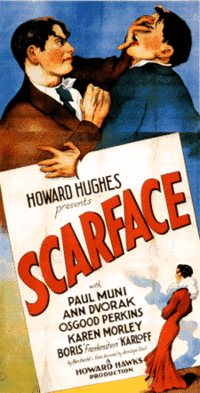
New DVD: Scarface (1932)

Scarface 1932

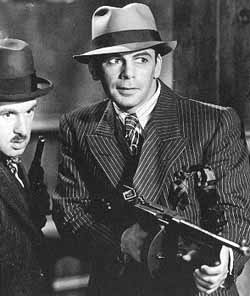
Scarface (1932) directed by Howard Hawks and starring Paul Muni, the proto-ganster flick, has just been released on DVD from a pristine transfer. Buy the DVD

The New York Times review yesterday by David Kehr:

this is the greatest of the early-30s gangster films. Paul Muni, in what would remain his most uninhibited performance, is the simian title character, a thinly disguised Al Capone who machine-guns his way to the top of the Chicago rackets. (In a darkly playful touch, each of his assassinations is marked, somewhere in the frame, by an X.) Universal has made a new transfer of this essential title, making it available for the first time on DVD apart from its perverse inclusion as an extra in the deluxe edition of Brian De Palma’s dimly satirical, ultraviolent 1983 remake with Al Pacino.

Hawks’ film begins as an uncomfortably exhilarating comedy about the joys of unchecked desire, and ends as an expressionistic horror movie with howls of madness and intimations of incest. This disc includes a censor-pleasing alternate ending in which Muni’s Tony Camonte is caught, convicted and hanged, instead of going down, still a compelling force of nature, in the heat of battle.

Scarface 1932

Film Noir’s Anti-Hero: The Outsider

Film Noir’s Anti-Hero: The Outsider

The Outsider’s case against society is very clear. All men and women have [these] dangerous impulses, yet they keep up a pretence, to themselves, to others; their respectability, their philosophy, their religion, are all attempts to gloss over, to make look civilized and rational something that is savage, unorganised, irrational. He is an Outsider because he stands for truth… the Outsider is a man who cannot live in the comfortable, insulated world of the bourgeois… because he stands for Truth. What can be said to characterise the Outsider is a sense of strangeness, or unreality… The Outsider is a man who has awakened to chaos… Even if there seems no room for hope, truth must be told… chaos must be faced.

Colin Wilson – The Outsider (1956, Gollanz, London)

The Killers (1946): Fata Morgana

The Killers (1946)

Insurance detective unravels the killing of a washed-up boxer.

– Steve H. Scheuer, Movies on TV and Video.

One of my favorite films noir. Burt Lancaster plays the former-boxer turned hoodlum with elegance and style, and Ava Gardner is hot as the femme fatale. A brilliant narrative technique by director Robert Siodmak, employing flash-backs and the story of an insurance investigation to hold it all together, produces a taut and entertaining movie.

Like most great noirs, this picture transcends the genre and is not only a story of greed, love, and betrayal, but is also about loss, friendship, innocence, and the brutal realities of trying to make a buck in a hostile world. There is a wider socio-historical context, which is more than ably discussed by Jim Groom in a recent post on his BavaTuesday blog.

The Killers (1946)


Film Noir: “All I can see is in the frame”

Out Of The Past (1947)

Tonight I came across a deeply interesting paper by fellow Australian, Rafaelle Caputo, titled Film noir: “You sure you don’t see what you hear?, published in the Australian Journal of Media & Culture (Vol5 No 2 1990). Caputo studied cinema at La Trobe University and has been a writer on film for over 15 years, contributing to various journals and newspapers. The title of the paper includes a line from Out of the Past (1947).

The paper is scholarly, but has something very important to say to all fans of the genre:

There certainly is something one can point to called film noir, which starts and stops at certain points in time, which has been written about and tabled in the history of cinema, and which has been the focus of much critical debate. Equally, however, there tends to exist another film noir whose style seemingly departs from that tradition, locked away in a kind of time capsule, but which forms it own delicate lines of tradition, continuing to creep around. Finally, I feel the best way to proceed in the reading of film noir is along a path suggested by another line from Out of the Past: “All I can see is the frame … I’m going inside to look at the picture”.

Caputo’s thesis is that defining a movie as a film noir derives from it a having a “noir sensibility” rather than fitting a pre-defined template of rules or guidelines. His argument is coherent and established, inter alia, by reference to a set of films made in Hollywood over a period ranging from the 40s though to the 70s. His analysis of Out of the Past is so brilliant it makes you want to tear away and watch that timeless work yet again.

The film [Out of the Past] opens with exterior shots of an expansive landscape of mountains and forest dissolving into each other while the credits fade-in with each dissolve, until finally there is a dissolve into a stretch of highway with a road sign in the foreground pointing directions and distances for various towns. Into the shot drives a black car, casually travelling into the distance of the frame; then a cut to a travelling-shot from the rear of the car, at an angle over the shoulder of the figure dressed in black behind the steering wheel. The shot knits our point of view with his as we pass another road sign indicating the approaching town of Bridgeport. This shot is maintained until the car pulls into a gas station, but as soon as the car comes to a halt there is an almost immediate cut, still from the same camera position but at a slightly lower angle. The gas station building now takes up most of the screen space, horizontally spilling onto the road from left of frame, and in view atop the building is another sign set off against the clouds which reads ‘Jeff Bailey’. This slight change in camera angle gives the impression of the building jutting out into the car’s diagonal path as though it has forced the black-clad figure of Joe Stefanos to stop abruptly rather than stop by his own volition…

Caputo convincingly argues that Klute (1971) is not a noir. It is interesting that the forthcoming NYC Noir noir festival organised by Film Forum includes a screening of Klute.

Other films noir referred to in the article:

The Killers (1946) and The Killers (1964)
Kiss of Death (1947)
Kiss Me Deadly (1955)
Twilight’s Last Gleaming (1977)

New York City Noir: Dark Dangerous Corrupt Sexy

The Taking Pelham 123 (1974)

The NY Times today published an article, Noir and the City: Dark, Dangerous, Corrupt and Sexy, by Terrence Rafferty, covering the N.Y.C. Noir film noir festival organised by Film Forum starting Friday. See my post of July 11 for the full program.

Rafferty reviews the major pictures and the article is supported on-line with high quality stills.

GUILT, desire, fear, ambition and the bad behavior those human frailties give rise to are the favored themes of the sort of film we now call noir. So it’s hardly surprising that a fair number of these pictures are set in New York City, where guilt, fear, desire, ambition and bad behavior are pretty much a way of life. Any city will do, of course, because all cities generate a certain amount of the anxiety that film noir feeds on. And all cities, somewhere, have dark, scary streets that can, in noir’ violent allegories of moral ambiguity, stand in for the dimmer, grubbier recesses of the soul. But New Yorkers pride themselves on having more of everything than people in other cities do. If noir is the great urban style of the movies and it is then New York City is surely the noirest place on earth.  More

The Asphalt Jungle (1950): When The City Sleeps

The Asphalt Jungle (1950)

The The Asphalt Jungle adapted by Ben Maddow from the novel by R.W. Burnett is a movie with soul. A film that treats every character in the story as someone with a life worth knowing: the essence of a film noir. The command by director, John Huston of his story, his ensemble players, and the filmic context is profound and breathtaking.

From the opening shots, dramatised by the almost post-modern score of Miklos Rozsa, you know you are entering the realm of a great film-maker:

The Asphalt Jungle (1950) The Asphalt Jungle (1950)

The Asphalt Jungle (1950) The Asphalt Jungle (1950)

Throughout this opening sequence we hear the police radio chatter from inside the police car, but the visuals are never disturbed by a cut to inside the vehicle.

I will not cover territory more ably explored by others, but will focus on one scene that transcends melodrama and the noir genre. Safe-cracker Cavelli after being wounded during the robbery is seen in the background dying in his marital bed, through the open door of the bedroom from the kitchen of his apartment, where his distraught wife, Maria, beautifully played by Teresa Celli (who appeared in bit parts in only a handful of movies before moving into obscurity in 1953), at the kitchen table admonishing the hunchback getaway driver, Gus, for bringing this tragedy upon her young family.

The Asphalt Jungle (1950) The Asphalt Jungle (1950)

Maria has the best line in the picture. As a police siren wails in the background:

“Sounds like a soul in hell.”

Crossfire (1947)

Crossfire (1947)

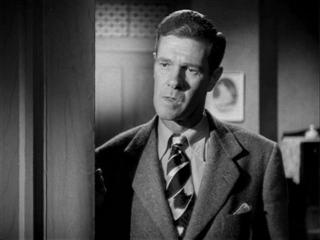
Crossfire may have some historical interest for Gloria Grahame fans, but I don’t see it as a noir. It is a good B crime picture, but the only complexity is found in the peripheral characters of the taxi dancer and her strange boyfriend. It is predictable and too overtly preachy to sustain a deeper analysis. The main players are not deeply drawn and there is no real tension.

Crossfire (1947)

Paul Kelly, as the weird spurned lover of taxi-dancer Ginni, steals the film:

You know what I just told you – it’s lie…

Do you believe that – that’s a lie too…

The Killing (1956) – Great But Not Noir?

The Killing (1956)
Stanley Kubrick’s The Killing is a great movie but it is not a film noir. Essentially it is a classic heist gone wrong story filmed in noir style. The view expressed in Steven H.Scheuer’s Movies on TV (1993-94) though brutal is fair: “Crooks plan a daring race-track robbery. Direction by Stanley Kubrick, a newcomer at the time, is unnecessarily arty but interesting.”

For me the most interesting scene is in the Chess parlor where the caper’s mastermind played by Sterling Hayden, recruits a heavy to start a distracting bar-room brawl at the track. The heavy is played by Nicholas (‘Kola’) Kwariani, a professional wrestler and wrestling promoter, and dedicated chess player who frequented “The Flea House” in New York City, which is also where this recruitment scene was filmed. As far as I know this was his only screen appearance ever!

The Killing (1956)

Kwariani has the best lines in the movie, and delivers them with a thick Eastern European accent and a perfect world-weary understanding of exactly what he is saying :

Johnny Clay (Sterling Hayden)
Maurice Oboukhoff (Kola Kwariani)

Johnny: Good game, Maurice?

Maurice: Johnny, my old friend. How are you?
Good to see you. Been a long time, eh?
How long have you been out?

Johnny: Not long.

Maurice: It was difficult, no?

Johnny: Yeah.

Maurice: Very difficult.
You have my sympathies, Johnny.
You have not yet learned that you have to be like everyone else.
The perfect mediocrity.
No better, no worse.

Individuality is a monster, and it must be strangled in its cradle to make our friends feel comfortable.

You know, I often thought that the gangster and the artist are the same in the eyes of the masses. They’re admired and hero-worshipped, but there is always present an underlying wish to see them destroyed at the peak of their glory.

Johnny: Yeah…

Download the full dialog transcript of the screenplay from Drew’s Script-O-Rama.