Director’s cut of Metropolis found

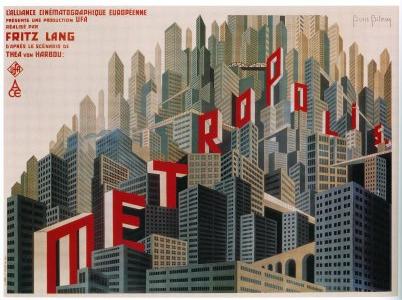
Metropolis (1927)

The long-lost original print of a Fritz Lang’s silent masterpiece, Metropolis (1927), has been found in Argentina.

The original 3½-hour film was believed lost  after its US distributor, Paramount, cut it by 30 minutes after a poor reception from critics. But the German newspaper Die Zeit has reported that a copy of the original was sent to Argentina in 1928, where it has been gathering dust in the Buenos Aires Film Museum.

The lost footage, some of which is badly scratched, includes battle scenes and sections that flesh out a number of subplots and characters. Paula Felix-Didier, the curator of the museum, viewed the film only after a chance remark from a projectionist, who noted that it was longer than other versions. A film restorer who has seen the new footage said the film had its rhythm back. Source: The Telegraph – London

Samuel Fuller Restrospective in St. Louis

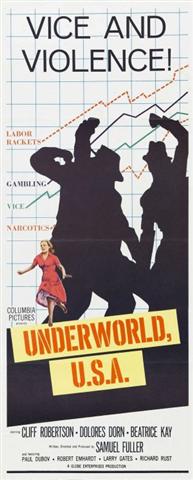
Underworld USA (1961)The Webster University Film Series will present a Samuel Fuller film each Thursday through July, starting tonight with his directorial debut, I Shot Jesse James (1949).

Coming up:

Pickup on South Street (1949) – July 10
Underworld, U.S.A (1961) – July 17
Shock Corridor (1963)  – July 24
The Big Red One (1980) – July 31

San Quentin (1946): B-noir filler

San Quentin (1946)

Ex-con on parole tracks down escaped con who tried to kill him after a prison bust and a trail of violent robberies (RKO 70min)

San Quentin (1946), an early RKO factory job, not to be confused with the early Bogart movie of 1937, is a shoot-em-up with a message, complete with a real-life intro from an ex-Warden of Sing-Sing.

Tough guy actor, Lawrence Tierney, the bad-guy from The Devil Thumbs A Ride (1947), plays it straight as the defender of a prison reform program under threat, who falls under suspicion for the attempted murder of a cop after a violent prison escape. The direction is tight and the night scenes are nicely lit in noir fashion.  A mean on-the-streets car chase and a gripping hand-to-hand climax tie the ribbon on this one.

San Quentin (1946)

This is the original NY Times review from 1947:

“As an attempted deviation from the normal prison melodrama, “San Quentin,” which made its appearance at the Gotham on Saturday, suffers the curse of a split personality. For the story line of this offering forks between seriously extolling self rehabilitation among convicts and straight cops-and-robbers adventure. And, rather early in its course, the yarn about an ex-prisoner and founder of San Quentin’s Inmates Welfare League, whose good work is nearly wrecked by an escaped killer, strays from its noble intentions to settle down to a traditional manhunt. From there on the going is normal, prosaic and only occasionally exciting.

Lawrence Tierney, whose screen portrait of Dillinger made that outlaw a paragon of hate, violence and bad temper, is the grim lad who seeks the killer, to vindicate the good names of the warden and the League. Mr. Tierney makes an indomitable, two-fisted, steely-eyed and tight-lipped tracker. But he is a sleuth—a man under parole at that—who shuns the aid of the law, a circumstance which is rather difficult to nationalize. As a man who has crashed out of countless cinema jails, Barton MacLane is thoroughly acceptable as the apparently reformed bank robber who escapes to sully the League’s escutcheon. As a climactic touch, the hand-to-hand showdown between MacLane and Tierney, makes quite an edifying donnybrook. Marian Carr and Joe Devlin as Tierney’s girl friend and sidekick, respectively; Harry Shannon and Tony Barrett handle some of the principal roles. And, though former Warden Lewis E. Lawes of Sing Sing sounds a note of approval in the prologue, “San Quentin” can hardly be listed as a documentary.”

Philip Marlowe: not so hard-boiled…

philip marlowe

From Raymond Chandler’s novel, Farewell, My lovely (1940):

It got darker.  I thought; and thought in my mind moved with a kind of sluggish stealthiness, as if it was being watched by bitter and sadisitic eyes. I thought of dead eyes looking at a moonless sky, with black blood at the corners of the mouths beneath them…

It got darker. The glare of the red neon sign spread farther and farther across the ceiling. I sat up on the bed and put my feet on the floor and rubbed the back of my neck.

I got up on my feet and went over to the bowl in the corner and threw cold water on my face. After a little while I felt a little better, but very little. I needed a drink, I needed a lot of life insurance, I needed a vacation, I needed a home in the country. What I had was a coat, a hat and a gun. I put them on and went out of the room…

‘I’m scared,’ I said suddenly. ‘I’m scared stiff… I’m afraid of death and despair,’ I said. ‘Of dark water and drowned men’s faces and skulls with empty eyesockets.  I’m afraid of dying, of being nothing…’

The Hitch-Hiker (1953): Desert Noir

The Hitch-Hiker (1953)Two ordinary Joes driving to Mexico on a fishing trip are waylaid by a serial killer on the run (RKO 71 mins). Directed by actress Ida Lupino and based on a true story adapted by maverick writer Daniel Mainwaring. Cinematography by veteran noir cameraman Nicholas Musuraca.

Usually billed nowadays as the only film noir directed by a woman, this b-noir starts out well but fails to develop sufficient tension and a flat ending disappoints.  Lupino’s direction is adequate, but the strong opening noir-lit scenes of urban hijack and murder would be largely the work of Musuraca. Even Musuraca seems to lose it in the open spaces of the Mexican desert where most of the subsequent action is played out.

The Hitch-Hiker (1953)

Star-billing is given to Edmond O’Brien and Frank Lovejoy as the hostages, but they are constrained by their largely passive roles, and it is b-noir regular, William Talman, in a memorable portrayal as the psychotic killer, who holds the picture together.  The desperado’s savage menace and barely contained hysteria is entirely convincing, and it is this that saves the movie from obscurity.

The Big Steal (1949): “Oh Mexico”

The Big Steal (1949)

Comedy melodrama. Army officer (Robert Mitchum) is framed for a robbery and sets off after the culprit in a wild car chase across Mexico with a swell girl (Jane Greer). A hoot! Directed by Don Seigel and written by Gerald Drayson Adams and Geoffrey Homes from a story by Richard Wormser.

Last year in an insightful post on Mexico and Film Noir on his mardecortesbaja.com blog, Lloydville said: “Greer and Mitchum in Out Of the Past have their romantic idyll in Mexico but can’t bring the magic of it back with them to the States.  This fits in with the notion of Mexico as a lost or unattainable paradise.  But sometimes the idea of Mexico went to filmmakers’ heads – they got giddy with the possibilities of it.  Films that started out noir would, once they crossed south of border, turn into larks, light-hearted and feckless. Re-teamed in The Big Steal, Greer and Mitchum venture into Mexico to try to extricate themselves from typical noir predicaments involving betrayal and unjust accusation, but the dark clouds vanish almost immediately – they find love and high-spirited adventure instead of noir’s dark, impenetrable maze, and all ends well.  Film noir expert Elizabeth Ward amusingly suggests that The Big Steal ought to be labelled fiesta noir…”

The Big Steal is a fun ride with a nice twist at the end that leaves you wanting more. Mitchum and Greer are magic together.  There are really funny running gags with Greer delivering great lines with wit and charm: any guy with blood in his veins will fall for her in this picture.

The Big Steal (1949)

The supporting cast is strong, with a great turn by the veteran Mexican-born  actor Ramon Novarro as a wiley Mexican police inspector, who has some magic lines. The scene where Greer fabricates an elopement story for the soft-hearted foreman of a road-gang is high farce infused with a true empathy and affection for the romance of Mexico and her people. This affection permeates the whole film with a sense of true liberation.  The bouncy Mexican musical soundtrack echoes this mood of fun and adventure.

Two of my favorite songs reflect this love of Mexico: Elvis singing Mexico (Tepper,Bennett) in his 1963 movie Fun In Acapulco, and James Taylor’s Mexico. Elvis sings Mexico with such joy that for as long as the song lasts his voice takes you there:

Mexico, Mexico
They’ve got muchas, mucha-chas, amigos
…Latin features, never saw such adorable creatures
…Love to dig, ooh…the nights here

We live it up and love it up amigo
Life begins when you’re in Mexico

You never order, water
When you order south of the border
…In to kiss a lovely senorita
You do the samba, la bamba
…I’ll go where you go
Life begins when you’re in Mexico

Mexico, Mexico
They’ve got muchas mucha-chas, amigos
…never saw such adorable creatures

We’ll live it up and love it up amigo
Life begins…when you’re in…MEXICO…

James Taylor’s Mexico is more plaintive and shares a longing for some mythical place:

Way down here you need a reason to move
Feel a fool running your stateside games
Lose your load, leave your mind behind, Baby James

Oh, Mexico
It sounds so simple I just got to go
The sun’s so hot I forgot to go home
Guess I’ll have to go now

Americano got the sleepy eye
But his body’s still shaking like a live wire
Sleepy Senorita with the eyes on fire

Oh, Mexico
It sounds so sweet with the sun sinking low
Moon’s so bright like to light up the night
Make everything all right

Baby’s hungry and the money’s all gone
The folks back home don’t want to talk on the phone
She gets a long letter, sends back a postcard; times are hard

Oh, down in Mexico
I never really been so I don’t really know
Oh, Mexico
I guess I’ll have to go

Oh, Mexico
I never really been but I’d sure like to go
Oh, Mexico
I guess I’ll have to go now

This love for Mexico is expressed more deeply and poetically in Jack Kerouac’s On the Road:

I was alone in my eternity at the wheel, and the road ran straight as an arrow. Not like driving across Carolina, or Texas, or Arizona, or Illinois; but like driving across the world and into the places where we would finally learn ourselves among the Fellaheen Indians of the world, the essential strain of the basic primitive, wailing humanity that stretches in a belt around the equatorial belly of the world from Malaya…to Morocco to the selfsame deserts and jungles of Mexico.

Oh Mexico…

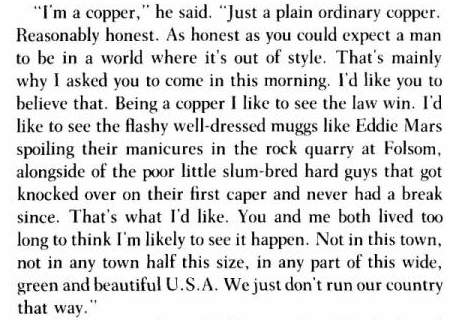
The Big Sleep: “flashy well-dressed mugs”

From Raymond Chandler’s novel, The Big Sleep (1939):

The Big Sleep - Novel - 1939

New Book on Edgar G. Ulmer

Edgar G Ulmer

A new book on the work of Poverty-Row director, Edgar G. Ulmer, who made the cult b-noir, Detour (1945), was released in May.

The book, Edgar G. Ulmer: Detour on Poverty Row, was reviewed today by Michael H. Price in the Fort Worth Business Press:

[In] Edgar G. Ulmer: Detour on Poverty Row … Editor [Gary D.] Rhodes and a well-chosen crew of contributing writers consider Ulmer in light of not only his breakthrough film, 1934’s The Black Cat at big-time Universal Pictures, or such finery-on-a-budget exercises as Bluebeard (1944) and Detour (1945), but also Ulmer’s tangled path through such arenas as exploitation films (1933’s Damaged Lives), Yiddish-language pieces (1937’s Green Fields), well-financed symphonic soap opera (1947’s Carnegie Hall), and ostensible schlock for the drive-in theaters (1957’s Daughter of Dr. Jekyll)… A perceptive chapter from Christopher Justice wonders aloud whether the writer-director might be considered “the godfather of sexploitation,” in view of the “new aesthetic terrain and … core prototypes” that can be observed in such films as Damaged Lives and Girls in Chains (1943) and The Naked Venus (1958)… Tony Williams regards Ulmer as an advancer, rather than a follower, of the “psychobiography” approach that Orson Wells had defined with Citizen Kane in 1941 — on the evidence of an often-maligned, oftener-ignored Ulmer picture called Ruthless (1948). (Ruthless stars Zachary Scott as an industrialist who might make Welles’ Charles Foster Kane look like Rebecca of Sunnybrook Farm by comparison.)

New Criterion DVD: “The Furies”

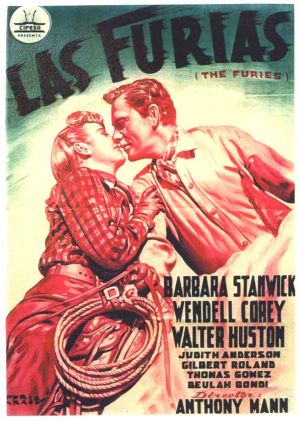
The Furies (1950)

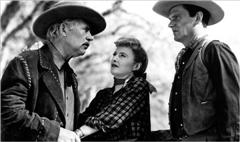
Criterion today released on DVD one of the great noir westerns, The Furies (1950) directed by Anthony Mann.

From the LA Times review by Dennis Lim:

In truth, “The Furies,” frontier setting notwithstanding, barely counts as a western. There are elements of film noir in both the plot and the look; many key scenes unfold under cover of darkness (Victor Milner earned an Oscar nomination for his moody cinematography). Above all, though, it plays like a Freudian melodrama, dissecting the hysterical and ultra-competitive love-hate relationship between widowed patriarch T.C. Jeffords ( Walter Huston) and his headstrong daughter, Vance ( Barbara Stanwyck).

From the NY Times review by Dave Kehr:

Mann gives the action a metaphysical dimension that overwhelms easy psychoanalytic readings. As in his films noirs (Raw Deal, Desperate), he systematically composes his shots to create a sense of instability, using lines of perspective or boldly massed foregrounds to pull the images off balance. The titanic struggle between father and daughter has knocked the world off its axis.

The Furies (1950)

Links:
LA Times Review by Robert Lim
NY Times Review by Dave Kehr
Criterion: The Furies
The New Yorker Review by Richard Brody
The House Next Door Review by Dan Callaghan

Rare Screenings at Fifth Annual Albuquerque Film Noir Festival

Repeat Performance

This year’s 5th Annual Noir Film Festival, which started Friday today at the Guild Cinema in Nob Hill, Albuquerque (3405 Central Ave NE  255-1848), features some rarely screened titles that should have local film noir fans very excited:

JUNE 20 & 21 (FRIDAY & SATURDAY):

The Hidden Room

DOUBLE INDEMNITY (3:00, 7:00)
Dir. Billy Wilder – 1944 – 107m

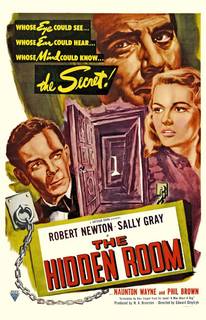
THE HIDDEN ROOM (a.k.a. OBSESSION) (5:10, 9:10)
Dir. Edward Dmytryk – 1949 – 96m – UK

JUNE 22 & 23 (SUNDAY & MONDAY):

REQUIEM FOR A HEAVYWEIGHT
The Original “Playhouse 90” Live Television Version (3:30, 7:00)
Dir. Ralph Nelson – 1956 – 90m

99 RIVER STREET (5:15, 8:45)
Dir. Phil Karlson – 1953 – 86m

JUNE 24 & 25 (TUESDAY & WEDNESDAY):
The Pretender

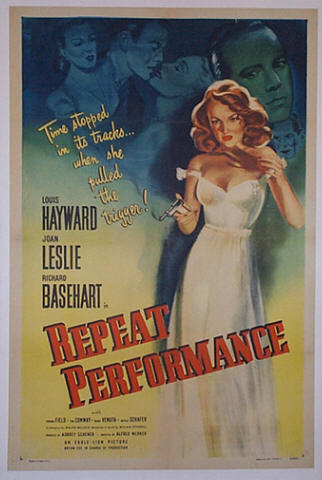
REPEAT PERFORMANCE (5:15, 8:30)
Dir. Alfred L. Werker – 1947 – 91m

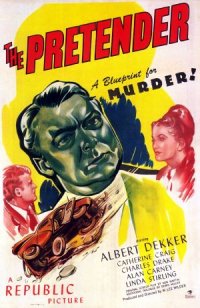
THE PRETENDER (7:00 ONLY)
Dir. W. Lee Wilder – 1947 – 69m

JUNE 26 & 27 (THURSDAY & FRIDAY):

TOMORROW IS ANOTHER DAY (3:10, 7:00)
Dir. Felix E. Feist – 1951 – 90m

KANSAS CITY CONFIDENTIAL (5:00, 8:45)
Dir. Phil Karlson – 1952 – 99m

JUNE 27 & 29 (SATURDAY & SUNDAY):

WIDMARK AND DASSIN
NIGHT AND THE CITY (2:30, 6:30)

ROAD HOUSE (4:30, 8:30)
Dir. Jean Negulesco – 1949 – 95m

JUNE 30 & JULY 1 (MONDAY & TUESDAY):

RARELY-SCREENED JOSEPH LOSEY
THE BIG NIGHT (5:30, 8:35)
Dir. Joseph Losey – 1951 – 75m

QUICKSAND (7:05 ONLY)
Dir. Irving Pichel – 1949 – 79m

JULY 2 & 3 (WEDNESDAY & THURSDAY):

CINEMATOGRAPHER JOHN ALTON IN TECHNICOLOR
SLIGHTLY SCARLET (5:00, 9:00)

JOSEPH LOSEY IN THE U.K.
THE CRIMINAL (7:00 ONLY)
Dir. Joseph Losey – 1960 – 97m – UK – Shown on digital video

JULY 4 & 5 (FRIDAY & SATURDAY):

CRY OF THE CITY (3:30, 7:05)
Dir. Robert Siodmak – 1948 – 95m

RARE SCREENING
CELL 2455, DEATH ROW (5:30, 9:05)
Dir. Fred F. Sears – 1955 – 77m


JULY 6 & 7 (SUNDAY & MONDAY):

RESTORED 35MM PRINT
THE BLACK BOOK (a.k.a. REIGN OF TERROR) (3:30, 7:00)
Dir. Anthony Mann – 1949 – 89m

STRANGE ON THE RANGE!
TERROR IN A TEXAS TOWN (5:20, 8:45)
Dir. Joseph H. Lewis – 1958 – 81m

JULY 8 & 9 (TUESDAY & WEDNESDAY):
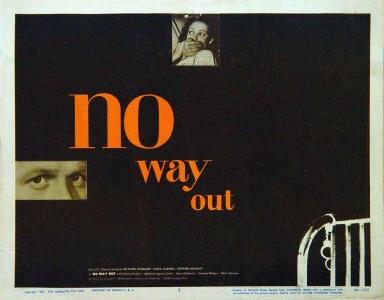
No Way Out

THE CRIMSON KIMONO (5:20, 9:05)
Dir. Sam Fuller – 1959 – 81m

RICHARD WIDMARK
NO WAY OUT (7:00 ONLY)
Dir. Joseph L. Mankiewicz – 1950 – 106m

Full details here.