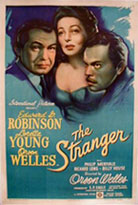
Watch , The Stranger, an Orson Welles’s noir on-line free at RetroTV. Stars Edward G. Robinson, Loretta Young, and Orson Welles. IMDB Rating 7.5/10. From the New York Times review of the movie’s recent DVD release:

FilmsNoir.Net – all about film noir
the art of #filmnoir @filmsnoir.net | Copyright © Anthony D'Ambra 2007-2026
Watch , The Stranger, an Orson Welles’s noir on-line free at RetroTV. Stars Edward G. Robinson, Loretta Young, and Orson Welles. IMDB Rating 7.5/10. From the New York Times review of the movie’s recent DVD release:

Jim Groom of the BavaTuesday Blog has written an interesting post on Robert Siodmak’s The Killers, featuring a chilling clip from the opening scene of this classic noir.
… The first 10 minutes of The Killers is noir at its meanest and most brutal, particularly because it is framed by a historical moment in which the is world reeling from the realization of the violent extremes that humanity is all too capable of. Film Noir in many ways marks the end of humanism through the filmic language and ushers in the rise of our modern era…


Watched Kiss Me Deadly
While she only appears briefly at the start of the film, the performance of Cloris Leachman as the doomed Christina, pervades the film until the cataclysmic finale. A must-see movie!
I love this Italian poster, which has taken some liberties – unless I missed the nude scene…

Near the end of Jacques Tourneur’s classic noir, Out of the Past (1947), there is a scene that must be one of the greatest compositions in American cinema:

The lighting, and the placement of the central elements, from the sofa on which Robert Mitchum rests his hand to the archway that frames Jane Greer, is brilliant. The femme fatale, Kathie Moffat, is framed in the dark background, while Jeff Bailey is highlighted in the foreground. The elemental contrast between good and evil is perfectly balanced, with the natural perspective of the lens emphasising the distance between the two protagonists. The window lattice shadow falling across the floor in the background behind Kathie enforces the perspective established by the lighting and placement of the actors. To complete the tension Kathie is clothed in saintly garb and presents a demure demeanour.
The Images Journal web site features interviews with these stellar noir directors:
Billy Wilder – A really fun interview from July 1975.

SunsetBlvd. (1950)
Wilder On Double Indemnity (1944):
Well, he was just kind of a middle-class insurance guy who works an angle. If he is that tough, then there is nothing left for Stanwyck to work on. He has to be seduced and sucked in on that thing. He is the average man who suddenly becomes a murderer. That’s the dark aspect of the middle-class, how ordinary guys can come to commit murder.
Wilder’s noirs:
Double Indemnity (1944)
The Lost Weekend (1945)
Sunset Blvd. (1950)
Ace in the Hole (1951)
Samuel Fuller – 1972 to 1976 composite of several interviews.

Pickup on South Street (1953)
Fuller on his noir movies:
When I was making these damned pictures, I never knew about film noir… To me it’s the emotion, the lies, the double-cross… that defines what kind of drama it is.
Fuller’s noirs:
Pickup on South Street (1953)
House of Bamboo (1955)
The Crimson Kimono (1959)
Underworld USA (1961)
Shock Corridor (1963)
The Naked Kiss (1964)

It is a shame the brilliant shot used for the opening credits of The Narrow Margin
Fleischer’s major noirs:
Bodyguard (1948)
Follow Me Quietly (1949)
Trapped (1949)
The Clay Pigeon (1949)
Armored Car Robbery (1950)
The Narrow Margin (1952)
Diskant’s noir credits include:
Kansas City Confidential (1952)
On Dangerous Ground (1952)
The Racket (1951)
They Live by Night (1948)
Riffraff (1947)

Ten minutes into Out of the Past, when Jeff picks-up Ann for the trip to Lake Tahoe to meet with Whit, and during which Jeff begins to tell Ann about his mysterious past in flashback, Jeff opens the car door for Ann, and while he moves to the driver side and takes the wheel, the director, Jacques Tourneur, frames Ann alone inside the divided windscreen of the car for a full 10 seconds.

It is early morning and the scene is dark with foreboding, as Jeff’s past races to catch up with him. By framing Ann alone in the car, with the dividing upright of the car windscreen closing the frame and excluding Jeff from the scene, Tourneur precisely conveys the relationship as doomed.
This is a master craftsman at work.
Tourneur’s other Hollywood noirs include:
Experiment Perilous (1944)
Berlin Express (1948)
Nightfall (1957)

Another interesting post from the mardecortesbaja.com blog:
Nicholas Ray’s On Dangerous Ground is a problematic film noir on many grounds but in an odd way it helps define the genre. More precisely, it helps us realize that film noir isn’t really a genre at all but a way of identifying a particular strain of post-WWII dread as it came to infect many different kinds of film…
Through to June 10, Astoria’s Museum of the Moving Image will present the first comprehensive retrospective of this director’s films since his death in 1997.
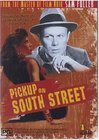
The noir films included are “Pickup on South Street” (1953) and “Underworld USA” (1961), “Shock Corridor” (1963), “The Naked Kiss” (1964), “The Big Red One” (1980) and the controversial “White Dog” (1982), a study of racial hatred that Paramount Pictures chose not to release in the United States at the time of its completion because of its subject matter.
 FilmsNoir.Net - all about film noir