Alain Silver and James Ursini have produced yet another book on film noir. This time they look at the graphics used to market noir movies. The book titled ‘Film Noir Graphics: Where Danger Lives’ is lavishly illustrated with over 300 full color posters, lobby cards, and other marketing handouts. All the graphics are rendered in high resolution from pristine originals. Many items I have not seen before, and quite a few are for more obscure films that will whet the appetite of many a noir fan.
More a coffee-table short black than a serious study, the book is one you will want to dip into between movie sessions. There is a commentary of sorts organized by chapters with titles derived from major films noir, such as ‘Touch of Evil’ and ‘Night and the City’. The narrative is a set of elaborated captions that segue into each other as you move from page to page. Silver and Ursini attempt to unify their comments by covering the use of noir motifs and how these elements are rendered by the artists who produced the artwork. Differences across studios and countries are identified. What is interesting is the artistic license taken by some artists depicting scenes and themes which are not found in the actual movie. There is a degree of repetition in the text from chapter to chapter, and sometimes the commentary jumps across pages and you find that you are not quite sure which graphic is being referred to.
Whether the US$40 price-tag is value for money is debatable. The internet is a treasure trove for poster addicts, with such sites as movieposterdb.com offering free downloads of high-res images organized in a searchable database. It comes down to the value you place on the commentary, which does offer some insights. What is missing is a wider survey of the role of graphics in movie marketing, and a behind the scenes look at who the artists were and how the material was produced.
You can buy the book from Amazon. An eBook version is not currently available.
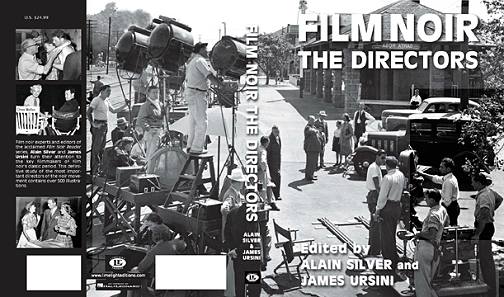
Another book on film noir directors. Do we need another? Arguably rather we need more books on film noir screenwriters, cinematographers, and composers. That said, a new book on film noir is almost always worth reading, and this goes for Alain Silver’s and James Ursini’s latest editorial effort.
Film Noir: The Directors a book of nearly 500 pages covers 28 directors and is loaded with over 500 images, mostly production stills and on-location shots of directors at work. Contributions come from the editors and a wide-range of writers, with a strong leaning toward academics. Each chapter focuses on a director with a short bio, a noir filmography, and an analysis of each of their noirs. There are very few actual frames and this is disappointing.
Most names you would expect are included: Robert Aldrich, John Brahm, Jules Dassin, André de Toth, Edward Dmytryk, John Farrow, Felix Feist, Samuel Fuller, Henry Hathaway, Alfred Hitchcock, John Huston, Fritz Lang, Joseph H. Lewis, Joseph Losey, Ida Lupino, Anthony Mann, Max Ophuls, Gerd Oswald, Otto Preminger, Nicholas Ray, Don Siegel, Robert Siodmak, Jacques Tourneur, Edgar G. Ulmer, Raoul Walsh, Orson Welles, Billy Wilder, and Robert
But there are major omissions which I find hard to fathom: auteurs like Abraham Polonsky, Robert Rossen, Richard Fleischer, Vincent Sherman, Rudolph Mate, and Phil Karlson, spring to mind. The editors acknowledge there are omissions in their Introduction, and put them down to a rather cryptic rationale “the best directors are not necessarily the best examples”, and they don’t elaborate. The result is that a number of seminal and important films noir are not included in this otherwise comprehensive compendium.
In a book about directors one shouldn’t complain of that focus, but despite acknowledging the contributions of writers there is a tendency in the essays to conflate story elements as the work of the director. Certainly many noir directors were closely involved in the development of scripts, but the contribution of the scenarist demands greater recognition. Equally the contributions of the cinematographer and the composer in major noirs were integral to the output, with a director’s better movies often made in collaboration with a particular DP or with the aid of a great score.
After recently viewing Felix Feist’s The Threat (1949), in this post I have chosen to look at the chapter on that director by noir writer and blogger Jake Hinkson. Hinkson offers analyses of Feist’s four noir films:
Hinkson’s writing is rather flat, in keeping I suppose with the book’s academic slant. He reads rather too much into these movies which are solid b’s and, apart from The Man Who Cheated Himself, not highly distinguished. Tellingly Feist was said to see himself not as an artist or craftsman, but as a story-teller as related by his son in an interview with Hinkson.
The Threat (1949)
Hinkson uses the concept of POV (point of view) as a fair (but less then revelatory) approach in studying the dynamics of the noir protagonist’s interaction with the other characters in these films. In doing so Hinkson confuses the story told by the script with the director’s rendering of the playbook, by talking about a character’s POV as both a visual device and as an element of the story. While Hinkson is aiming to highlight how the director uses mis-en-scene to give visual cues to the dominance of the protagonist in each of the movies under discussion, the character’s actions are largely self-evident. (It is also hard to reconcile Hinkson’s focus on an aggressive protagonist with concluding his essay by saying that Feist consistently portrayed “weak-willed male protagonists”.) In any event it is the screenplay that determines this and Feist wrote the scenario for only one of these pictures, The Devil Thumbs a Ride, which was based on the 1937 novel by Robert C. Du Soe. I am happy with Hinkson’s solid treatment of that movie, though it is the strength of Lawrence Tierney’s perverse characterisation as the bad guy that distinguishes it from other b’s of the period.
Hinkson’s reading of The Man Who Cheated Himself, which I consider Feist’s best noir, is problematic. Oddly, Hinkson sees it as Feist’s weakest noir. In this film Feist goes beyond the confines of the b-picture and presents an overt moral ambivalence and a complex conflicted protagonist. Hinkson considers that Feist fails to convince the viewer of Lee J. Cobb’s infatuation with wealthy socialite Jane Wyman. He describes her as “sexless” and asserts “that Feist has a characteristic lack of interest in eroticism”. To the contrary, I think Wyatt is great in her role as the selfish society dame getting her kicks with an aging cop. Her narcissism and predatory sexuality are there – just not delivered with a sledgehammer. Ironically Hinkson later in his review of Tomorrow Is Another Day describes the relationship of the two lovers on the lam as an “amour-fou”. (Incidentally Hinkson fails to acknowledge that this amour-fou develops into a stable almost banal domestic intimacy that precipitates the protagonists’ redemption. In The Devil Thumbs a Ride there is also a strong sexual undercurrent with one of the abducted woman attracted to the violent Tierney.)
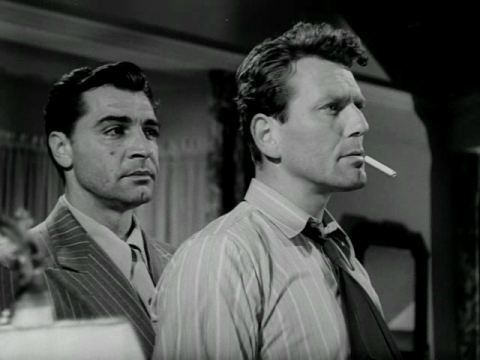
The Threat (1949) is an interesting screener. A vicious killer and gang-boss played by chronic bad-guy Charles McGraw breaks out of prison and hatches an elaborate plan to high-tail it to an isolated air-strip in the California desert where an accomplice will fly him out of the country. For vengeance and insurance he abducts the cop and the DA who put him in stir, and the ex-girlfriend of his plane-flying accomplice. (He thinks the dame sold him out to the cops.)
What is interesting is that McGraw’s protagonist is ruthlessly intelligent, hatching a wily ruse to get him past police road-blocks. Immediately after the break he repairs to a neat suburban home to lay low while he abducts his captives and readies his trip to the desert in a removalist’s van. Hinkson does a good job of dissecting the structure of Feist’s direction and his use of mis-en-scene. Although he incorrectly describes the staging hide-out as a “flop house”, and thereby misses a pivotal symbolic element.
McGraw holds the whole thing together and the scenario plays out in a decidedly subversive way. McGraw fails only because of chance after persistently outwitting the cops and the machinations of his hostages when they get the jump on him. His dénouement is one of retribution and driven by very primal instincts.
I hope to review other chapters in the coming months.
American films noir from the classic cycle have essentially the same narrative structure as other Hollywood movies, and that the entertainment value of a movie lies in the delicate balancing of pleasure and anxiety.
Yesterday I started reading Frank Krutnik’s ‘In a Lonely Street: Film noir, genre, masculinity’ (2001), a book which explores the film noir narrative structure as a defining element with a focus on movies of the 1940s. Early on Krutnik argues that American films noir from the classic cycle have essentially the same narrative structure as other Hollywood movies, and that the entertainment value of a Hollywood movie lies in the delicate balancing of pleasure and anxiety. Krutnik says that “In submitting to an engagement with the fictional process, the spectator offers in exchange not just money (at the box-office) but also a psychical/emotional investment.” (p 5)
For me anxiety and the more prevalent downbeat resolution of the narrative in film noir are the defining aspects.
Krutnik outlines the classic Hollywood narrative in these terms: a crisis or destabilizing event occurs that is resolved by an heterosexual male to impress and win a passive female. (Any over-simplification is to my account.) Where noir diverges is that the male is typically an anti-hero, the female not passive and many times the protagonist. The latest movie I have watched nicely illustrates this.
A Dangerous Profession an RKO b from 1949 is an undistinguished crime movie competently made and well-acted. A former cop turned bail bondsman is asked to bail out a guy charged with a heist and the killing of a cop, and who is the husband of a former lover, and he lets his infatuation take-over. The woman is attractive and we are not sure she can be trusted, but she does little anyway. The protagonist has to sort things out after the husband jumps bail and is murdered. He solves the mystery, apprehends the crooks, and gets the girl. Order is re-established. Some have classified this movie as noir, which it clearly isn’t. A film noir would probe the psychology of the protagonists and perhaps uses expressionist stylistics to represent mood and character. There would certainly be a degree of ambiguity as to the morality of the players and their motivations, and there would more than likely be a downbeat ending or a resolution that came at a significant cost. A good example is The Big Sleep (1946) .
TV Noir: The Twentieth Century by Ray Starman and Screwball Comedy and Film Noir: An Analysis of Their Imagery and Character Kinship by Thomas C. Renzi…
A couple or recent publications have come to my attention.
TV Noir: The Twentieth Century by Ray Starman
Starman covers 50 prime-time television series over 50 years from Treasury Men (1950-55) to the X-Files (1993-99). For those like me who grew up watching b&w TV in the 50s and 60s there is a wealth of noir analysis and a big dose of nostalgia, with chapters on shows like Dragnet, The Naked City, The Untouchables, Peter Gunn, 87th Precint (a personal favorite), The Fugitive, and Streets of San Francisco. Available from Amazon.
Screwball Comedy and Film Noir: An Analysis of Their Imagery and Character Kinship by Thomas C. Renzi
A comparative analysis of Screwball Comedy and Film Noir. Despite their contrast in tone and theme, Renzi sees Screwball and Noir as having many common narrative elements in common, and discusses their historical development and related conventions, offering detailed analyses of a number of films, among them The Lady Eve and His Girl Friday on the Screwball side, and Gilda and Sunset Blvd. on the Noir side. Available from Amazon.
Noted film noir authority and writer James Ursini has just published a new book, Directors on the Edge: Outliers in Hollywood, analysing the work of five émigré b-noir directors…
Now Available on Amazon
Noted film noir authority and writer James Ursini (The Film Noir Reader series, L.A. Noir, and many DVD commentaries) has just published a new book, Directors on the Edge: Outliers in Hollywood, analysing the work of émigré b-noir directors Hugo Haas, Reginald LeBorg, Ida Lupino, Gerd Oswald, and Edgar G. Ulmer. Ursini argues that as ‘outriders’ working outside the Hollywood mainstream these auteurs were the best observers of their adopted culture – of the zeitgeist of their times – and purveyors of an alternative cinema, ‘transgressive’ films critical of the mainstream. Ursini says that hopefully the book will lead to a greater appreciation of these directors “who used limited budgets to create thoughtful and critical films within a system that encouraged conformity and repetition”, and who were forerunners to the American independent film movement.
Edgar G. Ulmer's Detour (1949)
Edgar G. Ulmer is the best known of the group for his cult b-noir Detour (1945). To my mind his best movie was the Black Cat (1934) – an erotic expressionist masterpiece. Ida Lupino has a reputation as the only female noir director of the classic film noir cycle, with The Hitch-Hiker (1953), considered her best picture. Gerd Oswald is best known for the late-cycle A Kiss Before Dying (1956), and TV productions in the 50s and 60s. Reginald LeBorg had a long journeyman career in movies and television from the 30s to the 70s. It will certainly be fascinating to see how Ursini weaves these film-makers into his thesis!
“film noir is like a Harley-Davidson: you know right away what it is… the object being only the synecdoche of a continent, a history and a civilization…”
“As it has come down to us through the decades, it is an object of beauty, one of the last remaining to us in this domain, situated as it is between neo-realism and the New Wave, after which rounded objects like these will no longer be made… because there is always an unknown film to be added to the list, because the stories it tells are both shocking and sentimental… film noir is like a Harley-Davidson: you know right away what it is. The object being only the synecdoche of a continent, a history and a civilization…”
– Vernet, Marc (1993). “Film Noir on the Edge of Doom”, in Copjec, Joan, ed. (1993). Shades of Noir. London and New York: Verso. ISBN 0-86091-625-1, pp. 1–31.
This edited quote is from the opening paragraph of the cited article by French film academic Marc Vernet. The full paragraph is set out below.
Vernet here is cheekily setting up the reader. We nod yes, and yes, as we read through this metaphysical paean to film noir, but Vernet’s purpose is to demolish this mythic edifice. Vernet sees the conception of film noir as a deluded idée fixe conceived by the French film writers of the immediate post-WW2 from a corpus of films released in a flood of American movies screened in liberated Paris in 1946.
In essence Vernet considers film noir an invalid construct. For Vernet, what noir aficiniados see as films noir are simply crime movies; chiaroscuro filming was evident in Hollywood movies since 1910; and German expressionism is hardly an influence. I can buy this up to a point. I have always thought that Expression has only a tenuous connection with film noir, and Vernet argues the chiaroscuro angle strongly by reference to a number of pre-code Hollywood films – talkies and silents. But his justification of the view that film noir is an idée fixe is scoped so narrowly as to negate his own argument. He insists that the noir canon comprises only crime stories featuring a private detective and a femme-fatale, and he has nothing to say about French poetic realism.
I do though like Vernet’s explanation of why post-war French film scholars and the enfants terribles of the New Wave so loved film noir. I don’t fully agree with how get’s there though. He sees film noir – as he narrowly defines it – as ‘conservative’: the hard-boiled hero is a defender of traditional values against the conglomerate; as the individual against the collective – a sort of proto-superman – like Gary Cooper’s architect in King Vidor’s expressionist bizarro noir of Ayn Rand’s unreadable novel ‘The Fountainhead’. For me the idea that film noir is not subversive does not stand up to any fair analysis. I have dealt with this issue at length in many articles posted at filmsnoir.net, and will leave it to the reader to explore those arguments more fully in those posts.
Getting back to why Vernet thinks the French noiristas of the 40s and 50s loved noir. Those leftist intellectuals – the likes of Godard, Truffaut, Claire, and Rivette, according to Vernet had to sublimate their hatred of American imperialism to their love of Hollywood movies, particularly films noir and b-movies, by seeing in those pictures a critique of capitalism and its alienating institutions. To my mind he reaches a pretty fascinating conclusion albeit for the wrong reasons. Classic film noir is subversive and many of the classic noirs were critiques of traditional values, and were made by committed leftists and others not comfortable with the ethos of American capitalism.
Vernet, Marc (1993). "Film Noir on the Edge of Doom"
Office memorandum, Walter Neff to Barton Keyes, Claims Manager. Los Angeles, July 16th, 1938. Dear Keyes: I suppose you’ll call this a confession when you hear it. I don’t like the word confession…
Double Indemnity (1944)
Office memorandum, Walter Neff to Barton Keyes, Claims Manager. Los Angeles, July 16th, 1938. Dear Keyes: I suppose you’ll call this a confession when you hear it. I don’t like the word confession… When it came to picking the killer, you picked the wrong guy, if you know what I mean. Want to know who killed Dietrichson? Hold tight to that cheap cigar of yours, Keyes. I killed Dietrichson. Me, Walter Neff, insurance agent, 35 years old, unmarried, no visible scars – until a little while ago, that is. Yes, I killed him. I killed him for money – and a woman – and I didn’t get the money and I didn’t get the woman. Pretty, isn’t it?
I am currently reading a book on French cinema by American academic T. Jefferson Kline titled Unravelling French Cinema (John Wiley & Sons 2010). As the title indicates, Kline by examining French films from the early 1930s to the present day explores the nature of French cinema. His guiding thesis is that French films are more concerned with the nature of cinema than with narrative for its own sake. It is a complex analysis and the author’s scholarly approach makes the book daunting reading.
Kline initiates an intriguing discussion of cinema as a process of mourning, which goes not only to the examination of certain films but to the very nature of cinema. He focuses on art-house films and strangely mentions French poetic realism only as an aside. The great poetic realist films of the 1930s are not discussed, nor the French noirs of the 1940s and 1950s. The fatalism of these films to me seems germane to any discussion of cinema as mourning, and to an understanding of film noir.
Let us take these word’s from Kline’s book: “We can think of many films that move us precisely because the main character must die, and so we mourn… we must realize that cinema in its most essential form is an image of something that is no longer there. Like a cherished photograph, we can look at it over and over again, but we can never make its subjects return to the physical form they enjoyed when the film was made.” (p. 334)
This is the very nature of the fatalism inherent in poetic realism and in film noir: a doomed protagonist battling the fates. The very use of flashback in many noirs reinforces this fatalism – the fate of the protagonist is known from the outset. Billy Wilder’s Double Indemnity (1944) and Robert Siodmak’s The Killers (1946) are the definitive flashback noirs.
They stopped making noir movies over 60 years ago, but the books on film noir keep on coming… and capsule reviews of four classic noirs
Budd Bottiecher's Behind Locked Doors (1948)
Books
They stopped making noir movies over 60 years ago, but the books on film noir keep on coming. A slew of new titles will be published before year’s end:
Gloria Grahame, Bad Girl of Film Noir: The Complete Career
Robert J. Lentz
Binding: Paperback
Release Date: July 5th, 2011
In Lonely Places: Film Noir Beyond the City
Imogen Sara Smith
Binding: Paperback
Release Date: July 5th, 2011
The Maltese Touch of Evil: Film Noir and Potential Criticism (Interfaces: Studies in Visual Culture)
Richard L. Edwards & Shannon Clute
Binding: Paperback
Release Date: December 13th, 2011
What Is Film Noir?
William Park
Binding: Hardcover
Release Date: September 16th, 2011
Movies
Noirs I have recently watched – those marked with an * be added to my list of essential noirs (!):
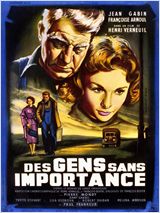
Des gens sans importance (People of No Importance – France 1956)
French fatalism meets neo-realism in a tragic story of working-class life. A long-haul trucker falls for an aimless young waitress from a road-side café. Great acting from Jean Gabin and the earthy Françoise Arnoul. 4½ stars
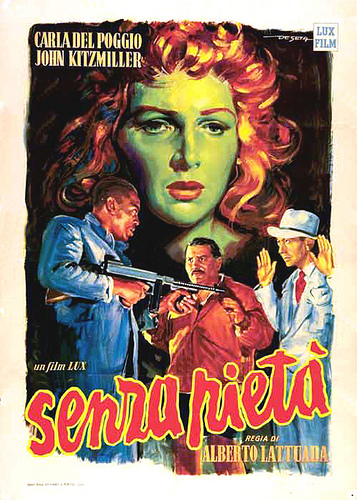
Senza pietà (Without Pity – Italy 1948) *
Black GI and a local girl on the skids in a doomed love triangle cannot escape tragic entrapment. Compelling neo-realist melodrama with a decidedly noir denouement. 4½ stars
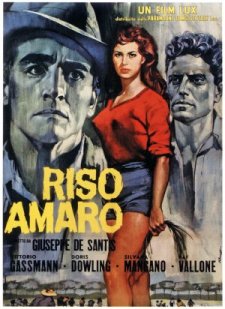
Riso Amaro (Bitter Rice – Italy 1949)
Classic neo-realist socialist melodrama. Homme-fatale destroys a passionate innocent. A bad girl is redeemed and homme-fatale meets a gruesome noir end in an abattoir. 5 stars
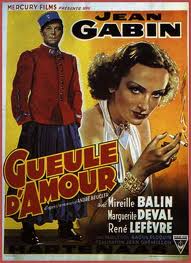
Guele d’Amour (Ladykiller – France 1937) *
A fatalistic tale of amour-fou fuelled by a callous femme-fatale. Hunk Jean Gabin and the luminous Mireille Balin star. Looks decades ahead its time. 4½ stars
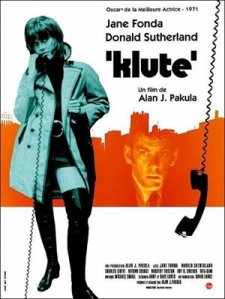
Klute (1971) *
Alan J. Pakula’s signature reworking of classic noir motifs in a masterly study of urban paranoia and alienation. Jane Fonda earned an Oscar for her brilliant portrayal of articulate b-girl the target of mystery psychopath. 5 stars
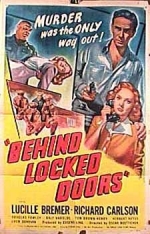
Behind Locked Doors (1948)
An entertaining Bud Bottiecher b-movie. PI Richard Carlson enters a sanatorium undercover to flush out a crook. A feast of metaphors for Bottiecher aficionados and good entertainment for the rest of us. Moody lensing from Guy Roe (Railroaded!, Trapped Armored Car Robbery, The Sound of Fury). 3½ stars
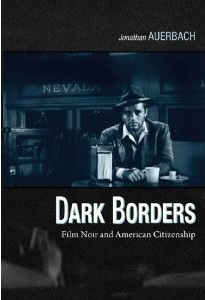
Jonathan Auerbach, Professor of English at the University of Maryland and regular presenter at film noir screenings, has just published his much anticipated book on film noir, Dark Borders…
Jonathan Auerbach, Professor of English at the University of Maryland and regular presenter at film noir screenings, has just published his much anticipated book on film noir, Dark Borders: Film Noir and American Citizenship, astudy which connects the sense of alienation conveyed by American film noir in the 40s and 50s with the anxieties about citizenship and national belonging in mid-20th century America, by providing in-depth interpretations of more than a dozen noir movies. Professor Auerbach shows how politics and aesthetics merge in these noirs, where the fear of subversive “un-American” foes is reflected in noirs such as Double Indemnity, Out of the Past, Border Incident, Pickup on South Street, Stranger on the Third Floor, The Chase, and Ride the Pink Horse. These anxieties surfaced during a series of wartime and post war emergency measures, beginning with the anti-sedition Smith Act (1940), the Mexican migrant worker Bracero Program (1942), the domestic internment of Americans of Japanese ancestry (1942), and the HUAC hearings in 1947.
Professor Auerbach, in 2008 in an issue of the scholarly Cinema Journal (47, No. 4, Summer 2008) in an article anticipating his book and titled ‘Noir Citizenship: Anthony Mann’s Border Incident’, posits an ambitious thesis about national borders and the borders of film genres: “Looking closely at how images subvert words in Anthony Mann’s generic hybrid Border Incident (1949), this article develops the concept of noir citizenship, exploring how Mexican migrant workers smuggled into the United States experience dislocation and disenfranchisement in ways that help us appreciate film noir’s relation to questions of national belonging.” The article offered a rich analysis of Border Incident, and developed a fascinating study of the sometimes antagonistic dynamic between the police procedural plot imperatives of the screenplay, and the subversive visual imagery fashioned by cinematographer John Alton. The scene in Border Incident where the undercover agent Jack, is murdered by the furrowing blades of a tractor is one of the most horrific in film noir, and Professor Auerbach rightly observes that the agent “gets ground into American soil by the monstrous machinery of US agribusiness… [this is] a purely noir moment of recognition that reveals the terrifying underbelly of the American farm industry itself in its dependence on and ruthless exploitation of Mexican labor”.
The paperback is available for only US$20.48 from Amazon. A great price for a book offering an original perspective that demands the attention of anyone interested in the origins of film noir.
The gods, like most other practical jokers, have a habit of repeating themselves too often
The gods, like most other practical jokers, have a habit of repeating themselves too often. Man has, so to speak, learned to expect the pail of water on his head. He may try to sidestep, but when, as always, he gets wet, he is more concerned about his new hat than the ironies of fate. He has lost the faculty of wonder.
The tortured shriek of high tragedy has degenerated into a petulant grunt. But there is still one minor booby-trap in the repertoire which, I suspect, never fails to provoke a belly-laugh on Olympus. I, at any rate, succumb to it with regularity. The kernel of the jest is an illusion; the illusion that the simple emotional sterility, the partial mental paralysis that comes with the light of the morning, is really sanity.
– Eric Ambler, ‘Cause For Alarm’, London, 1938. Ambler, an English writer, wrote the source novels for the films noir Journey Into Fear (1943) and The Mask of Dimitrios (1944).





 FilmsNoir.Net - all about film noir
