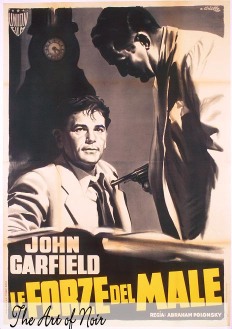
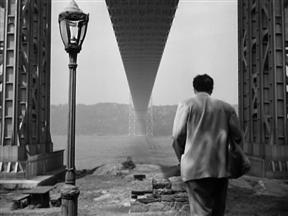
The Killers (1946): Fata Morgana

The Killers (1946)

Insurance detective unravels the killing of a washed-up boxer.

– Steve H. Scheuer, Movies on TV and Video.

One of my favorite films noir. Burt Lancaster plays the former-boxer turned hoodlum with elegance and style, and Ava Gardner is hot as the femme fatale. A brilliant narrative technique by director Robert Siodmak, employing flash-backs and the story of an insurance investigation to hold it all together, produces a taut and entertaining movie.

Like most great noirs, this picture transcends the genre and is not only a story of greed, love, and betrayal, but is also about loss, friendship, innocence, and the brutal realities of trying to make a buck in a hostile world. There is a wider socio-historical context, which is more than ably discussed by Jim Groom in a recent post on his BavaTuesday blog.

The Killers (1946)


Film Noir: “All I can see is in the frame”

Out Of The Past (1947)

Tonight I came across a deeply interesting paper by fellow Australian, Rafaelle Caputo, titled Film noir: “You sure you don’t see what you hear?, published in the Australian Journal of Media & Culture (Vol5 No 2 1990). Caputo studied cinema at La Trobe University and has been a writer on film for over 15 years, contributing to various journals and newspapers. The title of the paper includes a line from Out of the Past (1947).

The paper is scholarly, but has something very important to say to all fans of the genre:

There certainly is something one can point to called film noir, which starts and stops at certain points in time, which has been written about and tabled in the history of cinema, and which has been the focus of much critical debate. Equally, however, there tends to exist another film noir whose style seemingly departs from that tradition, locked away in a kind of time capsule, but which forms it own delicate lines of tradition, continuing to creep around. Finally, I feel the best way to proceed in the reading of film noir is along a path suggested by another line from Out of the Past: “All I can see is the frame … I’m going inside to look at the picture”.

Caputo’s thesis is that defining a movie as a film noir derives from it a having a “noir sensibility” rather than fitting a pre-defined template of rules or guidelines. His argument is coherent and established, inter alia, by reference to a set of films made in Hollywood over a period ranging from the 40s though to the 70s. His analysis of Out of the Past is so brilliant it makes you want to tear away and watch that timeless work yet again.

The film [Out of the Past] opens with exterior shots of an expansive landscape of mountains and forest dissolving into each other while the credits fade-in with each dissolve, until finally there is a dissolve into a stretch of highway with a road sign in the foreground pointing directions and distances for various towns. Into the shot drives a black car, casually travelling into the distance of the frame; then a cut to a travelling-shot from the rear of the car, at an angle over the shoulder of the figure dressed in black behind the steering wheel. The shot knits our point of view with his as we pass another road sign indicating the approaching town of Bridgeport. This shot is maintained until the car pulls into a gas station, but as soon as the car comes to a halt there is an almost immediate cut, still from the same camera position but at a slightly lower angle. The gas station building now takes up most of the screen space, horizontally spilling onto the road from left of frame, and in view atop the building is another sign set off against the clouds which reads ‘Jeff Bailey’. This slight change in camera angle gives the impression of the building jutting out into the car’s diagonal path as though it has forced the black-clad figure of Joe Stefanos to stop abruptly rather than stop by his own volition…

Caputo convincingly argues that Klute (1971) is not a noir. It is interesting that the forthcoming NYC Noir noir festival organised by Film Forum includes a screening of Klute.

Other films noir referred to in the article:

The Killers (1946) and The Killers (1964)
Kiss of Death (1947)
Kiss Me Deadly (1955)
Twilight’s Last Gleaming (1977)

New York City Noir: Dark Dangerous Corrupt Sexy

The Taking Pelham 123 (1974)

The NY Times today published an article, Noir and the City: Dark, Dangerous, Corrupt and Sexy, by Terrence Rafferty, covering the N.Y.C. Noir film noir festival organised by Film Forum starting Friday. See my post of July 11 for the full program.

Rafferty reviews the major pictures and the article is supported on-line with high quality stills.

GUILT, desire, fear, ambition and the bad behavior those human frailties give rise to are the favored themes of the sort of film we now call noir. So it’s hardly surprising that a fair number of these pictures are set in New York City, where guilt, fear, desire, ambition and bad behavior are pretty much a way of life. Any city will do, of course, because all cities generate a certain amount of the anxiety that film noir feeds on. And all cities, somewhere, have dark, scary streets that can, in noir’ violent allegories of moral ambiguity, stand in for the dimmer, grubbier recesses of the soul. But New Yorkers pride themselves on having more of everything than people in other cities do. If noir is the great urban style of the movies and it is then New York City is surely the noirest place on earth.  More

The Asphalt Jungle (1950): When The City Sleeps

The Asphalt Jungle (1950)

The The Asphalt Jungle adapted by Ben Maddow from the novel by R.W. Burnett is a movie with soul. A film that treats every character in the story as someone with a life worth knowing: the essence of a film noir. The command by director, John Huston of his story, his ensemble players, and the filmic context is profound and breathtaking.

From the opening shots, dramatised by the almost post-modern score of Miklos Rozsa, you know you are entering the realm of a great film-maker:

The Asphalt Jungle (1950) The Asphalt Jungle (1950)

The Asphalt Jungle (1950) The Asphalt Jungle (1950)

Throughout this opening sequence we hear the police radio chatter from inside the police car, but the visuals are never disturbed by a cut to inside the vehicle.

I will not cover territory more ably explored by others, but will focus on one scene that transcends melodrama and the noir genre. Safe-cracker Cavelli after being wounded during the robbery is seen in the background dying in his marital bed, through the open door of the bedroom from the kitchen of his apartment, where his distraught wife, Maria, beautifully played by Teresa Celli (who appeared in bit parts in only a handful of movies before moving into obscurity in 1953), at the kitchen table admonishing the hunchback getaway driver, Gus, for bringing this tragedy upon her young family.

The Asphalt Jungle (1950) The Asphalt Jungle (1950)

Maria has the best line in the picture. As a police siren wails in the background:

“Sounds like a soul in hell.”

The Killing (1956) – Great But Not Noir?

The Killing (1956)
Stanley Kubrick’s The Killing is a great movie but it is not a film noir. Essentially it is a classic heist gone wrong story filmed in noir style. The view expressed in Steven H.Scheuer’s Movies on TV (1993-94) though brutal is fair: “Crooks plan a daring race-track robbery. Direction by Stanley Kubrick, a newcomer at the time, is unnecessarily arty but interesting.”

For me the most interesting scene is in the Chess parlor where the caper’s mastermind played by Sterling Hayden, recruits a heavy to start a distracting bar-room brawl at the track. The heavy is played by Nicholas (‘Kola’) Kwariani, a professional wrestler and wrestling promoter, and dedicated chess player who frequented “The Flea House” in New York City, which is also where this recruitment scene was filmed. As far as I know this was his only screen appearance ever!

The Killing (1956)

Kwariani has the best lines in the movie, and delivers them with a thick Eastern European accent and a perfect world-weary understanding of exactly what he is saying :

Johnny Clay (Sterling Hayden)
Maurice Oboukhoff (Kola Kwariani)

Johnny: Good game, Maurice?

Maurice: Johnny, my old friend. How are you?
Good to see you. Been a long time, eh?
How long have you been out?

Johnny: Not long.

Maurice: It was difficult, no?

Johnny: Yeah.

Maurice: Very difficult.
You have my sympathies, Johnny.
You have not yet learned that you have to be like everyone else.
The perfect mediocrity.
No better, no worse.

Individuality is a monster, and it must be strangled in its cradle to make our friends feel comfortable.

You know, I often thought that the gangster and the artist are the same in the eyes of the masses. They’re admired and hero-worshipped, but there is always present an underlying wish to see them destroyed at the peak of their glory.

Johnny: Yeah…

Download the full dialog transcript of the screenplay from Drew’s Script-O-Rama.

Force of Evil (1948)

Force of Evil (1948)

Many have written long and more eloquently than I ever could on this great film from Abraham Polonsky, which transcends the noir genre and is as close as Hollywood ever got to social realism. John Garfield brings his signature honesty and gritty complexity to the film. That the careers of these artists were destroyed in their prime by rabid political hacks and the narrow bigotry of Hollywood moguls is tragic.

Force of Evil was the first film that Polonsky directed, and the assurance displayed in its construction is breathtaking: from the lighting and camera-work, to the editing and pacing. The hard-edged and almost jazz score by David Raksin is used to brilliant effect.
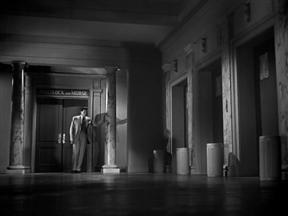
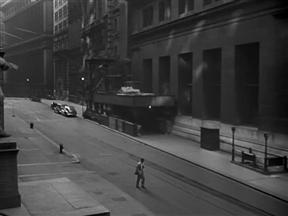
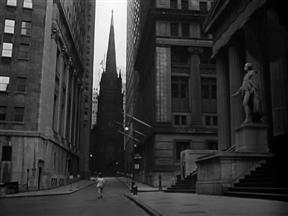
These are some of the best scenes in the movie:

Force of Evil (1948)Force of Evil (1948) Force of Evil (1948) Force of Evil (1948) Force of Evil (1948)

New DVD: Ace In The Hole (1951)

Ace In The Hole (1951)

A new Criterion DVD of the classic film noir, Ace in the Hole (1951), directed by Billy Wilder and starring Kirk Douglas, is now out and has been reviewed by Lou Lumenick in the New York Post:

“It’s dark for 2007, let alone for 1951,” says Spike Lee, who admits to stealing the flick’s famous last shot – stricken star Kirk Douglas falling, his eye within inches of the camera – for “Malcolm X.” More

Spike Lee is featured in one of the many special features on the DVD, which include a 1980 feature-length documentary on Wilder and vintage interviews with Wilder and Kirk Douglas.

Update 20 July 2007: Two more reviews of this DVD release have appeared:

Wilder’s Bleak Commentary Comes Up Ace by Chris Garcia on Austin360.com –

Some call it satire. If so, it’s satire of the bleakest stripe. It is certainly “newspaper noir,” a sub-genre marked by tough, ink-stained downers like “Sweet Smell of Success” and “Underworld Story” that expose the power of the press when it’s gone sour and scheming.

Noir’s window into American society is filthy but clear. “Ace in the Hole” presents more than a view through it. It offers a timely reflection, pushing the movie past a crack thriller and grim character study to something elegiac and urgent.

Presence of Malice by Jack Shafer on SLATE –

“Ace in the Hole” disturbs journalists because they recognize too much of themselves and their colleagues in the film’s loathsome protagonist, Charles Tatum (Kirk Douglas). Like most classic film noir tough guys, Tatum is running from a sordid past. He’s stranded in Albuquerque with no money and a car with bad tires and a burned bearing, so he ambles into the Sun-Bulletin office and pitches the straight-laced editor for a job…

New DVD – James Ellroy: American Dog

LA Confidential

DVD Savant, Glenn Erickson, reviews this new DVD on noir novelist, James Ellroy, who penned LA Confidential:

Arte’s DVD of James Ellroy: “American Dog” is an excellent presentation of a show with a beautiful look; the views of Los Angeles are a slick tour of a noir city. The audio is good and the music editorial excellent, with those classical pieces weaving in and out of Ellroy’s edgy speeches. An extras menu leads to several interesting sidebar videos. Two dinner conversations with Ellroy and his friends (Rick Jackson, Bruce Wagner, Dana Delaney, Joe and Matthew Carnahan, Michelle Grace) at the Pacific Dining Car are followed by a 2005 reading of American Tabloid at the Hammer Museum by Ellroy, Bruce Wagner and Dana Delany. Ellroy is presented with the ‘Jack Webb Award’ by the LAPD, an honor that must have been a prelude to the film’s interview with the oddly worshipful Chief Bratton. Galleries of vintage L.A. postcards, and gruesome crime scene photos finish the presentation. More

Noir Lighting

The prolific Lloydville of mardecortesbaja.com has just posted a great article on film noir lighting: The Look of Noir.

It’s a commonplace of writing about film noir to see its dark, moody lighting as derived more or less directly from the German expressionist cinema of the 1920s and 1930s… There’s another, home-grown visual tradition that I think had a much clearer influence on the look of noir — the American tabloid crime photography of the 1930s and 1940s…

This closing frame from Jacques Tourneur’s Out of The Past (1947) illustrates Lloydville’s argument, with a natural flash-like highlighting of skin-tones:

Out Of The Past (1947)

While Lloydville mounts a very strong case, and knows more about the topic than me, I wonder whether the development was simply a result of using a new technology to film night scenes, rather than there being a conscious or even unconscious tabloid or other influence on directors or cameramen. A factor also is the extent to which the placement of lighting is used to light a scene. A tabloid photographer has control only over his flash and his camera’s perspective. Consider this frame, again from Out of The Past, where the only available light is deliberately placed at a back angle to the scene.

Out Of The Past (1947)

Noir: More Dark Than Black

I today re-read Jim Groom’s post on his BavaTuesday Blog about Robert Siodmak’s The Killers, and found issue with his comment that:

…Noirs seldom, if ever, focus on a figure of standing and greatness that is newsworthy for the life they lived, but rather for the crimes they committed. Noirs often focus upon the deranged, criminal, impoverished, or forgotten characters -a style of film dedicated to the unspeakable elements of society who spend their time moving from one boarding house to the next…

If we consider the great films noir, this view does not stand up to reasonable scrutiny. In great disparate noirs like, for example, Double Indemnity, Out Of the Past, The Maltese Falcon, The Big Heat, and even, Kiss Me Deadly, the protagonists are infinitely more complex and, paradoxically, their actions on many levels simply human.

As Billy Wilder said of Double Indemnity (1944):

“Well, he was just kind of a middle-class insurance guy who works an angle. If he is that tough, then there is nothing left for Stanwyck to work on. He has to be seduced and sucked in on that thing. He is the average man who suddenly becomes a murderer. That’s the dark aspect of the middle-class, how ordinary guys can come to commit murder.”

Update 16 July 2007: Many thanks to Jim Groom for his response to this post:

I think you make an excellent point here. When I was framing this I guess I was thinking Noir in relationship to a figure like Charles Foster Kane or some of the larger biopic pictures that have the great individual as their central character. Wilder’s quote frames these characters not so much as marginal as he does average or middle-class. Yet, I’m not so sure that Walter Neff comes across as your average Joe. I think the same can be said of the protagonists from Out of the Past and Kiss Me Deadly for sure, all of these protagonists are anything but everyday middle-class Americans. Think about Walter Neff, he isn’t married with a happy nuclear family, his apartment is rather modest, and his first encounter with Phyllis is a bit steamier and more dynamic than what you might expect from “Mr. Smith Goes to Washington.” As to the complexity of these characters, I couldn’t agree with you more. What attracts me to the Noir is that it takes the marginal, or “middle-class,” figure and gives you a look at their inner-working in some really gripping ways. Also, it systematically demystifies any sense of their normality, or a concept of normality more generally.

In short, though, this is a great site and you have no idea how much I have enjoyed looking through your archives. I also want to thank you for engaging in a focused discussion about Noir -I can’t think of anything more worthwhile and entertaining. I have a bunch to say about both Out of the Past and Kiss Me Deadly, so I imagine their will be many more conversations to come!

I certainly look forward to Jim’s threads on Out of the Past and Kiss Me Deadly.

Regarding Jim’s reference to the Walter Neff character in Double Indemnity, Fred MacMurray in this role I agree is as far removed as can be imagined than, for instance, his performance three years later in the Egg And I. But from what I have read, it seems Billy Wilder chose MacMurray for this noir role to build on his hitherto decent guy screen persona. Neff is seen as a loner yes, but he holds down a middle-class job, and is respected by his colleagues. When Neff falls for femme-fatale, Phyllis Dietrichson (the great Barbara Stanwyck in THAT wig), he is not only seduced by her allure, but by his loneliness. A man can fatally love a woman he does not quite trust, because he desperately wants to believe otherwise, and fears being alone again more than the fateful consequences of his attachment. Neff may rationalise the liaison differently but the sense of betrayal is deep:

She liked me. I could feel that. The way you feel when the cards are falling right for you, with a nice little pile of blue and yellow chips in the middle of the table. Only what I didn’t know then was that I wasn’t playing her. She was playing me, with a deck of marked cards and the stakes weren’t any blue and yellow chips. They were dynamite.

In Out of the Past, Jeff Bailey, tries to make a decent life for himself away from his corrupting city life, but his past cannot be escaped. The good woman in his life knows his essential decency, and it is the stuff of true tragedy that her memory of him is tainted by her being told the lie of his betrayal at the end.

Dave Bannion in The Big Heat, is an honest cop, pushed by desperation to almost committing murder. It is the gangster’s moll, Debbie Marsh, played by the incandescent Gloria Graham, who does the deed, with a gun casually tossed by Bannion onto a seedy hotel bed. Indeed, Debbie is the pivotal character in the movie. She lives an abased life yes, but she has an essential decency that is untainted by her circumstances. She ridicules her boyfriend’s toadying to his mob boss, and is not afraid to get cheeky with the capo himself. Her shooting of the corrupt cop’s blackmailing wife has a perverse moral integrity.

In The Maltese Falcon, Sam Spade is a loner PI, sleeping with his partner’s cheating wife, but even after he falls for his partner’s killer, he never loses his essential moral compass.

And as I have said elsewhere, the Mike Hammer of Kiss Me Deadly, an erstwhile sleaze, is somehow redeemed by his quest to not forget the doomed Christina.