Blog Feed

New Noir DVD Reviews

Two new film noir reviews based on new DVD releases have just been published:

Nightmare Alley

Nightmare Alley (1947) by Tom Huddleston of NotComing.com:

Nightmare Alley is an obscure post-war thriller, a noirish tale of circus fakes and con men every bit as crafty and exploitative as the characters it depicts, and just as much fun. Full Review

The Wrong Man (1956) by Dan Schneider of Blog Critics:

Perhaps [Alfred Hitchcok’s] most successful such ‘oddball’ film was 1956’s black and white social realism film The Wrong Man, starring Henry Fonda. It was manifestly influenced by the spate of European films that indulged in the Neo-Realistic style of such masters as Vittorio De Sica, Federico Fellini, and Roberto Rossellini. It was also based upon a real life case of mistaken identity in 1953 which nearly put an innocent man in prison. Full Review

The Wrong Man

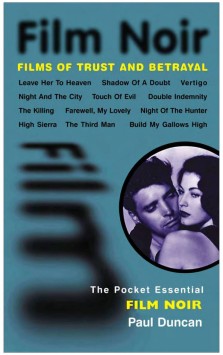
New Edition of Film Noir eBook

For US$9.99 you can download the 2nd edition the Film Noir eBook by Paul Duncan from eBooks.com. An excerpt:

The usual relationship in a Film Noir is that the male character (private eye, cop, journalist, government agent, war veteran, criminal, lowlife) has a choice between two women: the beautiful and the dutiful.The dutiful woman is pretty, reliable, always there for him, in love with him, responsible “all the things any real man would dream about. The beautiful woman is the femme fatale, who is gorgeous, unreliable, never there for him, not in love with him, irresponsible “all the things a man needs to get him excited about a woman. The Film Noir follows our hero as he makes his choice, or his choice is made for him. The reason the femme fatale meets the male character is because she has already made her choice. She is usually involved with an older, very powerful man (gangster, politician, millionaire), and she is looking to make some money from the relationship. She needs a smart man (who is also dumber than her) to go get that money, and take the fall if things go wrong. Enter the male character. The story follows the romantic/erotic foreplay of their relationship. The male character is often physically and mentally abused in this meeting and separating of bodies. Sometimes, he ends up doing very bad things. What is most surprising about Film Noir, and the reason I suspect it has become so difficult to categorise and pigeonhole, is that the focus of the films can be from the point of view of any of the characters caught in this relationship. For example, we can follow the femme fatal’s story or, as is more often the case, the dutiful woman’s. (The timid, unknowing woman who learns about the dark side of life harks back to the Gothic novel of the nineteenth century, which is where Noir Fiction came from.) This is because all the characters are equally interesting “they are all either obsessed with something they desire (money, power, sex), or compelled to do what they do because of their nature, or the physical or social environment they live in. The Film Noir follows a number of discernible frameworks within which the characters clash and collide. To show the workings of the police and government agencies, we had the Documentary Noir. Many filmmakers worked with army documentary units during World War Two, and discovered the freedom of movement the new, lightweight cameras afforded them. Audiences back home also got used to seeing them, so they found it easier to accept the rough style when it was presented to them as a feature film.The Docu Noir invariably had an authoritative voice telling us the facts (time, place, purpose) of the case, and we followed the investigation through to the end.The first one was The House on 92nd Street (1945) directed by Henry Hathaway, who did several in this style. Others of note include Call Northside 777 (1948), The Naked City (1948) (which spawned a TV series), Joseph H Lewis’ The Undercover Man (1949) and The Enforcer (1951). In the 50s, this style was subverted and reinvented by Alfred Hitchcock in his magnificent The Wrong Man (1956). In this film, instead of glorifying the law, we see a man and his family becoming victims of the police procedure – in the end his wife has a mental breakdown.

Out Of The Past (1947) – Tourneur’s Mise En Scene Revisited

Near the end of Jacques Tourneur’s classic noir, Out of the Past (1947), there is a scene that must be one of the greatest compositions in American cinema:

Out Of The Past

The lighting, and the placement of the central elements, from the sofa on which Robert Mitchum rests his hand to the archway that frames Jane Greer, is brilliant. The femme fatale, Kathie Moffat, is framed in the dark background, while Jeff Bailey is highlighted in the foreground. The elemental contrast between good and evil is perfectly balanced, with the natural perspective of the lens emphasising the distance between the two protagonists. The window lattice shadow falling across the floor in the background behind Kathie enforces the perspective established by the lighting and placement of the actors. To complete the tension Kathie is clothed in saintly garb and presents a demure demeanour.

Dashiell Hammett: The Red Gumshoe

In the paranoid 1950’s, Dashiell Hammett was jailed under sinister manipulation of The Smith Act. Popular radio serials based on Hammett’s books, including The Maltese Falcon, were immediately cancelled, and his books withdrawn from publication in the US.

When he was released from prison the IRS, attached his income and the copyright on his books and stories for payment of back taxes and penalties. He was broke and unpublishable.

Hammett died in 1961. Two years later friend, fellow writer and progressive, Lillian Hellman, bought back the copyrights to his works at an IRS auction for US$5,000.

In 1998, the Editorial Board of The Modern Library named The Maltese Falcon as one of the 100 best novels in English of the 20th century.

In 2005, the US Senate approved a resolution commemorating the 75th anniversary of The Maltese Falcon and recognising it as a great American crime novel.

Film Noir Interviews: Billy Wilder and Samuel Fuller

The Images Journal web site features interviews with these stellar noir directors:

Billy Wilder – A really fun interview from July 1975.

Sunset Blvd.
SunsetBlvd. (1950)

Wilder On Double Indemnity (1944):

Well, he was just kind of a middle-class insurance guy who works an angle. If he is that tough, then there is nothing left for Stanwyck to work on. He has to be seduced and sucked in on that thing. He is the average man who suddenly becomes a murderer. That’s the dark aspect of the middle-class, how ordinary guys can come to commit murder.

Wilder’s noirs:

Double Indemnity (1944)
The Lost Weekend (1945)
Sunset Blvd. (1950)
Ace in the Hole (1951)

Samuel Fuller – 1972 to 1976 composite of several interviews.

Pickup On South Street
Pickup on South Street (1953)

Fuller on his noir movies:

When I was making these damned pictures, I never knew about film noir… To me it’s the emotion, the lies, the double-cross… that defines what kind of drama it is.

Fuller’s noirs:

Pickup on South Street (1953)
House of Bamboo (1955)
The Crimson Kimono (1959)
Underworld USA (1961)
Shock Corridor (1963)
The Naked Kiss (1964)

Male Anxiety and Film Noir

By Lloydville on the mardecortesbaja.com blog Friday 29 Jun 2007: Male Anxiety and Film Noir.

…The male anxiety embodied in the [noir] tradition clearly derives from a deeper source — the moral discombobulation of war itself, the spiritual exhaustion this particular conflict induced, and the inconceivable fact of the atomic bomb which raised moral issues and created fears that the human psyche was ill-prepared to engage… The ravaged psyches of Americans in the aftermath of a “good war”, a good war they won, so vividly explored in film noir, in some ways says more about the nature of all wars than any works of art which dealt with the conflict itself.

Lloydville is as always provocative, but in film noir, it is the narrative and existential angst rather than anxiety that drives the male protagonist. The post-war anxiety of film audiences can help explain the popularity of the genre, but I think Ann Douglas in her piece in the March 2007 issue of Vanity Fair takes us further:

Noir is premised on the audience’s need to see failure risked, courted, and sometimes won; the American dream becomes a nightmare, one strangely more seductive and euphoric than the optimism it repudiates… Noir provided losing with a mystique.

In America it is the anxiety of being a “loser” that underlies male existence more than the experience of war.

The male archetype in film noir is an outsider. The great noir novels, The Maltese Falcon and The Big Sleep, for example, that were brought to the screen, were written before WW2 in the 1930’s, and cannot be understood by reference to post-war trauma.

Consider two noirs recently featured in filmsnoir.net posts: Out Of The Past (1947) and The Big Heat (1953). In both movies, the male protagonists are clearly outsiders. Jeffy Bailey in Out of the Past tries to be rid of his past in a small town but his outsider status is firmly established from the outset before he even appears on the screen, and in The Big Heat, honest cop, Dave Bannion, is not helped by fellow cops in his fight against corruption and moral turpitude. These men are outsiders also in the fuller European sense, and it is no coincidence that the directors, Tournier and Lang, were emigres from Europe.

Out Of The Past

The Big Heat

The Narrow Margin (1952): Opening Credits

The Narrow Margin (1952)
It is a shame the brilliant shot used for the opening credits of The Narrow Margin (1952), by great noir director, Richard Fleischer, is obscured by the credits. In a single elegantly paced panning shot, cinematographer, George E. Diskant, establishes the noir atmosphere of the movie.

Fleischer’s major noirs:

Bodyguard (1948)
Follow Me Quietly (1949)
Trapped (1949)
The Clay Pigeon (1949)
Armored Car Robbery (1950)
The Narrow Margin (1952)

Diskant’s noir credits include:

Kansas City Confidential (1952)
On Dangerous Ground (1952)
The Racket (1951)
They Live by Night (1948)
Riffraff (1947)

The Narrow Margin (1952)

Dark Art: What Makes a Film Noir?

A post today on the Monochrom.Blog lead me to an excellent article by Chris Fujiwara on this topic in his review, in the Boston Globe on 15 January 2006, of the book, The Philosophy of Film Noir (2006), a collection of essays from the University of Kentucky Press that explores the philosophical underpinnings of movies from the classic noir period and after.

Chris Fujiwara, a writer living in Chelsea, is the author of, Jacques Tourneau: The Cinema of Nightfall (Johns Hopkins University Press), and was working on a critical biography of Otto Preminger at the time he wrote the article.

I have not read The Philosophy of Film Noir, and my post of June 20, The Big Heat: Film Noir As Social Criticism, is purely coincidental, but Fujiwara’s discussion of the influence of Eureopean extistentialism on American noir in the the 40s and 50s is supportive of the views expressed in my post. I recommend the full article to you, and offer these highlights:

The philosophy of noir has also been linked to the European literary and philosophical movement known as Existentialism, though frequently when commentators use that term, it’s less with the writings of Sartre and Camus in mind than as a stand-in for ideas like ”absurdity” and ”alienation.” In an essay portentously called ”Film Noir and the Meaning of Life,” his contribution to ”The Philosophy of Film Noir,” Steven M. Sanders, an emeritus professor of philosophy at Bridgewater State College in Massachusetts, claims that ”the thread running through the design of film noir is the sense that life is meaningless.” Noir, Conard writes, is nothing less than ”a sensibility or worldview that results from the death of God.”…

This kind of analysis isn’t new, but it highlights something that isn’t always discussed about noir: That the genre, which evokes such quintessentially American icons as Bogart and a shadow-filled Los Angeles, actually finds its roots in Europe… [my emphasis]

As ”The Philosophy of Noir” reminds us, during its peak era, noir was the form that imported ”European” alienation, doubt, and dread into the framework of the American crime film.

I should also acknowledge in this post the comment from Lloydville of mardecortesbaja.com to my June 20 post:

You make a good point…  film noir definitely derived in part from European existentialism . . . but existentialism itself was influenced by Poe, via Baudelaire, so the lines of connection are complex.

We can’t see film noir as simply a European product, an import, because it was so wildly popular with the American public, which must reflect an existential malaise that did reach North America after WWII, aroused by the horrific spectacle of the conflict and by the atomic bomb. It reflected a subconscious dread deeply rooted in the American psyche.

Appropriately, Fujiwara concludes his article by saying: As always, however, the definition of noir itself remains in the shadows.

AFI Again Ignores Film Noir Heritage

For what it’s worth, a new AFI list of the Top 100 Movies of All Time has been published, with only nine movies with noir credentials making the list:

3 Casablanca (-1)
9 Vertigo (+52)
16 Sunset Blvd. (-4)
21 Chinatown (-2)
29 Double Indemnity (+9)
31 The Maltese Falcon (-8)
48 Rear Window (-6)
55 North By Northwest (-15)
97 Blade Runner ( -)

I would contend that only four of these movies: Subnset Blvd, Chinatown, Double Indemnity, and The Maltese Falcon are true noirs. So only three out of a 100 is bad. Even if one is not an afficianodo of film noir, I cannot comprehend how Orson Welles’ The Third Man, is not on the list.

These 22 noirs were listed in the ballot of 400 films sent to voters, but did not make the final cut:

The Big Sleep
Gilda
Gun Crazy
I Am A Fugitive From A Chain Gang
LA Confidential
Laura
Little Caesar
The Lost Weekend
Memento
Mildred Pierce
The Night Of The Hunter
Out Of the Past
The Postman Always Rings Twice
Rear Window
Scarface
Strangers On A Train
The Sweet Smell Of Success
The Thin Man
The Third Man
Touch Of Evil
White Heat

New Raymond Chandler Noir

Sin City (2005) director, Frank Miller will direct a new feature film noir for Universal. The movie will be an adaptation of the Raymond Chandler novella, Trouble is My Business, which has not been previously produced for the screen, and will star Sin City lead, Clive Owen.

Universal and production partner, Strike Entertainment, obtained the rights for the story from UK-based Chorion. The studios hope this film will kick off a series of PI Philip Marlowe flicks.

Films Noir based on Chandler novels:

The Big Sleep (1946)
Lady in the Lake (1946)
Strangers on a Train (1951)
The Long Goodbye (1973)