Blog Feed

Film Noir Women: Does she really love him?

But does she really love him? That’s always the question about these heroines-obsessive to the hero, central to the movie. De Carlo’s Anna [Criss-Cross], for example, is willing enough to betray her racketeer husband for love of Lancaster, but not willing to stay with him once the husband catches up with them. Not when she can take the money and run…  It’s one of the noir heroine’s most invariable features that she is motivated by greed: she is poor and wants to be rich, or else she is rich and wants to be richer. She may inspire romantic dreams, but she doesn’t have them herself. Not like he does, anyway. That’s one of the advantages she has over him.

– James Harvey, Movie Love in the Fifties

NPR has posted under its You Must Read This feature, an interesting excerpt from Harvey’s book on the femme-fatale from  the early 40’s to the late 50’s, with nicely drawn portraits of the femmes-fatale from The Maltese Falcon, Double Indemnity, The Killers, Criss-Cross, The Woman in the Window, Scarlet Street, Pushover, Pitfall, Gun Crazy, The File on Thelma Jordan, The Locket, and Where Danger Lives.

Road House (1948): Noirish Melodrama

Road House (1948)

The love between a sultry cabaret singer and the manager of a road-house is thwarted by the jealous and vengeful owner (1948 20th Century Fox Directed by Jean Negulesco 95 mins)

A melodrama made memorable by a bravura performance from Ida Lapino as a cynical cabaret singer who finds love.  Her rendition of “One for My Baby” with a bluesy solo piano accompaniment is arresting, and her sensuality is palpable and provocative. She delivers her cynical lines  with a world-weary cigarette-smokey voice and her one-liner put-downs are delivered with perfect timing.  She is one hot dame, and the passions she arouses are very believable.

Road House (1948)

Richard Widmark is strong in only his third role as the schizoid road-house owner who covets Ida, but a stolid Cornel Wilde as Widmark’s manager and rival for the singer’s affection is a damper on the action.

The movie is set-bound and it shows, but veteran director Jean Negulesco composes interesting and fluid takes with almost-noir lighting.

Reports from David Goodis Retrospective

Dark Passage (1947)
Dark Passage (1947)

In his The Evening Class blog, Michael Guillen, has posted a series of reports and interviews from The Dark Cinema of David Goodis series, including introductory remarks to each screening from Eddie Muller and Pacific Fim Archives director Steve Seid:

Angel Face (1952): Gothic Noir

Angel Face (1952)

A young psychopath with an Electra complex tries to murder her step-mother
(1952 RKO Directed by Otto Preminger 91 mins)

Angel Face is a dark and occasionally chilling gothic melodrama with Jean Simmons effectively cast against type as an ‘enfant-terrible’, and Robert Mitchum as her hapless object of desire and manipulation.  While well-made and with high production values, the film moves too slowly and Mitchum’s trademark laconic persona is a further drag on the action.  The final denouement though half-expected is still a shocker.  But on balance, Preminger’s sardonic detachment, which usually finds favor with film critics, makes the film look and feel one-dimensional.

An interesting costuming twist telegraphs the repression of forbidden sexual desire on the day a fatal plot is executed: the protagonist contrary to her usually modestly feminine attire on this day sports a very tight sweater and a waist-hugging belt.

Angel Face (1952)

Marlowe on Dames: Trouble is my business

Scarlet Street (1945)

She wore a street dress of pale green wool and a small cockeyed hat that hung on her ear like a butterfly. Her eyes were wide-set and there was thinking room between them. Their color was lapis-lazuli blue and the color of her hair was dusky red, like a fire under control but still dangerous. She was too tall to be cute. She wore plenty of make-up in the right places and the cigarette she was poking at me had a built-on mouthpiece about three inches long. She didn’t look hard, but she looked as if she had heard all the answers and remembered the ones she thought she might be able to use sometime.

From Raymond Chandler’s short-story Trouble Is My Business (1939)

Dark City (1998) The Director’s Cut: Zapped by the biochemist

Dark City (1998)

The Director’s cut of Dark City (1998) has been released on DVD this week.  A sci-fi noir from director Alex Proyas, it explores the nature of consciousness and memory in a classic stylised noir city, which is the closest a contemporay color movie has ever come to evoking the look of a 40’s film noir.
Dark City (1998)

It is a visually stunning and enigmatic dream-scape where true identity doesn’t exist, but is the construct of a biochemist in the employ of dark soul-less aliens, who inhabit cadavers, collectively employed in attempting to stave off extinction by reconstructing physical reality and manipulating the brain’s chemistry.  The noir motif of an amnesiac protagonist on the run after he is implicated in the serial killing of b-girls is the arc on which the story is woven.  It is an amalgam of Al Hartley’s Amateur (1994), which preceded it, and The Matrix (1999), of the following year: a brave new world with a ghost in the machine…

References:
Brave New World – Aldous Huxley
The Ghost in the Machine – Arthur Koestler

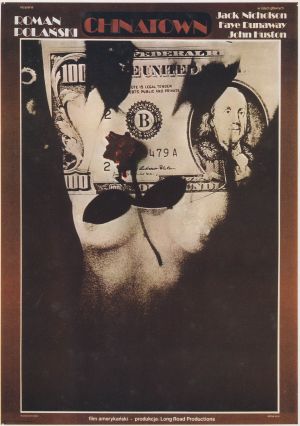
Chinatown (1974): Review by Pick-Up Flix

Chinatown (1974)

Michael Clawson has posted to his blog, Pick-Up Flix, a review of Roman Polanski’s Chinatown (1974) with an original take on Chinatown as metaphor: the title refers to a place where law and order (i.e. death) are circumvented by the tragedy and corruption of life. Roman Polanski wasn’t creating just a mystery; he was bowing to the greatness in which mystery thrived — film noir”.

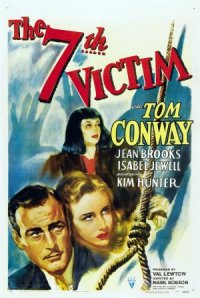
The 7th Victim (1943): Review by Film Sufi

The 7th Victim (1943)

The Film Sufi blog has posted an interesting review of the Val Lewton horror flick, The Seventh Victim (1943) directed by Mark Robson: “one of a string of hypnotic films noir he brought to the screen, coming right after “The Cat People”, “I Walked With a Zombie”, and “The Leopard Man”. What makes this film interesting is the wide gulf separating its virtues and its flaws”.

Kiss of Death (1947): More Than Udo

Kiss of Death (1947)

A reformed hood, who turns state evidence to get parole to care for his kids after his wife’s suicide, is a marked man (Fox 1947 Directed by Henry Hathaway 98 mins)

Kiss of Death is usually remembered for the debut performance of Richard Widmark as the giggling psychotic hit-man Tommy Udo and his brutal murder of a hood’s wheelchair-bound mother. But it is a strong performance by Victor Mature as the squealer, Nick Bianco, out to save his family, that holds the film together. An unaffected Coleen Gray is engaging as the love interest Nettie.  Brian Donlevy gives his usual straight-up delivery as the Assistant DA who offers Bianco a get out of jail free card.

The action is tautly directed and is set mostly on the actual streets of New York, where the innocent streets of suburbia in the afternoon are a counterpoint to the dark sordid streets of the city at night. The only weakness is a redundant and banal voice-over commentary on the action by Nettie, which is also at odds with the noir theme that redemption costs. The climatic resolution is nicely nuanced and well-paced, as is the claustrophobic tension of the perps sweating out a slow elevator ride down from the 27th floor of an office building after a jewellery heist. The family scenes of Bianco with his daughters and Nettie are beautifully played and deeply moving, without resort to sentimentality.

Kiss of Death (1947)

The Breen Office and Noir

Laura (1944)

In the 1940’s the Breen Office rejected initial scripts (amongst many other films) for The Maltese Falcon (1941), Laura (1944), and Murder, My Sweet (aka Farewell, My Lovely 1944):

The Maltese Falcon… required the… following revisions: Joel Cairo should not be characterized as a ‘pansy type’; the ‘suggestion of illicit sex between Spade and Brigid’ should be eliminated; there should be less drinking; there should be no physical contact between Iva and Spade ‘other than that of decent sympathy’; Gutman should say ‘By Gad!’ less often; and ‘Spade’s speech about District Attorneys should be rewritten to get away from characterizing [them] as men who will do anything to further their careers.’ A similar pattern of objections can be seen in the Breen Office reports on other celebrated films noirs. A… review of Laura insisted that Waldo Lydecker must be portrayed as a ‘wit and debonair man-about-town’ and that ‘there can never be any suggestion that [he] and Laura have been more than friends’; meanwhile, scenes of police brutality had to be downplayed, along with the drinking at Laura’s apartment… [A] report on Farewell, My Lovely informed the producers that ‘there must, of course, be nothing of the ‘pansy’ characterization about Marriott’; by the same token, Mr. Grayle could not ‘escape punishment’ by committing suicide, and the scenes of pistol-whipping, drinking, and illicit sex would have to be reduced or treated indirectly.

– James Naremore, More Than Night – Film Noir In Its Contexts (UCLA Press 1998)