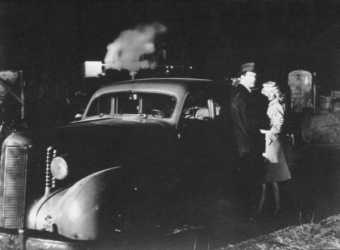
Deadline at Dawn (1946): Screwball noir

An Adrian Scott production for RKO, Deadline at Dawn (1946) is a  great ‘screwball’ noir that is a must-see.  A young Susan Hayward is as cute as a button in the lead role of a taxi-dancer who falls for a sailor mixed up in the murder of a b-girl.  The screenplay by Clifford Odets is based on a Cornell Woolrich story, and is as dark as any noir and as left as a Hollywood movie could go at the time.  At the end, a guy who has murdered a female blackmailer and general no-good dame, as the cops lead him away, laments “Imagine, at my age, to have to learn to play a harp”.  Think about it. Subversive yes! It is the only feature directed by Broadway director Harold Clurman, who was moon-lighting in Hollywood at the time, after the break-up of the Group Theater in NY.  DP Nick Musuraca’s chiaroscuro lensing completes the picture.  As Trevor Johnston says in his review for the Time out Film Guide, “it’s made with cockeyed artistry from beginning to end, and shouldn’t be missed”.

The action takes place in a single night in New York, with a signature Woolrich race against time. Much of Odets’s dialogue owes little to Woolrich and is an entertaining mash-up of clever puns that is in the tradition of the romantic screwball comedies of the period. A cavalcade of character actors portrays an ensemble of zany denizens of the New York night; taxi-dancers, b-girls, gangsters, blackmailers, besotted drunks, and cabbies.  But there is a serious underside: the greed, corruption, and passions of the noir city, where a murder seems the only way-out, and where trusting a stranger is seen as foolish even if the guy is in a jam.

There is a lot of left philosophising, as you would expect from an activist team of film-makers.  Academic’s have taken issue with this alleged hijacking of Woolrich’s story.  Mayer and McDonnell in Encyclopedia of Film Noir (2007) complain that “Unfortunately, the  film’s script tries to inject overt social meaning, and Woolrich’s clever plot is pushed aside by Odets’s pretentious dialogue”, and Robert Porfiro in Silver’s and Ward’s Film Noir: A Encyclopedic Reference (1992) concludes “Odet’s patronizing concern for the common people, and even worse, his pseudo-poetic, elliptical dialogue are out of place in the lower-class locales  of the film”.

Porfirio’s political prejudices aside, these haughty criticisms of Odet’s dialogue don’t align with my feelings. Odet’s dialogue is clever and rings true for every character.  The sailor is a small-town boy with solid values and his simple home-spun philosophy of honesty and fairness is totally believable.  Hayward’s taxi-dancer is also from a small town and the necessary cynicism she has acquired in the dark city is genuine – a matter of survival – but she retains her formative values and acts on them despite her city ways.  She is attracted to the young ‘hick’ sailor because he unlike most guys in the big city does not have an angle: what you see is what you get.  Here Odet’s focus is the fundamental noir motif of city vs. country, corruption and immorality vs. sincerity and decency.

A taxi-driver who helps the couple, Gus Hoffman, is played with assurance by Paul Lukas. Gus, an immigrant with a strong accent, is the film’s philosopher and the target of Porfiro’s attack.  He is a man who has seen injustice and suffering, and his words are world-weary and wise.  Such men exist and I have known many: working people educated in the school of life.

You make your own judgment.  This is a conversation between Gus and the Susan Hayward character, June, before they are interrupted by a cop on the beat:

Life in this crazy city unnerves me too,
but I pretend it doesn’t.
Where’s the logic to it?
Where’s the logic?

The storm clouds have passed us.
Over Jersey now.
Statistics tell us we’ll see the stars again.

Golly, the misery that walks around
in this pretty, quiet night.

June.
The logic you’re looking for…
…the logic is that there is no logic.
The horror and terror you feel, my dear,
comes from being alive.
Die and there is no trouble,
live and you struggle.
At your age, I think it’s beautiful
to struggle for the human possibilities…
…not to say I hate the sun
because it don’t light my cigarette.
You’re so young, June, you’re a baby.
Love’s waiting outside
any door you open.
Some people say,
“Love is a superstition.”
Dismiss those people,
those Miss Bartellis, from your mind.
They put poison-bottle labels
on the sweetest facts of life.
You are 23, June.
Believe in love and its possibilities
the way I do at 53.

What’s wrong here?
This man bothering you?

He’s the only man in four years
in New York who hasn’t?

Noir Poets: Ira Wolfert

All the things a man has to go through to get to live here, thought Leo, the things, the things, thousands and millions and millions of dirty things to hurt people and hurt himself.  The street seemed drowned in stone. It looked narrow and drowned, a thing emptied of life and walled with swollen, stone bones. The feeling of costly desolation was heavy in Leo. This costly desolation was splendor, but Leo did not think of it as splendid. Yet he tried to be faithful to the rich. He tried to think of the costly desolation as good for sleep. Only the rich could afford to buy quiet like this in the heart of the city, he told himself. He felt suddenly that only a man who had made himself rich could become barren enough to want and be comfortable in this desolation.

–  Ira Wolfert, ‘Tucker’s People’ (aka ‘The Underworld’), NY, 1943, p. 71

Abraham Polonsky’s and Ira Wolfert’s screenplay for Force of Evil (1948) was based on Wolfert’s novel.

John Alton: The Amazing Mr X (aka The Spiritualist 1948)

capturing bits of light at rest on things of beauty – John Alton *

John Alton: Noir Filmography as Cinematographer

1947

  • T-Men Directed by Anthony Mann Eagle-Lion (Edward Small Production) 96 minutes
  • The Pretender Directed by W. Lee Wilder Republic 68 minutes

1948

  • The Spiritualist (The Amazing Mr. X) Directed by Bernard Vorhaus Eagle-Lion 79 minutes
  • Raw Deal Directed by Anthony Mann Eagle-Lion (Edward Small Production) 78 minutes
  • He Walked by Night Directed by Alfred Werker Eagle-Lion (Bryan Foy Production) 80 minutes
  • Hollow Triumph (The Scar) Directed by Steve Sekely Eagle-Lion 83 minutes

1949

  • The Crooked Way Directed by Robert Florey United Artists (Benedict Bogeaus Production) 80 minutes
  • Border Incident Directed by Anthony Mann MGM (Nicholas Nayfack Production) 92 minutes
  • Reign of Terror (The Black Book) Directed by Anthony Mann Eagle-Lion 89 minutes

1950

  • Mystery Street Directed by John Sturges MGM 92 minutes
  • Witness to Murder Directed by Roy Rowland United Artists (Erskine Productions) 81 minutes
  • Devil’s Doorway Directed by Anthony Mann MGM 84 minutes

1950

  • The People Against O’Hara Directed by John Sturges MGM 101 minutes

1955

  • The Big Combo Directed by Joseph H. Lewis Allied Artists (Sidney Harmon Production) 86 minutes

1956

  • Slightly Scarlet Directed by Allan Dwan RKO (Benedict Bogeaus Production) 91 minutes

_______
* John Alton, ‘Painting with Light’ (Macmillan, NY, 1949), p. xli

The Noir City: Underworld

Abraham Polonsky’s and Ira Wolfert’s screenplay for Force of Evil (1948) was based on Wolfert’s 1943 novel ‘Tucker’s People’ (aka ‘The Underworld’).  I have been unable to find an attribution for this brilliant cover.

Books Digest: Crossfire, Jewish Directors, and Streets With No Names – Part 1 Jewish Noir Directors

This is the first in a series of posts in which I will cover books on film noir that I have been reading, and which aficionados of film noir will find interesting.

For this first post, I have chosen DRIVEN TO DARKNESS: Jewish Émigré Directors and the Rise of Film Noir (Rutgers University Press, 2009 ) by Vincent Brook.

In Driven To Darkness author Vincent Brook argues that the development of film noir in Hollywood was largely driven by emigre Jewish directors; and that the the noir motifs of the femme-fatale and the weak and ambivalent noir protagonist, have their origins in Jewish folklore, the historical oppression of Jews, and the German expressionist theater of the early 20th century.  He argues his case by reference to the films of Fritz Lang, Robert Siodmak, Billy Wilder, Otto Preminger, Edgar G. Ulmer, Curtis Bernhardt, Max Ophuls, John Brahm, Anatole Litvak, and Fred Zinnemann.

While Brook presents his case in detail and with a broad historical sweep, I am not convinced.  The Jewish influence exists, but it does not explain the rise of noir. Brook supports his thesis principally by reference to plot elements, based on the (questionable) presumption that these derive from the director and not from the script. Many of the films cited by Brook have screenplays (or are from stories) written by non-Jews, and the influence of the American hard-boiled crime fiction of the 30s and 40s is not given sufficient consideration.

Nonetheless, I found particularly interesting the chapters on Fritz Lang. Brook presents the novel view that Lang in his films noir is escaping his Jewishness and perhaps seeking expiation for something he may have done in Germany before he fled the country. Lang’s recollections of his life in Germany and his reasons for leaving, have been found to be unreliable, and this has been of interest to scholars. Lang’s first wife died by his own hand. He claimed to have accidently shot her. There is a lingering suspicion in some quarters that Lang actually murdered her. Brook hypothesises this presumption of guilt and sees real parallels in a number of Lang’s noirs, particularly Scarlet Street (1945), where a weak artistic male protagonist is driven by lust and jealousy to kill the femme-fatale who has betrayed him. By the end of the movie, the killer is so consumed by guilt that he lives a deranged homeless existence in a noir city, so hopelessly dark, that it shattered the closed romantic realism of Hollywood for good. Brook’s analysis has a particular cogency in the case of Scarlet Street. The film was Lang’s first independent Hollywood feature and he “was allowed the luxury of working for three months on the script with Dudley Nichols” (Andrew Spicer, ‘Film Noir’, 2002, p123).

Recommended.

Femme Fatale: Moscow Cafe

that sinister bloodcurdling, deep-probing, lashing look. It was a hangman’s look, a look like the contact of sexual organs

– M. Ageyev, Novel With Cocaine, 1929 (?) translated from the Russian by Michael Henry Hein (Picador 1985)

Femme Fatale: Till the end of the line

Femme Fatale: Till the end of the line

She takes the car down into the dark night
of celestial terrors and sordid delights

An unspoken intent

The loser has fallen under her spell
a web of intrigue and too-late regret
Broken and under control she has her surrogate
a dismal avatar

Terrible purpose for promises of bliss
keep him focused
the cold hard steels burns his shaking hand

No way out
all the way
till the end of the line

Noir City 1929: God’s Man

From Lynd Ward’s woodcut graphic novel God’s Man (1929)

Noir Poets: Lou Reed

Dirty Boulevard

Pedro lives out of the Wilshire Hotel
he looks out a window without glass
The walls are made of cardboard, newspapers on his feet
his father beats him ’cause he’s too tired to beg

He’s got 9 brothers and sisters
they’re brought up on their knees
it’s hard to run when a coat hanger beats you on the thighs
Pedro dreams of being older and killing the old man
but that’s a slim chance he’s going to the boulevard

He’s going to end up, on the dirty boulevard
he’s going out, to the dirty boulevard
He’s going down, to the dirty boulevard

This room cost 2,000 dollars a month
you can believe it man it’s true
somewhere a landlord’s laughing till he wets his pants
No one here dreams of being a doctor
or a lawyer or anything
they dream of dealing on the dirty boulevard

Give me your hungry, your tired your poor I’ll piss on ’em
that’s what the Statue of Bigotry says
Your poor huddled masses, let’s club ’em to death
and get it over with and just dump ’em on the boulevard

Get to end up, on the dirty boulevard
going out, to the dirty boulevard
He’s going down, on the dirty boulevard
going out

Outside it’s a bright night
there’s an opera at Lincoln Center
movie stars arrive by limousine
The klieg lights shoot up over the skyline of Manhattan
but the lights are out on the Mean Streets

A small kid stands by the Lincoln Tunnel
he’s selling plastic roses for a buck
The traffic’s backed up to 39th street
the TV whores are calling the cops out for a suck

And back at the Wilshire, Pedro sits there dreaming
he’s found a book on magic in a garbage can
He looks at the pictures and stares at the cracked ceiling
“At the count of 3” he says,
“I hope I can disappear”

And fly fly away, from this dirty boulevard
I want to fly, from dirty boulevard
I want to fly-fly-fly-fly, from dirty boulevard…

– Lou Reed  | LP Album ‘New York’ (1989)

Summary Noir Reviews: Casbah on the Bayou

Pépé le Moko (1937)
Jean Gabin is cool and Mireille Balin is an angel in this fatalistic but not noir classic.  What is subversive is that the lovers are not bourgeois: he is a gangster and she is a kept woman. Only the French could produce a tragedy of such romantic pathos, with the Casbah an exotic labyrinth of  both despair and sanctuary.  So was inaugurated poetic realism.  A film for the soul.

Dark Waters (1944)
A southern thriller of cruelty and  entrapment from Andre de Toth.  This little known bayou gothic challenges Siodmak’s The Spiral Staircase for atmosphere.  Merle Oberon heads a solid cast which includes Thomas Mitchell and Elisha Cook Jr. as bad guys, and Franchot Tone as a small-town doctor who saves the day.  Oberon’s luminous innocence seduces you from the outset.

The Enforcer (1951)
Bogart as an activist DA pursues Murder Inc in a noirish police procedural.  The first time the sinister usage of  ‘contract’ was spoken on the screen.   Bogart sadly just goes through the motions, but the motley crew of contract killers display a truly disturbing pathology.

The Glass Wall (1953)
A great socio-realist sleeper buried by Columbia on release. Director Max Shane and DP Joe Biroc showcase the teeming streets of New York.   While Shane had a hand in the excellent script, his direction could have been tighter.  The protagonist, an Hungarian war refugee played by Vittoria Gassman, jumps ship after his request for entry into the US is rejected.  Scenes of the desperate Gassman amongst the crowds on the streets of NY are documentary, and the central noir motif of individual alienation in the anonymity of the city is dramatically evoked – a cold glass ‘wall’.  Gloria Grahame is beguiling as a young woman on the skids who helps.

Border Incident (1949)
Essential expressionist noir from director Anthony Mann, DP John Alton, and writer John C Higgins, is a savage critique of US agribusiness.  Alton’s imagery is wholly subversive.  Ostensibly a police procedural about the trafficking of illegal farm workers from Mexico for the farms of Southern California, Alton’s rendering of the desert landscape with a haunting natural light elevates the exploitation of the ‘braceros’ to the realm of tragedy, and from tragedy to a damning political indictment.