Brick (2005) – Disappointing

Brick (2005)

First time independent director, Rian Johnson, shot the alleged neo-noir Brick after raising $500,000 from friends and relatives. The film received the Special Jury Prize at Sundance.

After all the hype, I was disappointed. Though technically competent and with clever allusions to the film noir genre, I found the story distasteful and with little real meaning or social value. The plot is confusing and the mumbled dialog of tribal argot generally unintelligible. An obvious influence is Tarantino, and this is also a negative.

The film may have some meaning for local audiences, but outside CA you can give it a miss. Or maybe, I am just too old…

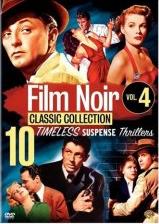
New DVD Set: Film Noir Classic Collection Vol. 4

Films Noir Collection DVD

On July 31, Warner Home Video, will release Film Noir Classic Collection, Vol. 4, which contains a bumper 10 remastered movies on five double DVDs from the classic film noir period of the 40s and 50s:

Act of Violence / Mystery Street
Crime Wave / Decoy
Illegal / The Big Steal
They Live By Night / Side Street
Where Danger Lives / Tension

Each DVD in the set can be purchased separately.

The DVD release has reviewed by Glenn Erickson of DVDTalk.Com, with a focus on They Live By Night and Side Street.

Update 7 Aug 2007: Decoy has been has been reviewed on Noir Of the Week.
Update 8 Aug 2007: All movies on the DVD are reviewed in filmjournal.net by clydefro.
Update 9 Aug 2007: All movies on the DVD are reviewed by Adnan Tezer at dvd.monstersandcritics.com.
Update 13 Aug 2007: All movies on the DVD are reviewed by dvdverdict.com.
Update 14 Aug 2007: All movies on the DVD are reviewed by The Shelf DVD Reviews.
Update 21 Aug 2007: All movies on the DVD are reviewed by Film Forno.
Update 9 Sep 2007: An interesting review of the DVD and film noir generally by Cullen Gallagher of The Brooklyn Rail.

These movies are a feast for noir fans with many of the top-level directors and stars of the period featured:
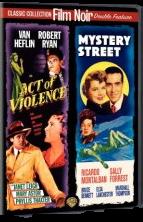
Act Of Violence / Mystery Street

Act of Violence (1948)
Cast:
Van Heflin, Robert Ryan, Janet Leigh, Mary Astor, Phyllis Thaxter
Director: Fred Zinnemann
War veteran Frank Enley seems to be a happily married small-town citizen until he realises Joe Parkson is in town. It seems Parkson is out for revenge because of something that happened in a German POW camp, and when a frightened Enley suddenly leaves for a convention in L.A., Parkson is close behind.

Mystery Street (1950)
Cast:
Ricardo Montalban, Sally Forrest, Bruce Bennett, Elsa Lanchester, Marshall Thompson
Director: John Sturges
Vivian, a B-girl working at “The Grass Skirt,” is being brushed off by her rich, married boyfriend. To confront him, she hijacks drunken customer Henry Shanway and his car from Boston to Cape Cod, where she strands Henry…and is never seen again. Months later, a skeleton is found (sans clothes or clues) on a lonely Cape Cod beach. Using the macabre expertise of Harvard forensic specialist Dr. McAdoo, Lt. Pete Morales must work back from bones to the victim’s identity, history, and killer. Will he succeed in time to save an innocent suspect?
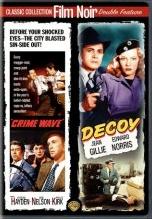
Crime Wave / Decoy

Crime Wave (1954)
Cast:
Sterling Hayden, Gene Nelson, Phyllis Kirk, Ted de Corsia, Charles Bronson
Director: André De Toth
Three San Quentin escapees kill a cop in a gas-station holdup. Wounded, Morgan flees through black-shadowed streets to the handiest refuge: with former cellmate Steve Lacey, who’s paroled, with a new life and lovely wife, and can’t afford to be caught associating with old cronies. But homicide detective Sims wants to use Steve to help him catch Penny and Hastings, who in turn extort his help in a bank job. Is there no way out for Steve?

Decoy (1946)
Cast: Jean Gillie, Edward Norris, Robert Armstrong, Herbert Rudley, Sheldon Leonard
Director: Jack Bernhard
Gangster Frank Olins (Robert Armstrong) is to die in the gas chamber much to the dismay of his girlfriend Margot Shelby (Jean Gillie) as he is carrying the secret of the location of $400,000 with him. Margot seduces gangster Jim Vincent (Edward Norris) to get him to engineer the removal of Olins’ body from the prison immediately after he dies in the gas chamber. She takes prison doctor Craig (Herbert Rudley) away from his nurse/girl friend (Marjorie Woodworth) and gets him to administer an antidote for cyanide gas poisoning. During the removal of Olins’ body, the hearse driver is killed by Tommy (Phil Van Zandt). The revived Olins gives Margot half of a map showing the money location and Vincent, in a fit of jealousy, kills Olins and takes the other half. Because the doctor’s plates on his car will get them through the police roadblocks, Vincent and Margot take him with them on the money hunt.
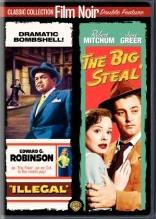
Illegal / The Big Steal

Illegal (1955)
Cast: Edward G. Robinson, Nina Foch, Hugh Marlowe, Robert Ellenstein, DeForest Kelley
Director: Lewis Allen
Ambitious D.A. Victor Scott zealously prosecutes Ed Clary for a woman’s murder. But as Clary walks “the last mile” to the electric chair, Scott receives evidence that exonerates the condemned man. Realizing that he’s made a terrible mistake he tries to stop the execution but is too late. Humbled by his grievous misjudgement, Scott resigns as a prosecutor. Entering private practice, he employs the same cunning that made his reputation and draws the attention of mob kingpin, Frank Garland. The mobster succeeds in bribing Scott into representing one of his stooges on a murder rap and Scott, in a grand display of courtroom theatrics, wins the case. But soon Scott finds himself embroiled in dirty mob politics. The situation becomes intolerable when his former protégé in the D.A.’s office is charged with a murder that seems to implicate her as an informant to the Garland mob. Can Victor defend the woman he secretly loves and also keep his life?

The Big Steal (1949)
Cast:
Robert Mitchum, Jane Greer, William Bendix, Patrick Knowles, Ramon Novarro
Director: Don Siegel
Jane and Duke (alias Capt. Blake) accidentally meet in Vera Cruz while chasing flim-flam man Fiske. Soon the local Inspector General (El Gato) is involved. Fiske races across Mexico, pursued by Jane and Duke, trailed by the real Capt. Blake. The crafty Inspector General is waiting for them in Tihuacan but they all give him the slip, just in time for the climactic finale. Very tight script and pacing.
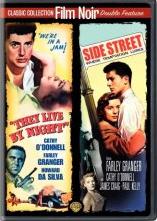
They Live By Night / Side Street

They Live by Night (1948
Cast:
Farley Granger, Cathy O’Donnell, Howard Da Silva, Jay C. Flippen, Helen Craig
Director: Nicholas Ray
In the ’30s, three prisoners flee from a state prison farm in Mississippi. Among them is 23-yo Bowie, who spent the last seven years in prison and now hopes to be able to prove his innocence or retire to a home in the mountains and live in peace together with his new love, Kitty. But his criminal companions persuade him to participate in several heists, and soon the police believe him to be their leader and go after “Bowie the Kid” harder than ever.

Side Street (1950)
Cast:
Farley Granger, Cathy O’Donnell, James Craig, Paul Kelly, Jean Hagen
Director: Anthony Mann
Joe Norson, a poor letter carrier with a sweet, pregnant wife, yields to momentary temptation and steals $30,000 belonging to a pair of ruthless blackmailers who won’t stop at murder. After a few days of soul-searching, Joe offers to return the money, only to find that the “friend” he left it with has absconded. Now every move Joe makes plunges him deeper into trouble, as he’s pursued and pursuing through the shadowy, sinister side of New York.
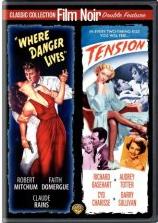
Where Danger Lives / Tension

Where Danger Lives (1950)
Cast: Robert Mitchum, Faith Domergue, Claude Rains, Maureen O’Sullivan, Charles Kemper
Director: John Farrow
One night at the hospital, young doctor Jeff Cameron meets Margo, who’s brought in after a suicide attempt. He quickly falls for her and they become romantically involved, but it turns out that Margo is married. At a confrontation, Margo’s husband accidentally gets killed and Jeff and Margo flee. Heading for Mexico, they try to outrun the law.

Tension (1950)
Cast: Richard Basehart, Audrey Totter, Cyd Charisse, Barry Sullivan, Lloyd Gough
Director: John Berry
A mousy drugstore manager turns killer after his conniving wife leaves him for another man. He devises a complex plan, which involves assuming a new identity, to make it look like someone else murdered her new boyfriend. Things take an unexpected turn when someone else commits the murder first and he becomes the prime suspect.

Film Noir’s Anti-Hero: The Outsider

Film Noir’s Anti-Hero: The Outsider

The Outsider’s case against society is very clear. All men and women have [these] dangerous impulses, yet they keep up a pretence, to themselves, to others; their respectability, their philosophy, their religion, are all attempts to gloss over, to make look civilized and rational something that is savage, unorganised, irrational. He is an Outsider because he stands for truth… the Outsider is a man who cannot live in the comfortable, insulated world of the bourgeois… because he stands for Truth. What can be said to characterise the Outsider is a sense of strangeness, or unreality… The Outsider is a man who has awakened to chaos… Even if there seems no room for hope, truth must be told… chaos must be faced.

Colin Wilson – The Outsider (1956, Gollanz, London)

Film Noir: “All I can see is in the frame”

Out Of The Past (1947)

Tonight I came across a deeply interesting paper by fellow Australian, Rafaelle Caputo, titled Film noir: “You sure you don’t see what you hear?, published in the Australian Journal of Media & Culture (Vol5 No 2 1990). Caputo studied cinema at La Trobe University and has been a writer on film for over 15 years, contributing to various journals and newspapers. The title of the paper includes a line from Out of the Past (1947).

The paper is scholarly, but has something very important to say to all fans of the genre:

There certainly is something one can point to called film noir, which starts and stops at certain points in time, which has been written about and tabled in the history of cinema, and which has been the focus of much critical debate. Equally, however, there tends to exist another film noir whose style seemingly departs from that tradition, locked away in a kind of time capsule, but which forms it own delicate lines of tradition, continuing to creep around. Finally, I feel the best way to proceed in the reading of film noir is along a path suggested by another line from Out of the Past: “All I can see is the frame … I’m going inside to look at the picture”.

Caputo’s thesis is that defining a movie as a film noir derives from it a having a “noir sensibility” rather than fitting a pre-defined template of rules or guidelines. His argument is coherent and established, inter alia, by reference to a set of films made in Hollywood over a period ranging from the 40s though to the 70s. His analysis of Out of the Past is so brilliant it makes you want to tear away and watch that timeless work yet again.

The film [Out of the Past] opens with exterior shots of an expansive landscape of mountains and forest dissolving into each other while the credits fade-in with each dissolve, until finally there is a dissolve into a stretch of highway with a road sign in the foreground pointing directions and distances for various towns. Into the shot drives a black car, casually travelling into the distance of the frame; then a cut to a travelling-shot from the rear of the car, at an angle over the shoulder of the figure dressed in black behind the steering wheel. The shot knits our point of view with his as we pass another road sign indicating the approaching town of Bridgeport. This shot is maintained until the car pulls into a gas station, but as soon as the car comes to a halt there is an almost immediate cut, still from the same camera position but at a slightly lower angle. The gas station building now takes up most of the screen space, horizontally spilling onto the road from left of frame, and in view atop the building is another sign set off against the clouds which reads ‘Jeff Bailey’. This slight change in camera angle gives the impression of the building jutting out into the car’s diagonal path as though it has forced the black-clad figure of Joe Stefanos to stop abruptly rather than stop by his own volition…

Caputo convincingly argues that Klute (1971) is not a noir. It is interesting that the forthcoming NYC Noir noir festival organised by Film Forum includes a screening of Klute.

Other films noir referred to in the article:

The Killers (1946) and The Killers (1964)
Kiss of Death (1947)
Kiss Me Deadly (1955)
Twilight’s Last Gleaming (1977)

New York City Noir: Dark Dangerous Corrupt Sexy

The Taking Pelham 123 (1974)

The NY Times today published an article, Noir and the City: Dark, Dangerous, Corrupt and Sexy, by Terrence Rafferty, covering the N.Y.C. Noir film noir festival organised by Film Forum starting Friday. See my post of July 11 for the full program.

Rafferty reviews the major pictures and the article is supported on-line with high quality stills.

GUILT, desire, fear, ambition and the bad behavior those human frailties give rise to are the favored themes of the sort of film we now call noir. So it’s hardly surprising that a fair number of these pictures are set in New York City, where guilt, fear, desire, ambition and bad behavior are pretty much a way of life. Any city will do, of course, because all cities generate a certain amount of the anxiety that film noir feeds on. And all cities, somewhere, have dark, scary streets that can, in noir’ violent allegories of moral ambiguity, stand in for the dimmer, grubbier recesses of the soul. But New Yorkers pride themselves on having more of everything than people in other cities do. If noir is the great urban style of the movies and it is then New York City is surely the noirest place on earth.  More

The Killing (1956) – Great But Not Noir?

The Killing (1956)
Stanley Kubrick’s The Killing is a great movie but it is not a film noir. Essentially it is a classic heist gone wrong story filmed in noir style. The view expressed in Steven H.Scheuer’s Movies on TV (1993-94) though brutal is fair: “Crooks plan a daring race-track robbery. Direction by Stanley Kubrick, a newcomer at the time, is unnecessarily arty but interesting.”

For me the most interesting scene is in the Chess parlor where the caper’s mastermind played by Sterling Hayden, recruits a heavy to start a distracting bar-room brawl at the track. The heavy is played by Nicholas (‘Kola’) Kwariani, a professional wrestler and wrestling promoter, and dedicated chess player who frequented “The Flea House” in New York City, which is also where this recruitment scene was filmed. As far as I know this was his only screen appearance ever!

The Killing (1956)

Kwariani has the best lines in the movie, and delivers them with a thick Eastern European accent and a perfect world-weary understanding of exactly what he is saying :

Johnny Clay (Sterling Hayden)
Maurice Oboukhoff (Kola Kwariani)

Johnny: Good game, Maurice?

Maurice: Johnny, my old friend. How are you?
Good to see you. Been a long time, eh?
How long have you been out?

Johnny: Not long.

Maurice: It was difficult, no?

Johnny: Yeah.

Maurice: Very difficult.
You have my sympathies, Johnny.
You have not yet learned that you have to be like everyone else.
The perfect mediocrity.
No better, no worse.

Individuality is a monster, and it must be strangled in its cradle to make our friends feel comfortable.

You know, I often thought that the gangster and the artist are the same in the eyes of the masses. They’re admired and hero-worshipped, but there is always present an underlying wish to see them destroyed at the peak of their glory.

Johnny: Yeah…

Download the full dialog transcript of the screenplay from Drew’s Script-O-Rama.

New DVD: Ace In The Hole (1951)

Ace In The Hole (1951)

A new Criterion DVD of the classic film noir, Ace in the Hole (1951), directed by Billy Wilder and starring Kirk Douglas, is now out and has been reviewed by Lou Lumenick in the New York Post:

“It’s dark for 2007, let alone for 1951,” says Spike Lee, who admits to stealing the flick’s famous last shot – stricken star Kirk Douglas falling, his eye within inches of the camera – for “Malcolm X.” More

Spike Lee is featured in one of the many special features on the DVD, which include a 1980 feature-length documentary on Wilder and vintage interviews with Wilder and Kirk Douglas.

Update 20 July 2007: Two more reviews of this DVD release have appeared:

Wilder’s Bleak Commentary Comes Up Ace by Chris Garcia on Austin360.com –

Some call it satire. If so, it’s satire of the bleakest stripe. It is certainly “newspaper noir,” a sub-genre marked by tough, ink-stained downers like “Sweet Smell of Success” and “Underworld Story” that expose the power of the press when it’s gone sour and scheming.

Noir’s window into American society is filthy but clear. “Ace in the Hole” presents more than a view through it. It offers a timely reflection, pushing the movie past a crack thriller and grim character study to something elegiac and urgent.

Presence of Malice by Jack Shafer on SLATE –

“Ace in the Hole” disturbs journalists because they recognize too much of themselves and their colleagues in the film’s loathsome protagonist, Charles Tatum (Kirk Douglas). Like most classic film noir tough guys, Tatum is running from a sordid past. He’s stranded in Albuquerque with no money and a car with bad tires and a burned bearing, so he ambles into the Sun-Bulletin office and pitches the straight-laced editor for a job…

Noir Lighting

The prolific Lloydville of mardecortesbaja.com has just posted a great article on film noir lighting: The Look of Noir.

It’s a commonplace of writing about film noir to see its dark, moody lighting as derived more or less directly from the German expressionist cinema of the 1920s and 1930s… There’s another, home-grown visual tradition that I think had a much clearer influence on the look of noir — the American tabloid crime photography of the 1930s and 1940s…

This closing frame from Jacques Tourneur’s Out of The Past (1947) illustrates Lloydville’s argument, with a natural flash-like highlighting of skin-tones:

Out Of The Past (1947)

While Lloydville mounts a very strong case, and knows more about the topic than me, I wonder whether the development was simply a result of using a new technology to film night scenes, rather than there being a conscious or even unconscious tabloid or other influence on directors or cameramen. A factor also is the extent to which the placement of lighting is used to light a scene. A tabloid photographer has control only over his flash and his camera’s perspective. Consider this frame, again from Out of The Past, where the only available light is deliberately placed at a back angle to the scene.

Out Of The Past (1947)

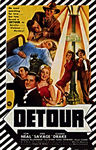
Detour (1945)

Detour (1945)

Watch, Detour, one of the great films noir on-line free at RetroTV. Starring Tom Neal, Ann Savage. IMDB Rating 7.3/10. Considered by Lloydville of mardecortesbaja.com as one of the true noirs. “He went searching for love… but Fate forced a DETOUR to Revelry… Violence… Mystery!”

Trivia: Tom Neal did time in the early 60s for shooting his third wife dead in the back of the head with a 45.  More from Lloydville.

From the IMDB Review:

This is one of the all-time great examples of film noir. It can practically be used to define the genre: shadowy black and white cinematography; a star-crossed protagonist (“…fate sticks out a leg to trip you.”); a femme fatale (the unforgettable Ann Savage as Vera); cynical voice-over narration; ambiguous morality. All these elements are brought together magnificently by director Edgar G. Ulmer, who incredibly made this movie in several days on a shoestring budget. His direction is so masterful that the low budget sets only add to the film. This is a great masterpiece and one of the marvels in film history.

Director Edgar Ulmer’s other noir credits:

Bluebeard (1944)
Strange Illusion (1945)
The Strange Woman (1946)
Ruthless (1948)
Murder Is My Beat (1955)

Books On Film Search

The Third Man

Virtual-History.Com is a great site for tracking down books on film noir generally and any books that refer to a certain film. For example this search link will not only return books on The Third Man, but a list of books that substantially reference that film:

Books about The Third Man:

Rob White, The Third Man, London, 2003

Books with substantial mentioning of The Third Man:

David Zinman, 50 Classic Motion Pictures, The Stuff That Dreams Are Made Of, New York, 1970
JerryVermilye, The Great British Films, Secaucus, N.J., 1978
Ann Lloyd (editor), Movies of the Forties, London, 1982
Anthony Slide, Fifty Classic Films 1932-1982, A Pictorial Record, New York, 1985
Neil Sinyard, Classic Movies, London, 1993
William Hare, Early Film Noir, Greed, Lust and Murder Hollywood Style, Jefferson, North Carolina, and London, 2003

Books with entries on The Third Man:

Michael F. Keaney, Film Noir Guide, 745 Films of the Classic Era, 1940-1959, Jefferson, North Carolina, and London, 2003