Noir Motifs and the Allure of Noir: The Lure of Certain Doom

Where Danger Lives

Jim Ridley of the Nashville Scene has written an excellent article, The Naked City, on the film noir genre and its allure, while reporting on the upcoming Nashville Film Noir Festival:

… real-life ruin with plausibly grubby motives… all angular shadows and slashing black-and-white… [protagonists] either slaves to temptation and lust, or tarnished knights honor-bound to clean up their mess. Hard-edged in style, hard-headed in content and [with] their resolute lack of sentiment, these movies were existentialist to the core. You made a bad choice, and you lived—or more often, died—by the consequences.
[Dark Soul] …sums up the allure of noir: the chance to experience, vicariously, how it would feel to act on the impulses we’ve been wisely conditioned to ignore.

Clash By Night (1952): Love… because we’re bored

Clash By Night (1952)
Cheating wife faces the music…

Clash by Night (1952) from Fritz Lang transcends film noir in a neo-realist melodrama that turns the film noir motif upside down and inside out. Sexual abandon and existential entitlement are put on trial and found empty.

Lang and veteran noir photographer, Nicholas Musuraca, team with Paul Douglas, and noir regulars, Barbara Stanwyck and Robert Ryan, in a deep story grounded in simple lives and normal passions, from a screenplay by Alfred Hayes and David Dortot, based on a play by Clifford Odets. A very young Marilyn Monroe is also well-cast.

The realist feel is established in the long opening sequence which simply and eloquently documents the start of the working day in the fishing community of Monterey, but only after the impending drama is telegraphed in the opening scene with waves crashing on coastal rocks at night accompanied by a portentous and strongly emotive score from Roy Webb.

On one level, the picture is pure melodrama: sexual frustration, infidelity, deception, selfishness, and betrayal. On a deeper level it is about the possibility of redemption and the power of forgiveness. A female protagonist confronts the disastrous consequences of the false choices she has made. A tour-de-force performance from Barbara Stanwyck, who in her role as Mae, delivers a profound critique:

Earl Pfieffer (Robert Ryan)
Mae Doyle (Barbara Stanwyck)

Earl: You feel guilty? That’s the way they want you to feel.

Mae: They?

Earl: The world! All the people who haven’t got guts enough to do what they want to do…

Mae: All my life I’ve walked away from things.

Earl: And what’s stopping you now? Responsibility? … I told you somebody’s throat has to be cut!

Mae:
But it’s never our’s, is it Earl? It’s always someone else’s – why?

Earl: Because they’re soft.

Mae: And we’re tough, we’re hard? And if someone suffers because of us, that’s just too bad? That’s the way life is? Huh. How many times have I told myself that. Nothing counted but me. My disappointments, my unhappiness… I thought I was being honest. I thought I wasn’t lying, but I was. I said to the world, this is what I am, take me or leave me, so that it was always on my terms that they had to accept me. But it was a trick. Can’t you see Earl? It was a trick to avoid the responsibility of belonging to someone else.

Earl: What are you giving me? An hour ago you were in love.

Mae: I don’t know what the word means anymore. Not the way we use it.

Earl: You knew yesterday…

Mae: Love because we’re lonely, love because were frightened, love because we’re bored.

Clash By Night (1952): Love… because we’re bored

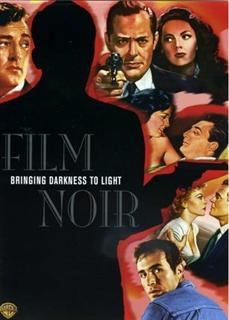
Film Noir: Bringing Darkness to Light (2006)

Film Noir Bringing Drakness To Light (2006)

A recent production from Leva FilmWorks on film noir, with a lot of talking heads and movie clips. A fair effort with well selected clips, but too focused on a limited selection of movies: no mention of Robert Siodmak or his pictures, and way too much attention paid to the inferior b-noir Decoy (1946).

The talking heads reprise established commentary and are settled in their views, but the contributions of James Ellory, who opens the film, are refreshing and challenging. He speaks with intense respect for the genre and careful precision: [film noir] exposited one great theme, and that great theme is “your fucked”.

Warner Home Video presents Film Noir: Bringing Darkness to Light as a bonus disc in their Film Noir Classic Collection: Vol. 3 box-set, with five 20-min. programs from the MGM series “Crime Does Not Pay” — “Women In Hiding” (1940), “You, the People” (1940), Fred Zinneman’s “Forbidden Passage” (1941), Joseph Losey’s “A Gun in his Hand” (1945), and “The Luckiest Guy in the World” (1947).

Rififi (France 1955): America’s Loss France’s Gain

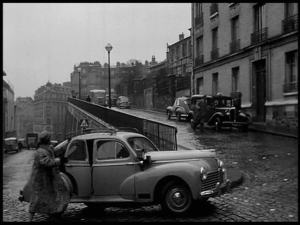
Rififi (France 1955)

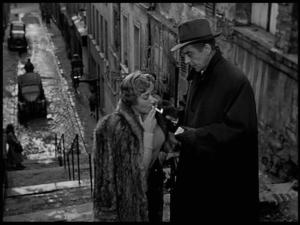
Rififi has to be the greatest French film noir of the 50’s. The taught direction of Jules Dassin, working in France after his blacklisting by the HUAC, has Paris in deep focus in this classic heist gone wrong picture. An excellent cast and sexy night-club interlude culminating in the terrific final scenes of a car desperately careening through the streets of Paris, make an absorbing and sobering thriller. The whole action is underpinned by an evocative and hip jazz score.

The best line in the movie is given to a peripheral character, the wife of one of the hoods, whose young son is kidnapped by a rival gang, and in her anger and angst calmly confronts him with these words:

There are kids… millions of kids who have grown up poor. Like you.
How did it happen… What was the difference between you and them that you became a hood, a tough guy, and not them?
Know what I think Jo, they’re the tough guys, not you.

Rififi (France 1955)

Rififi (France 1955)

Post-Noir: The New Hollow Men

May I suggest that neo-noir is over, and that we have entered the post-noir age.

Too many film pundits today are happy to spout the received wisdom that film noir was a response to some pervasive (but in reality non-existent) post-WW2 trauma-cum-malaise, and then uncritically enlist this (thoroughly) conventional wisdom as some contrived justification for the plunge of contemporary American cinema into an abyss of banal fascist violence: most recently American Gangster, Death Proof, Gone Baby Gone, Before the Devil Knows You’re Dead, and No Country for Old Men. Each of these tales of psychopathology are seen as relevant and somehow redeemed by technique or more commonly by referring to a film as being noirish, a homage to film noir, or darkly violent, with technique elevated over content.

For example, this is Chris Garcia, the Austin American-Statesman’s film writer, in an article Wednesday (forgive the length of the excerpt – it is a long article):

Topics in the larger movie picture, compelling trends — the return of film noir, the evolution of artists such as Johnny Depp and Sidney Lumet — that tickled the mind in 2007, have me wondering how they will play out this year and after.

Will there be (more) blood?

In mid-2006, I wrote about a resurgence of film noir, arguing that noir was back, bleak and bloody as ever, faithfully pessimistic, glibly projecting harsh views of human nature, about which it doesn’t trust as far as it can spit a gnawed toothpick.

I’m an iffy prognosticator, but I know and love my noir, so this stubborn trend hijacked my senses and made me watch. Especially because it didn’t abate in 2007. Indeed, it thrived.

Between 2005-06, a rash of crime noirs honored the savage codes and shadowy flourishes of the form: “Sin City,” “Miami Vice,” “Derailed,” “Brick,” “Kiss Kiss Bang Bang,” “The Ice Harvest” and “The Departed,” not to mention scads of Asian noirs, such as Hong Kong’s nifty “Election.”

Liking what it saw, 2007 bulged with the violently noirish — “American Gangster,” “Gone Baby Gone,” “Before the Devil Knows You’re Dead,” “No Country for Old Men,” “Eastern Promises,” “We Own the Night” and the reconstituted “Blade Runner: The Final Cut” — as well as the simply darkly violent, such as “3:10 to Yuma” and “Sweeney Todd.” (This is no country for gore-nography like “Hostel 2” and “Halloween” — mindless, amoral kid’s stuff.)

But why noir, why now?

Hollywood tied a tourniquet on bloody downer films following the Sept. 11, 2001, attacks, heralding a new sobriety at once respectful and, dare we say, craven. The national mood and all. But with these newer movies, Sept. 11 anxiety has demonstrably eased.

Eased, not vanished. And that’s the rub. We are still encumbered by moral confusion, convulsed by a faraway war gone sour, social and economic instability at home, fear-mongering about attacks on our soil, a pilloried presidential administration soon to be pushed into history by a giant, generational X factor.

We, as a nation, are nervous.

Such were the climes when film noir made its unofficial bow in ’40s and ’50s Hollywood, with a pained parade of often low-budget meditations on moral depredation, cruelty, lawlessness and social nihilism: “The Big Sleep,” “Out of the Past,” “Double Indemnity” “Kiss of Death,” “Detour,” “Kiss Me Deadly,” to name some of the best known.

These unusually grim pictures were a response to America’s post-World War II temperament. The Depression had lifted, yet a new malaise smudged the national view-finder. Dark films were born from dark times. Momentarily gone were the screwball romps and spangled musicals of the ’30s.

Parallels exist today. The events in New York and Washington, D.C., are enshrined in recent history, but we still feel queasy. And cinematic art reflects it, not here and there, but in the clot of films depicting murder, misanthropy and endings far from tidy, happy.

Bad brothers rob their parents’ jewelry store and their world collapses in a destructive heap in “Before the Devil Knows You’re Dead.” After a healthy body count, an undercover cop is seduced irrevocably into the gangster badlands he was assigned to dismantle in “Eastern Promises.” No one wins after the solving of a kidnapping reveals that few are good, not even the law, and the hero is left to agonize over a fatal decision in “Gone Baby Gone.” Fueled by a classic noir set-up and characters — a decent everyman pulled to ruin; a psychotic killer; a good but impotent cop — “No Country for Old Men” ends in a moral haze so thick it chokes.

As a moviegoer and crime genre fan, I’m perfectly at ease with these harrowing depictions of humankind and the climate in which it seeks, skulks and hides.

But will the trend continue this year and after? Check back after Jan. 18. That’s when the punishingly misanthropic “There Will be Blood” opens in Austin. The title says it all.

I have seen only two of these recent films: Gone Baby Gone, and Before the Devil Knows You’re Dead.

Ben Affleck returns to his home-town Boston for this directorial debut, Gone Baby Gone, a strange violent story of nostalgia and social mis-critique. Working-class Boston is portrayed in a pseudo-realist opening sequence of urban ennui and alienation as some “lost” place, where an urban flatfoot and his girl-friend get to play judge jury AND executioner, with a climax where the gumshoe executes an un-armed and deranged psychopath in a squalid tenement. Fascist violence as urban justice – rollover Tarantino.

From an arrogant novice to a disturbingly angry old man. Sidney Lumet’s Before the Devil Knows You’re Dead is an ugly urban fable, that by it’s end leaves you stunned as to why this film should have been made at all. A family of psychotics in a killing frenzy like the sharks in Orson Well’s The Lady From Shanghai: Then the beasts took to eating each other. In their frenzy… they ate at themselves. You could feel the lust of murder like a wind stinging your eyes. And you could smell the death reeking up out of the sea.

This is a post-noir cinematic wasteland where coherence and social awareness are sacrificed to the hollow men of contemporary Hollywood:

We are the hollow men
We are the stuffed men
Leaning together
Headpiece filled with straw. Alas!
Our dried voices, when
We whisper together
Are quiet and meaningless
As wind in dry grass
Or rats’ feet over broken glass
In our dry cellar

Shape without form, shade without colour,
Paralysed force, gesture without motion…

(From “The Hollow Men” T.S. Eliot)

A Psychoanalysis Of Noir

I am currently reading, the first ever book about film noir, A Panorama of American Film Noir, 1941-1953, published in France in 1955, and only translated into English in 2000.

It is a revelation. Authors Borde and Chaumeton, in seeking to explain why films noir appeared, see a major influence as the emergence of a wider awareness of psychoanalysis and its motifs in America at the time. Their analyses of their canon of the first big three post-war noirs are centered on the films’ dream-like qualities and the emergence of protagonists with pronounced psychoses: The Big Sleep (1945), Gilda (1946), and The Lady From Shanghai (1947).

Within the noir series Gilda was a film apart, an almost unclassifiable movie in which eroticism triumphed over violence and strangeness. Howard Hawke’s The Big Sleep is, on the other hand, a veritable classic of the genre, the essential laws of which it encapsulates… The Lady From Shanghai is a film noir in the full sense of the term… the director’s [Orson Welles] personality bursts out at every step, extends beyond the bounds of the series, and streams forth in a whole series of marvelous images.

The authors’ views on each of these movies are deeply eloquent. Very brief excerpts follow.

Gilda (1946)

Gilda: [the] apparently disconcerting plot is often… studied in the extreme… [tracing] … in the umpteen wrangles of Johnny Farrell, torn between Gilda and her husband, who’s clearly a father substitute father for him.

The Big Sleep

The Big Sleep: The sordid settings and their bizarre details, the brief but merciless fistfights, the furtive murders, the sudden reversal of roles, the “objects” in the Surreal sense of the word… the eroticism of blood and pain (Vivian kissing Marlowe’s bruised lips) … the wild dancing of the women… Never will film noir further the the description of a cynical, sensual, and ferocious world.

The Lady From Shanghai (1948)

The Lady From Shanghai: The main characteristic of this confused story is an atmosphere of malaise. But [the film] is mainly impressive for its extraordinary technical mastery… when the drama begins to take shape, the virtuosity of the direction becomes perceptible: a motley assortment of mobile shots, tilted frames, unexpected framings, long circular panning or tracing shots.

It is interesting that Borde and Chaumeto see virtuosity where the accepted wisdom is that these elements are weaknesses arising from post-production studio ‘butchering’ of Welles’ original vision. The authors indicate they were aware of this intervention.

[piclens-lite-link]

The Noir Anti-Hero

The Set-Up (1949)

Today I came across an article by one Tom Hart on the (alleged by some) neo-noir film Sin City in an obscure UK students portal.

Hart argues that this movie among other things bastardises the conventions of film noir insofar as there is no redeemed anti-hero. Strangely though he goes on to illustrate his point by referencing Bogart’s Rick in Casablanca.

What is interesting is Hart closes his piece with a nice take on the noir protagonist:

Noir anti-heroes can be amoral, cynics, corrupt, tormented by angst, ambiguous, absurd, but they are never, in the final event, without the courage to choose the absurd path in life. Sin City provides the basis for a great noir, but fails to deliver a redeemed anti-hero.

As Albert Camus observed:

‘In the midst of winter, I finally learned that there was in me an invincible summer.’

Film Noir and The Unconscious

The Killers

These on-line papers from the 2004 Conference of the Society for Critical Exchange make fascinating reading.

Shadowing Film Noir: Hollywood’s Political Unconscious

A Touch of Yellow in Film Noir
Sheng-mei Ma, Michigan State U.

‘Queer Eye’ for a ‘Straight Dick’: Contextualized Homosexuals in Film Noir
Scott F. Stoddart, Marymount Manhattan C

Face Plates: T-Men, Counterfeiting, and Noir Representation
Mark Osteen, Loyola C.

Toward a Definition of Film Noir

The File On Thelma Jordan

In their seminal book, A Panorama of American Film Noir, 1941-1953, authors Raymond Borde and Etienne Chaumeton, closed the opening chapter with these thoughts on the recurring motifs of films noir in the classical period:

It is easy to come to a conclusion: the moral ambivalence, criminal violence, and contradictory complexity of the situations and motives all combine to give the public a shared feeling of anguish or insecurity, which is the identifying sign of film noir at this time. All the works in this series exhibit a consistency of an emotional sort; namely, the state of tension created in the spectators by the disappearance of their psychological bearings. The vocation of film noir has been to create a specific sense of malaise. (p.13)

In his Introduction to the English translation, James Naremore refers to the Surrealist critique of cinema, and makes this telling observation:

At certain moments, even in ordinary genre film or grade-B productions, [cinema] could involuntarily throw off bizarre images, strange juxtapositions, erotic plays of light and shadow on human bodies, thus providing an opportunity for the audience to break free of repressive plot conventions and indulge in private fantasies. (p.xi)

The Big Combo (1955): Quintessential Noir

The Big Combo (1955)

Obsessed cop hunts down a psychotic crime boss

You think this is a mink… you think these are the skins of little wild animals sewn together for your pleasure – you’re mistaken… these are the skins of human beings… people, who have been beaten, sold, robbed, doped, murdered by Mr Brown.

I live in a maze… a strange blind backward maze, and all the little twisting paths lead back to Mr Brown.

The Big Combo is the greatest film noir of the 50’s: put simply a masterpiece of the genre. Directed by maverick “B” director Joseph H. Lewis and filmed by master cinematographer John Alton from a tight screenplay from Philip Yordan, this movie is totally engrossing and visually stunning. Each scene is a study in composition and expressionist lighting. The cast is exceptionally strong and each player delivers a nuanced performance. The hip 50s score of David Raksin introduced over the opening credits is both surreal and portentous.

There are no femme-fatales but three women who are pivotal to a tragic story of sex, obsession, psychosis, and perverted love.

While not wishing to downplay Jean Wallace, who is arresting as the female lead, for me Rita, the stripper and erstwhile girlfriend of the obsessed cop, holds the central interest. Played beautifully by Helene Stanton, a B actress in her first role (followed by some other minor roles until she disappeared into obscurity in 1957), Rita is the most fascinating and real person in the story: any more about the role will risk spoilers.

The Big Combo (1955)

Her scenes linger long in the memory, and when the film is over you realise how much integrity she has. That Helene Stanton could bring such depth to a supporting role is testimony to her strength as an actress and director Lewis’ ability to foster strong performances from raw talent.

If you only ever see one film noir, this is it.

The Big Combo