Your Ghost: “let him shoot me down”

Meshes of the Afternoon (1943)

Your Ghost (1994) – Kristin Hersh

If I walk down this hallway, tonight,
It’s too quiet,
So I Pad through the dark
and call you on the phone
Push your old numbers
and let your house ring
til I wake your ghost.
Let him walk down your hallway
it’s not this quiet
slide down your receiver
sprint across the wire
follow my number
slide into my hand.

It’s the blaze across my nightgown
it’s the phone’s ring.

I think last night
you were driving circles around me.

I can’t drink this coffee
til I put you in my closet
let him shoot me down
let him call me off
I take it from his whisper
you’re not that tough.

The Sound of Film Noir

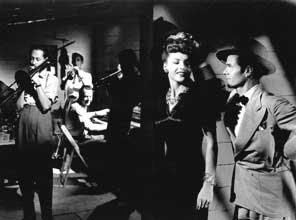
Phantom Lady (1944)

Robert Cumbow of the Parallax View blog has posted a very interesting article on film noir music scores discussing its origins, development,  and major composers from the early noirs to recent neo-noirs:

The sound of noir—plaintive sax solos, blue cocktail piano, the wail of a distant trumpet through dark, wet alleyways, hot Latin beats oozing like a neon glow from the half-shuttered windows of forbidden nightspots. You walk the sidewalks of big, lonely towns, with no destination in mind, following only the sounds, guided by them, wondering where they come from, what hurt souls cry out with such tones.

Mr Cumbow also highlights CD compilations of note.

Film Noir and The Doors

The Doors - Strange Days
Cover of The Door’s album Strange Days

As a child of the 60s, my favorite rock band is The Doors. The band’s innovative music and the dark subterranean lyrics of Jim Morrison never cease to enthrall me.  In previous posts I have featured lyrics from the band’s last album LA Woman:

At this year’s Sundance Festival, veteran feature-filmmaker Tom DiCillo will release his first documentary, When You’re Strange (2009), which documents the LA band’s rise in the mid-60s.

In an interview on SPOUTblog, DiCillo said: “I’ve always, always been turned on by music, and by film. The Doors’ music is extremely cinematic. Their music is very dense and highly emotional. It deals a lot with character, and blood, murder and a lot of crazy things.”

Ray Manzarek, the band’s keyboardplayer, agrees that The Doors were inspired and influenced by cinema.  Both he and Jim Morrison came out of the UCLA film school. “That’s where we became friends”, Manzarek said, “We’re definitely cinematic.” Morrison and Manzarek took film classes taught by director Josef von Sternberg.  Manzarek said von Sternberg inspired many of The Doors lyrics regarding moral ambiguity and dark eroticism.

Ain’t talkin’, just walkin’: Ain’t no altars on this long and lonesome road

Ain’t Talkin’
Words and Music by Bob Dylan (2006)

As I walked out tonight in the mystic garden
The wounded flowers were dangling from the vines
I was passing by yon cool and crystal fountain
Someone hit me from behind

Ain’t talkin’, just walkin’
Through this weary world of woe
Heart burnin’, still yearnin’
No one on earth would ever know

They say prayer has the power to help
So pray for me mother
In the human heart an evil spirit can dwell
I’m trying to love my neighbor and do good unto others
But oh, mother, things ain’t going well

Ain’t talkin’, just walkin’
I’ll burn that bridge before you can cross
Heart burnin’, still yearnin’
There’ll be no mercy for you once you’ve lost

Now I’m all worn down by weepin’
My eyes are filled with tears, my lips are dry
If I catch my opponents ever sleepin’
I’ll just slaughter them where they lie

Ain’t talkin’, just walkin’
Through the world mysterious and vague
Heart burnin’, still yearnin’
Walking through the cities of the plague

The whole world is filled with speculation
The whole wide world which people say is round
They will tear your mind away from contemplation
They will jump on your misfortune when you’re down

Ain’t talkin’, just walkin’
Eatin’ hog eyed grease in hog eyed town
Heart burnin’ – still yearnin’
Someday you’ll be glad to have me around

They will crush you with wealth and power
Every waking moment you could crack
I’ll make the most of one last extra hour
I’ll avenge my father’s death then I’ll step back

Ain’t talkin’, just walkin’
Hand me down my walkin’ cane
Heart burnin’, still yearnin’
Got to get you out of my miserable brain

All my loyal and much loved companions
They approve of me and share my code
I practice a faith that’s been long abandoned
Ain’t no altars on this long and lonesome road

Ain’t talkin’, just walkin’
My mule is sick, my horse is blind
Heart burnin’, still yearnin’
Thinkin’ ‘bout that gal I left behind

It’s bright in the heavens and the wheels are flying
Fame and honor never seem to fade
The fire’s gone out but the light is never dying
Who says I can’t get heavenly aid?

Ain’t talkin’, just walkin’
Carrying a dead man’s shield
Heart burnin’, still yearnin’
Walkin’ with a toothache in my heel

The suffering is unending
Every nook and cranny has it’s tears
I’m not playing, I’m not pretending
I’m not nursing any superfluous fears

Ain’t talkin’, just walkin’
Walkin’ ever since the other night
Heart burnin’, still yearnin’
Walkin’ ‘til I’m clean out of sight

As I walked out in the mystic garden
On a hot summer day, hot summer lawn
Excuse me, ma’am I beg your pardon
There’s no one here, the gardener is gone

Ain’t talkin’, just walkin’
Up the road around the bend
Heart burnin’, still yearnin’
In the last outback, at the world’s end

Copyright © 2006 Special Rider Music

LA Woman: “so alone…”

LA Woman

…Drivin’ down your freeways
Midnight alleys roam
Cops in cars, the topless bars
Never saw a woman…
So alone, so alone
So alone, so alone
Motel money murder madness…
Lets change the mood from glad to sadness

LA Woman – The Doors (1971)

Shades of Jazz on Noir

DOA (1950)

For noir cum jazz fans, and if you are in NY there are other venues and dates:

Shades of Jazz on Noir
Wednesday, April 23 7-9pm
Shades of Jazz on Noir is a performance project combining excerpts from classic films noir of the 40s and 50s projected onto a cinema screen and accompanied by live improvised jazz. More

Jim Morrison: LA Woman – Cars Hiss By My Window

Double Indemnity (1944)

The cars hiss by my window
Like the waves down on the beach
The cars hiss by my window
Like the waves down on the beach
I got this girl beside me
But she’s out of reach

Headlight through my window
Shinin’ on the wall
Headlight through my window
Shinin’ on the wall
Can’t hear my baby
Though I called and called…

Windows started tremblin’
With a sonic boom
Windows started tremblin’
With a sonic boom, boom
A cold girl’ll kill you
In a darkened room

Cars Hiss By My Window :Track 4 – LA Woman – The Doors (1971)

Breathless (A Bout De Souffle) – France 1959: New Wave Noir

Breathless (A Bout De Souffle) - France 1959: New Wave Noir

This iconoclastic debut by the French New Wave pioneer, Jean Luc Godard, has been re-released on a 2 disc DVD set with a new HD digital transfer from Criterion. The transfer has been supervised by the original director of photography of Breathless, Raoul Coutard. In the words of Amazon contributor, Jonathan E. Haynes “jehaynes” (Berkeley, CA): “With Coutard involved in Criterion’s issue, the film has undoubtedly been restored to some of its original, shocking, ragged beauty”.

The second disc includes archival interviews with the director and Jean-Paul Belmondo, who plays the young punk with noir affectations. Jean Seberg is perfect as the young American student in Paris ‘living dangerously’.

Breathless (A Bout De Souffle) - France 1959: New Wave Noir

Australian critic, Adrian Martin in 2004: “there is a semblance of a thriller plot complete with a betrayal, tailing cops, and a final shootout… but the subtle, formal pleasures of Breathless have yet to be fully appreciated. Whether through accident or design, Godard’s low-budget on-the-fly shooting style produced remarkable innovations.”

Forget about Tarantino, Godard is the genuine originator of (Martin again) “the mixture of loose gangster-crime plot, a smart attitude, and a hip array of high and low culture citations… and there is an insolent mildly outrageous rap pouring from Belmondo’s punk motormouth, but even that scarcely contradicts the Chandler-Hammett-Spillane tradition of hard-boiled talk.” (1001 Movies)

The original film noir jazz score by Martial Solal is available on CD:

Thieves’ Highway (1949)

Thieves’ Highway (1949)

From director, Jules Dassin, whose earlier films included the noirs, Brute Force (1947) and The Naked City (1948), Thieves’ Highway about the struggles of truckers trying to make a buck hauling fruit to the San Francisco produce markets, is great melodrama with a strong social conscience. It tells a story strongly rooted in the southern European migrant experience.

The screenplay was adapted by Albert Isaac Bezzerides from his novel Thieves’ Market (1949). Bezzeridis’ noir credits include Desert Fury (1947), Kiss Me Deadly (1955), On Dangerous Ground (1952), and They Drive by Night (1948). Dassin was blacklisted by the HUAC and left the US before the final cut was made, and word has it the studio axed his original “noir” ending and added a “happy-ending” re-take.

But even with a darker ending, I would not say it is a film noir. The protagonist, a straight-up guy, Nick Garcos, wants to avenge his Greek father’s maiming by a crooked wholesaler and risk his last dime on a freight trip that will give him the stake he needs to settle down with his hometown sweetheart – the perfect role for Richard Conte. The other femme is an Italian good-time girl, played beautifully by Italian actress, Valentina Cortese, who never really wants to hurt him, but is only drawn into the story by the conniving of the wholesaler, Mike Figlia, gleefully played by Lee J. Cobb.

What struck me is how well each of the main characters is drawn, and how the rush to get the load of apples to the market, propels the story, and the character development. The most potent scene is when Nick is pinned under his truck after the changing of a flat tyre goes wrong, just off the busy highway, where a never-ending stream of trucks rip through the night: the world is not going to stop for one poor guy stuck under his truck. Nick does survive after he is rescued by his erstwhile shady partner. This exemplifies a wonderful quality of the film: each character has a chance at redemption – only Figlia and his henchmen are too rotten achieve it.

Thieves’ Highway (1949)

Filmically it is also a great testimony to all who worked on its production. The atmosphere of the Frisco produce markets is rendered so convincingly, that it has a cinema verite quality.

Thieves’ Highway (1949)

I feel qualified to say this as this is one of the very rare times, I can directly relate to what is happening on the screen. I grew up in a small corner fruit store run by my immigrant parents in a working-class suburb of Sydney – a big harbour city with a produce market at it’s center. My father is Italian and my late mother was Greek. It was a struggle and we opened 7 days a week. During school vacation my father would wake me at 4am weekdays for the trip to the city markets, where I would haul the long barrow behind him, as he moved from stall to stall haggling to find produce at a price that he could sell and make a buck. This movie connected for me deeply.

Thieves’ Highway: a good story well told, and worth remembering.

Miklós Rózsa Centennial

On Aug. 17, the Academy of Motion Picture Arts and Sciences will kick off its Academy Centennial Salute to Miklós Rózsa at the Samuel Goldwyn Theater.
Rózsa scored a number of films noir:

Double Indemnity (1944)
Ministry of Fear (1944)
Lady on a Train (1945)
The Lost Weekend (1945)
The Strange Love of Martha Ivers (1946)
The Killers (1946)
The Red House (1947)
Brute Force (1947)
The Naked City (1948)
Kiss the Blood Off My Hands (1948)
The Bribe (1949)
Criss Cross (1949)
The Asphalt Jungle (1950)

My favorite is the Asphalt Jungle (1950). From the opening shots, Rózsa’s dramatic almost post-modern score establishes the feel of the picture, and remains in the memory forever. More from the LA Times.