James M. Cain on the Origins of Film Noir

The Postman Always Rings Twice

James M. Cain, who wrote the novels, Double Indemnity, The Postman Always Rings Twice, and Mildred Pierce, said in 1946 that the changes seen in Hollywood movies like Double Indemnity (1944):

“ [have] …nothing to do with the war [or any] … of that bunk… it’s just that producers have got hep to the fact that plenty of real crime takes place every day and that makes it a good movie. The public is fed up with the old-fashioned melodramatic type of hokum. You know, the whodunit at which the audience after the second reel starts shouting, “We know the murderer. It’s the butler. It’s the butler. It’s the butler.”

From Alain Silver and James Ursini (ed), Film Noir Reader 2,  pp 12-13

Raymond Chandler: God and The Lost Screenplay

Playback Script

During 1948-49 Raymond Chandler completed a Philip Marlowe screenplay titled Playback for Universal Pictures, but for financial and other reasons the movie was never produced. After starting a novelisation in 1953, he put the draft aside until 1957 when at the age of 70 in a final Scotch-fueled effort he completed the novel. It was Chandler’s last completed work of fiction. Chandler suffered from depression in his final years and attempted suicide in 1955. He died in March 1959 from natural causes.

In Playback the book, Chandler makes his only cameo appearance in a Marlowe story, as an old hotel lobby-sitter who gives PI Marlowe some information.  In the persona of  Henry Clarendon IV, who like Chandler in his later years used a walking cane and wore white gloves to hide a skin ailment, he says to Marlowe:

“ …you may not question a man’s religious beliefs however idiotic they may be. Of course I have no right to assume that I shall go to heaven. Sounds rather dull, as a matter of fact. On the other hand how can I imagine a hell in which a baby that died before baptism occupies the same degraded position as a hired killer or a Nazi death-camp commandant or a member of the Politburo? How strange it is that man’s finest aspirations, dirty little animal that he is, his finest actions also, his great and unselfish heroism, his constant daily courage in a harsh world—how strange that these things should be so much finer than his fate on this earth. That has to be somehow made reasonable. Don’t tell me that honor is merely a chemical reaction or that a man who deliberately gives his life for another is merely following a behavior pattern. Is God happy with the poisoned cat dying alone in convulsions behind the billboard? Is God happy that life is cruel and that only the fittest survive? The fittest for what? Oh no, far from it. If God were omnipotent and omniscient in any literal sense, he wouldn’t have bothered to make the universe at all. There is no success where there is no possibility of failure, no art without the resistance of the medium. Is it blasphemy to suggest that God has his bad days when nothing goes right, and that God’s days are very, very long?”

References:

1.    The script for Playback is available here
2.    Gene D. Phillips, Creatures of Darkness: Raymond Chandler, Detective Fiction, and Film Noir (University Press of Kentucky, 2003) pp. 217-221

Marlowe: How to make a pass…

The Big Sleep

“I’m Miss Vermilyea, Mr. Umney’s secretary,” she said in a rather chintzy voice.
“Please come in.”
She was quite a doll. She wore a white belted raincoat, no hat, a well-cherished head of platinum hair, booties to match the raincoat, a folding plastic umbrella, a pair of blue-gray eyes that looked at me as if I had said a dirty word. I helped her off with her raincoat. She smelled very nice. She had a pair of legs—so far as I could determine—that were not painful to look at. She wore night sheer stockings. I stared at them rather intently, especially when she crossed her legs and held out a cigarette to be lighted.
“Christian Dior,” she said, reading my rather open mind. “I never wear anything else. A light, please.”
“You’re wearing a lot more today,” I said, snapping a lighter for her.
“I don’t greatly care for passes this early in the morning.”
“What time would suit you, Miss Vermilyea?”
She smiled rather acidly, inventoried her handbag and tossed me a manila envelope. “I think you’ll find everything you need in this.”
“Well—not quite everything.”
“Get on with it, you goof. I’ve heard all about you. Why do you think Mr. Umney chose you? He didn’t. I did. And stop looking at my legs.”
I opened the envelope. It contained another sealed envelope and two checks made out to me. One, for $250, was marked “Retainer, as an advance against fees for professional services.” The other was for $200 and was marked “Advance to Philip Marlowe for necessary expenses.”
“You will account for the expenses to me, in exact detail,” Miss Vermilyea said. “And buy your own drinks.”
The other envelope I didn’t open—not yet. “What makes Umney think I’ll take a case I know nothing about?”
“You’ll take it. You’re not asked to do anything wrong. You have my word for that.”
“What else do I have?”
“Oh, we might discuss that over a drink some rainy evening, when I’m not too busy.”
“You’ve sold me.”

From Raymond Chandler’s last competed novel Playback (1958)

Marlowe on Dames: Trouble is my business

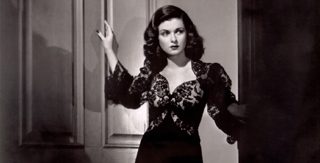
Scarlet Street (1945)

She wore a street dress of pale green wool and a small cockeyed hat that hung on her ear like a butterfly. Her eyes were wide-set and there was thinking room between them. Their color was lapis-lazuli blue and the color of her hair was dusky red, like a fire under control but still dangerous. She was too tall to be cute. She wore plenty of make-up in the right places and the cigarette she was poking at me had a built-on mouthpiece about three inches long. She didn’t look hard, but she looked as if she had heard all the answers and remembered the ones she thought she might be able to use sometime.

From Raymond Chandler’s short-story Trouble Is My Business (1939)

The Dark Cinema of David Goodis Series

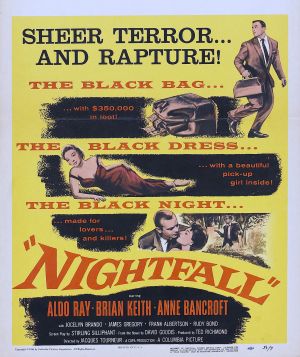
Nightfall (1957)

Streets of No Return: The Dark Cinema of David Goodis will run from August 1 – 23 at the Pacific Film Archive. Kelly Vance in a feature in today’s East Bay Express, previews the program and gives a short biography of Goodis.

The films to be shown:

And Hope to Die
The Burglar
The Burglars
Dark Passage
Descent into Hell
Nightfall
The Professional Man x Two
Shoot the Piano Player

The Unfaithful

There is a full program at the Archive’s web site.

Noir Reflections: T.S. Eliot

DOA

”damnation itself is an immediate form of salvation – of salvation from the ennui of modern life, because it at last gives some significance to living.”

T.S. Eliot: from an essay on Baudelaire (1930)

Marlowe on trade-offs

<a target="_blank" href=

Howard Penning
Reproduced under Creative Commons License

From Raymond Chandler’s novel, The Little Sister (1949):

They were never young and will never be old. They have no beauty, no charm, no style. They don’t have to please anybody. They are safe. They are civil without ever being polite and intelligent and knowledgable without any real interest in anything. They are what human beings turn into when they trade life for existence and ambition for security.

Marlowe on the moon and justice

From Raymond Chandler’s novel The High Window (1942):

The night was all around, soft and quiet. The white moonlight was cold and clear, like the justice we dream of but don’t find.

Marlowe on Blondes

From Raymond Chandler’s novel The Long Goodbye (1953):

Gloria Grahame

There are blondes and blondes and it is almost a joke word nowadays. All blondes have their points except perhaps the metallic ones who are as blond as a Zulu under the bleach and as to disposition as soft as a sidewalk. There is the small cute blonde who cheeps and twitters, and the big statuesque blonde who straight-arms you with an ice-blue glare. There is a blonde who gives you the up-from-under look and smells lovely and shimmers and hangs on your arm and is always very very tired when you take her home. She makes that helpless gesture and has that god-damned headache and you would like to slug her except that you are glad you found out about the headache before you invested too much time and money and hope in her. Because the headache will always be there, a weapon that never wears out and is as deadly as the bravo’s rapier or Lucrezia’s poison vial.

There is the soft and willing and alcoholic blonde who doesn’t care what she wears as long as it is mink or where she goes as long as it is the Starlight Roof and there is plenty of dry champagne. There is the small perky blonde who is a little pal and wants to pay her own way and is full of sunshine and common sense and knows judo from the ground up and can toss a truck driver over her shoulder without missing more than one sentence out of the editorial in the Saturday Review. There is the pale, pale blonde with anemia of some non-fatal but incurable type. She is very languid and very shadowy and she speaks softly out of nowhere and you can’t lay a finger on her because in the first place you don’t want to and in the second place she is reading The Waste Land or Dante in the original or Kafka or Kierkegaard or studying Provencal. She adores music and when the New York Philharmonic is playing Hindemith she can tell you which one of the six bass viols came in a quarter of a beat too late. I hear Toscanini can also. That makes two of them.

And lastly there is the gorgeous show piece who will outlast three kingpin racketeers and then marry a couple of millionaires at a million a head and end up with a pale rose villa at Cap Antibes, an Alfa-Romeo town car complete with pilot and co-pilot, and a stable of shopworn aristocrats, all of whom she will treat with the affectionate absentmindedness of an elderly duke saying goodnight to his butler.

The dream across the way was none of these, not even of that kind of world. She was unclassifiable, as remote and clear as mountain water, as elusive as its color.

Philip Marlowe: not so hard-boiled…

philip marlowe

From Raymond Chandler’s novel, Farewell, My lovely (1940):

It got darker.  I thought; and thought in my mind moved with a kind of sluggish stealthiness, as if it was being watched by bitter and sadisitic eyes. I thought of dead eyes looking at a moonless sky, with black blood at the corners of the mouths beneath them…

It got darker. The glare of the red neon sign spread farther and farther across the ceiling. I sat up on the bed and put my feet on the floor and rubbed the back of my neck.

I got up on my feet and went over to the bowl in the corner and threw cold water on my face. After a little while I felt a little better, but very little. I needed a drink, I needed a lot of life insurance, I needed a vacation, I needed a home in the country. What I had was a coat, a hat and a gun. I put them on and went out of the room…

‘I’m scared,’ I said suddenly. ‘I’m scared stiff… I’m afraid of death and despair,’ I said. ‘Of dark water and drowned men’s faces and skulls with empty eyesockets.  I’m afraid of dying, of being nothing…’