Blog Feed

Journey Into Fear (1943): Oriental Intrigue

Journey Into Fear (1943)

An hapless US munitions engineer visiting the Levant is the target of Gestapo spies
(1943 RKO. Directed by Norman Foster 79 mins restored version)
Unreleased preview version 91 mins

A Mercury Theater Production
Cinematography by Karl Struss
Screenplay by Joseph Cotten, Richard Collins, Ben Hecht and Orson Welles
Novel by Eric Ambler
Original Music by Roy Webb and Rex Dunn
Art Direction by Albert S. D’Agostino and Mark-Lee Kirk

Starring:
Joseph Cotten – Howard Graham
Dolores del Rio – Josette Martel
Orson Welles – Colonel Haki
Ruth Warrick – Mrs. Stephanie Graham

The official historical record has it that Orson Welles simply played a role in this movie, but original sources confirm that the film owes a lot to his creative genius. He had a part in writing the screenplay and in the direction. As Borde and Chaumeton say in their book A Panorama of Film Noir (1955):

“Journey into Fear, or ‘how fear makes people heroic’, bears the signature of Norman Foster, to be sure. But then Orson Welles collaborated on the scenario, and the exceptional breeziness and subtlety of his style emerge in the precision of the shooting script and the plastic beauty of the photography. Basing the film on a spy case that’s only a pretext and visibly turns into a hoax, Foster and Welles have rediscovered the chief laws of the noir genre: an oneiric plot; strange suspects; a silent killer in thick glasses, a genuine tub of lard buttoned up in a raincoat, who before each murder plays an old, scratched record on an antique phonograph; and the final bit of bravura, which takes place on the facade of the grand hotel of Batum. We may admire Orson Welles, with graying hair and mustache, in one of those minor, easy-going roles in which he excels: the Turkish Colonel Haki, head of the intelligence service and a womanizer.”

After mutilating The Magnificent Ambersons (1942) the year before, the studio bosses at RKO unsheathed their hatchets and hacked the completed Journey Into Fear from 91 minutes to 69 minutes for the US version and 71 minutes for the European release, and this was after various cuts from the screenplay required by the Breen office and The Legion of Decency. The 79 minute version currently available is a partial restoration, and the Welles.Net archive has a report of a further restoration. This report also provides some fascinating background on which scenes were cut.

The censors of the time, as from time immemorial, didn’t want audiences to have any fun, so as well cutting most political talk, they also had removed many scenes with ironic sexual references and any mention of religion. Still Journey Into Fear survives as a fascinating movie with moody atmospherics, exotic locales, sexy dames, weird villains, politics, wisdom, philosophy, and a wry humor.

A flawed gem, the picture is in a class of its own, and reminds me of John Huston’s glorious Beat The Devil (1953). Both movies have one guiding tenet: life is meant to be irreverent fun!

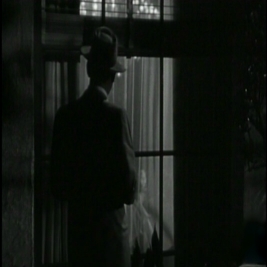
The beautiful opening shot before the credits that cranes up and peers into the window of a dingy hotel room at night and ends only after 80 seconds when the occupant leaves, and the magnificent climax on the outside ledges of another hotel at night during a rain-storm, are signature Welles. Welles has been quoted as saying that during filming, while the job of direction was given to Norman Foster, scenes were directed by “whoever was nearest the camera”. Bosley Crowther wrote in the NY Times on the film’s release: “that final duel in the beating rain on the ledge of a Batum hotel Mr. Foster [sic] has directed a melodramatic climax that is breathless and intense.”

Journey Into Fear (1943)

Those familiar with the early novels of Englishman, Eric Ambler, will know that the on-screen person of Joseph Cotton is a perfect fit for the typical Ambler hero: a timid middle-class everyman who becomes unwittingly embroiled in a nefarious and dangerous caper where he discovers guile and courage he never thought himself capable of, and after his adventure, is happy to return to the succour of a comfortable obscurity. Welles himself has a rollicking good-time hamming it up as a womanising Turkish intelligence officer. Dolores Del Rio is wonderful as a cabaret singer with sexy exotic charm, loyalty, and a calm worldly-wise aplomb: she is the perfect foil to the shy and unromantic Cotten.

The art direction for the early cabaret scene where Cotton is made to realise he is the target of a hit-man is beautifully evocative, and the whole sequence is immensely entertaining. When the action quickly moves to a tramp steamer, the sense of claustrophobia is deftly handled. To quote Crowther again: “The fright of the ordnance expert is constantly underscored by an uncanny use of light and distorted shadows in the ratty corridors of the ship; in a blacked-out cabin one senses the terror of the hidden expert as footsteps echo from the pitch-dark screen”.  Supporting roles that impinge on the protagonist have significant dialog and their characterisations are deeply drawn and well-acted. These characters also act as a philosophical chorus in scenes that while having a peripheral connection to the action, are anchored with elegant ruminations on god, war, love, death, politics, and marriage.

This is a connoisseur’s film: for those who rejoice in its eccentricities, wit, and romantic melodrama, while lamenting what has been lost to the barbarians.

Noir Westerns: A new take

Pursued (1947)

Michael Shepler, cultural coordinator for  PoliticalAffairs.net, has written an interesting article on noir westerns, Sagebrush Noir: The Western as ‘Social Problem’ Film. Schleper traces the origins of film noir from German expression through to the 50’s, and cites some Hollywood films of the 30s that are not usually referred to in discussions of film noir:

There were some pioneer American noirs such as Rowland Brown’s Beast of the City and Mamoulian’s City Streets and even a few embryonic westerns such as Wyler’s exceedingly grim version of the much filmed ‘Three Godfathers’ story, ‘Hell’s Heroes’ , shot in 1930.

He then goes on to review four western movies which he labels ‘Sagebrush Noirs’: Raoul Walsh’s Pursued (1947), Robert Wise’s Blood on the Moon (1948), and two early westerns by Anthony Mann,  The Furies (1950) and Devil’s Doorway (1950).  Other films noted by Shepler include Ramrod, Springfield Rifle, and Day of the Outlaw by Andre de Toth;  Jubal, 3:10 to Yuma, Cowboy and The Hanging Tree by Delmer Daves; Budd Boetticher’s Randolph Scott westerns  7 Men From Now (1957) and Comanche Station (1960);  Little Big Horn (1950) by Charles Marquis Warren; Sam Fuller’s I Shot Jesse James and Forty Guns; and two low budget Anthony Quinn films, The Man From Del Rio and The Ride Back which, were associated with Robert Aldrich’s ‘Associates and Robert Aldrich’ studio and produced during the same period as Kiss Me Deadly.

The full article is highly recommended.

White Heat (1949): Fission Noir

White Heat (1949)

Story of a psychotic hood with an Oedipus complex
(1949 Warner Bros. Directed by Raoul Walsh 114 mins)

Cinematography by Sid Hickox
Screenplay by Ivan Goff and Ben Roberts from a story by Virginia Kellogg
Original Music by Max Steiner
Art Direction by Edward Carrere

Starring:
James Cagney – Arthur ‘Cody’ Jarrett
Virginia Mayo – Verna Jarrett
Edmond O’Brien – Vic Pardo – alias for undecover cop Fallon
Margaret Wycherly – Ma Jarrett

Film Noir Filmographies:
Raoul Walsh: They Drive by Night (1940), High Sierra (1941)
Sid Hickox: To Have and Have Not (1944), The Big Sleep (1946), Possessed (1947),
Dark Passage (1947)
Virginia Kellogg: T-Men (1947) (story), Caged (1950) (screenplay)
Edward Carrere: Dial M for Murder (1954), I Died a Thousand Times (1955),
Sweet Smell of Success (1957)

White Heat (1949)

“White Heat = Scarface + Psycho” – Time Out

“The most gruesome aggregation of brutalities ever presented under the guise of entertainment” – Cue

“In the hurtling tabloid tradition of the gangster movies of the thirties, but its matter-of-fact violence is a new post-war style” – Time

“a wild and exciting picture of mayhem and madness” – Life

“an incendiary performance by James Cagney” – The Rough Guide to Film Noir

“Cagney is an epileptic and a borderline psychotic, and the cinema has rarely gone this for in a description of a true Oedipus” – A Panorama of American Film Noir (1955)

“Cagney… seems to incarnate the unstable explosive energies set loose by atomic fission” – Andrew Spicer in Film Noir

“A tragic grandeur… is achieved and culminates in Cody’s delirious and explosive self-immolation atop a metallic pyre” – Film Noir: An Encyclopaedic Reference

White Heat (1949)

From the daring and brutally violent train robbery that opens the film, this gangster flick has a relentless trajectory that ends only with the incendiary finale-de-resistance. Director, Raoul Walsh, and cinematographer, Sid Hickox, have produced one of the tautest and most electric thrillers ever to emanate from Hollywood, which together with the nuanced screenplay, has the spectator strapped into an emotional strait-jacket that is released only in the final explosive frames.

Jimmy Cagney as the criminal psychotic Cody Jarrett dominates the screen in a bravura performance that is as dynamic as it is intense. Edmond O’Brien as the undercover cop Fallon, is no match for Cagney, and appears flat and almost irrelevant. Cody’s razor-sharp intelligence, and unflinching decisiveness and brutality propel the action – Fallon and the other cops can only follow in his wake. Virginia Mayo is well-cast as Cody’s slatternly wife, and is as cheap and conniving as any gangster’s mole before or since. Only Ma Jarrett matches her in evil guile.

The film-making team conspires to hold you not only in awe of Cody but also to perversely empathize with him. Strange to say he is the only genuine character in the motley crew organised for the final disastrous heist. Even Fallon comes off looking lifeless and less than honorable. The mise-en-scene is calculated to subvert your moral compass. Cody is decisive and acts without hesitation or qualm, while Fallon’s actions are reactive and ponderous. When Fallon tries to sneak out of the gang’s hide-out on the eve of the heist to alert his superiors, he is way-laid and has to concoct a story about wanting to hook-up with his ‘wife’ for the night, as Cody talks intimately and almost poetically to him of his grief for his dead mother, and how he was just ‘talking’ to her when wandering in the brush outside.

In the final shoot-out Cody is pinned atop a gas storage silo at an LA refinery, while Fallon from a safe distance takes pot-shots at him with a sniper’s rifle. Cody won’t go down, and only when he wildly shoots his pistol into the silo is his fate finally sealed. Fallon looks far less heroic…

Sci-Fi Noir: New Book

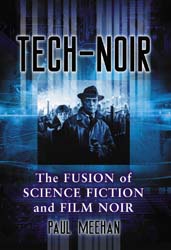
Tech-Noir

A new book Tech-Noir: The Fusion of Science Fiction and Film Noir by Paul Meehan has been published.

The publishers description:

This critical study traces the common origins of film noir and science fiction films, identifying the many instances in which the two have merged to form a distinctive subgenre known as Tech-Noir. From the German Expressionist cinema of the late 1920s to the present-day cyberpunk movement, the book examines more than 100 films in which the common noir elements of crime, mystery, surrealism, and human perversity intersect with the high technology of science fiction. The author also details the hybrid subgenre’s considerable influences on contemporary music, fashion, and culture.

The book has received a favorable review from film writer John Muir.

The Ghost Ship (1943): Noir at Sea

The Ghost Ship (1943)

The mad captain of a coastal freighter terrorises a rookie 3rd officer
(1952 RKO. Produced by Val Lewton and directed by Mark Robson 69 mins)

Cinematography by Nicholas Musuraca
Screenplay by Donald Henderson Clarke from a story by Leo Mittler
Original Music by Roy Webb
Art Direction by Albert S. D’Agostino and Walter E. Keller

Starring:
Richard Dix –  Captain Will Stone
Russell Wade – Tom Merriam, 3rd Officer
Skelton Knaggs – Finn, the mute crewman

CAPTAIN:
I’ll explain now. I told you you
had no right to kill the moth. That
its safety did not depend on you.
But I have the right to do what I
want with the men because their
safety does depend on me.
I stand ready any hour of the day
or night to give my life for their
safety and the safety of this
vessel — because I do, I have
certain rights of risk over them.
Do you understand?

At the outset, you should be aware that contrary to the expectations conjured by the film’s lurid poster, there are no nubile woman and no ghosts in this movie. Indeed, there are no women on the ship when it is at sea, where most of the action occurs.  The only woman that has a significant role is a plain and very proper middle-aged spinster carrying a torch for the captain, who visits the ship in port.

A strange film, The Ghost Ship, was out of circulation for 50 years shortly after its initial release due to a plagiarism suit.  Produced by Val Lewton’s horror unit at RKO, it is not a horror movie but a psychodrama with a strong atmosphere of entrapment. The production team of the magnificent The Seventh Victim made earlier in the same year transferred directly to this picture.  The actual story is simple and as most of the action occurs on a set, cameraman, Nicholas Musuraca, has few opportunities to bring a deeper focus to the action, though set-bound lighting and fog are used to good effect.

The Ghost Ship (1943)

The film is dominated by actor Richard Dix, who was nominated for a Best Actor Oscar for his performance in Cimarron (1931), winner of the Best Picture Oscar that year. He was a big box-office draw at RKO during the 30s appearing in mystery thrillers, pot-boilers, westerns and program fillers, and appeared in the “Whistler” series of mystery films at Columbia in the mid-40s. His portrayal of the insane Captain Will Stone is masterfully understated.  Bit-player Russell Wade  is believable as the rookie, a role he specialised in.  A suitably mysterious turn by Skelton Knaggs as Finn, the mute crewman whose dark voice-over narration adds a gothic dimension to proceedings, provides depth and a mystic counterpoint to the very real menace of the mad Captain. Finn is not just a chorus to the action as he has a pivotal role in the climactic resolution.  Quite another mystery is why his contribution went uncredited.

The arc of the film is the cat-and-mouse game between the captain and his 3rd officer, who has no escape as he is trapped on the ship commanded by his pursuer.  The terror of the 3rd officer’s entrapment is brilliantly portrayed in his cabin one night when each sound is ominous, and the sinister crescendo progressively pushes him further and further into a paralytic terror.

The calm exterior of the captain has the rest of the crew fooled, and the young man’s isolation is desperate, with the claustrophobic tension sustained right into the brutal climax.

A film you might think is slight immediately after viewing, subconsciously insinuates itself into your memory. A must see movie.

FINN (voice-over narration):
The man is dead. The waters of the
sea are open to us. With his blood
we have bought passage. There will
be the agony of dying and another
death before we come to land again.
Men’s lives are the red coin thrown
into the sea so that we may come
and go across the waters.

Noir City 2009 Program

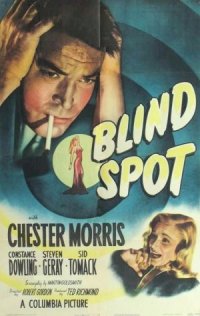
Blind Spot (1947)

Thanks to Dark Cty Dame for advance details of the program for NOIR CITY 7, the 2009 San Francisco Film Noir Festival, to be held January 23–February 1, 2009, at the Castro Theatre, and which will have a newspaper theme:

Friday, January 23
Deadline USA (1952)
Scandal Sheet (1952)

Saturday, January 24
Matinee:

Chicago Deadline (1949)
Blind Spot (1947)
Evening show (with Arlene Dahl):
Slightly Scarlet (1956)
Wicked as They Come (1956)

Sunday, January 25
Ace in the Hole (1951)
Cry of the Hunted (1953)

Monday, January 26

Alias Nick Beal (1949)
Night Editor (1946)

Tuesday, January 27

The Harder They Fall (1956)
Johnny Stool Pigeon (1949)

Wednesday, January 28

While the City Sleeps (1956)
Shakedown (1950)

Thursday, January 29

The Big Clock (1948)
Strange Triangle (1946)

Friday, January 30
The Unsuspected (1947)
Desperate (1947)

Saturday, January 31
Matinee:
Two O’Clock Courage (1945)
Beyond a Reasonable Doubt (1956)
Evening show:
One False Move (1992)

Sunday, February 1

Shock Corridor (1963)
The Killers (1946) (newly restored)

Full details to be announced.

Film Noir Notes: New Melville DVDs and San Francisco Noir Locales

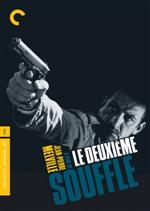
Le Deuxième Souffle (1966)

New Melvillle DVDs from Criterion
Criterion has released two new DVDs from French director, Jean-Pierre Melville: Le Doulos (1962) and Le Deuxième Souffle (1966).  Read the reviews at IFC Film News.

Virtual Tour of San Francisico Noir Locales
At 7:30 p.m. Nov. 11 the San Francisco Film Society’s creative director, Miguel Pendás, will take you on a virtual tour of “the ritzy homes of the rich on Nob Hill to the sleazy dives of the working class on the Embarcadero to see where some of the classic moments of 1940s and 1950s cinema were set” and explore  shooting locations of classic noirs such as Dark Passage, The Lady from Shanghai, Born to Kill, Sudden Fear, and The Maltese Falcon. Guest speaker Eddie Muller will provide an historical context and talk about his favorite San Francisco noir locations. Full Details

On Dangerous Ground (1951): “You get so you don’t trust anybody”

On Dangerous Ground (1951)

A city cop battling inner demons is sent up-state to ‘Siberia’
to assist in a man-hunt after bashing one too many suspects
(1952 RKO. Directed by Nicholas Ray 82 mins)

Cinematography by George E. Diskant
Screenplay by A.I. Bezzerides & Nicholas Ray from the
Gerald Butler novel ‘Mad with Much Heart”
Original Music by Bernard Herrmann
Art Direction by Albert S. D’Agostino and Ralph Berger

Starring Robert Ryan and Ida Lupino

On Dangerous Ground is visually stunning and without a wasted frame or line of dialog.  Director Nicholas Ray with the support of a talented team of film-makers has wrought a melodramatic noir with a dark beauty and haunting characterisations.  Leads Robert Ryan and Ida Lupino are so deeply immersed in their roles that they remain in your memory as real people inhabiting a white and craggy landscape steeped in a tragedy redeemed only by sacrifice and human compassion.

Ryan’s Jim Wilson is a cop, a sad loner with a seething anger that has it origins in loneliness and an existential despair that is directed against the low-lifes who inhabit the dark city streets he patrols nightly with his two partners.  Wilson is keen and tough, but is starting to lose control and his violent methods have got him into trouble. He is sent up-state to help out on a local murder investigation by his captain, and told to sort himself out. The action moves from the dark city streets to the high snow country where Wilson joins the man-hunt for the savage killer of a school-girl.   After a sighting of the suspect in the snow, Wilson and the girl’s enraged father give chase, and track the attacker to a lonely home in the mountains, where a young blind woman, Mary (Lupino), lives with her disturbed adolescent brother.

The story and its resolution traverse a dramatic arc that moves from the blackness and confinement of city streets and tenements to the expansive whiteness of the snow country.  The noir motif of stark chiaroscuro lighting is transformed into a metaphor for a liberation from confinement to openness; from personal isolation and distrust to reaching out to the other with trust; from despair, hatred, and self-loathing to hope, compassion and love.

On Dangerous Ground (1951)

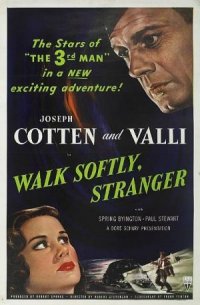
Walk Softly, Stranger (1950): Romantic Noir

Walk Softly, Stranger (1950)

A gambler on the skids pulls a heist as a final gambit after adopting
a false identity in a small town and falling for a rich crippled woman
(1948 RKO. Directed by Robert Stevenson 81 mins)

Cinematography by noir veteran Harry J. Wild
Screenplay by Manuel Seff and Paul Yawitz (adaptation of play by Frank Fenton)
Art Direction by RKO stalwart Albert S. D’Agostino, and Alfred Herman

Starring Joseph Cotten and Alida Valli

Although Walk Softly, Stranger was made before The Third Man (1949), its release was said to have been held off until after The Third Man to leverage the star appeal of Joseph Cotten and Alida Valli.  But the movie was panned by very faint praise from Bosley Crowther in his New York Times review on the film’s release, and is a sleeper.

I have always had a soft spot for Joseph Cotten, the modest everyman with unflinching decency and incredible loyalty, and I always fall in love with Alida Valli, Italy’s sensuous incarnation of Ingrid Bergman. Both these actors bring depth to this essentially b-romance with a noir arc, and Spring Byington is superb as the landlady who takes Cotten under her wing. The story is unusual enough to sustain interest until the climax, which is brief but effective. The script is literate and elegant, while also peppered with witty throwaway lines. There is a beautifully sardonic scene on the cusp of the climax with a car crashing into a billboard displaying a pointed advert.

The theme of the past catching up with noir protagonist is integral to the resolution, and Cotten toughens his persona credibly when he has to deal with an accomplice on-the-run and in confronting his pursuers. When he brutally punches his accomplice it is truly shocking, as such a violent reaction is at odds with his sincere affection for his landlady and poetic romancing of Valli.

This is a slow-moving noir with a hint of the classic women’s picture in the wooing and in the final redemptive scene, but rewards you with an honest story and memorable characters.

If you want dark dames and city streets menaced by violence, look elsewhere.

Walk Softly, Stranger (1950)Walk Softly, Stranger (1950)

German Expressionism: Not Orthochrome Nor Panchromatic

Nosferatu (1922)Nosferatu (1922)

Following my recent posts on German expressionism and its influence on film noir, I came across something interesting.  While recognising that the expressionist classics of the early 1920s had more than a chiaroscuro look to define their imagery, this characteristic is cited as the most relevant connection with Hollywood noir of the 40s and 50s.

Before the mid-1920s film stock was ‘colour-blind’ as it did not absorb the tones between light and dark, so the processed images had very stark contrast.  It was not until 1924-25, with the appearance of first Orthochrome and then the superior Panchromatic films, that the processed film could render a broad spectrum of grey tones.

This begs the question: was German expressionist chiaroscuro more a result of technical limitation than a creative initiative?