Film Noir Summary Reviews: Night Moves – From Paris to LA via Iverstown

Bob le Flambuer (France 1956)

Herman Melville is the master of cool, but as in reality cool masking a nihilist vacuum. Stylistically Melville’s noirs have a formal perfection, and rank as great cinema. And nihilism is as valid a world view as any other. Whether it is worthwhile is debateable of course. As a personal philosophy I find it destructive and largely a cop-out. It seems to say that meaninglessness justifies anything, by denying the possibility of the individual finding value in living. Nihilism is a kind of death in life and is the easiest response to existence. You have no responsibility and no need to explore and justify your choices. This is where Sartre and existentialism take us somewhere beyond the cold denial of meaning. We can see this dialectic by comparing Bob le Flambuer with Dassin’s Rififi, also set in Paris the year before, both about aging hoods, and both worlds apart.

Bob “the High-roller” Montagné is a midnight gambler living his nights out in the gambling dives of Pigalle. A reformed hood he has been straight for 20 years until a run of bad luck leaves him hard-up. A heist seems the way out, and as is the way of heists in the noir world, things don’t go to plan. The ending is downbeat and not so down-beat: the death of a protégé quickly forgotten, and the closing pathos reserved solely for Bob’s abandoned American convertible parked along a deserted stretch of beach in the South of France. A rabid misogyny propels the plot with the blame for things going wrong clearly down to the stupidity of a young harlot and the vicious revenge of an ambitious housewife.

The first 10 minutes are a tour-de-force with a doco-style introduction to the streets and denizens of Pigalle in the early morning after the night before. This technical brilliance is sustained through to the end. It is the cynical resolution and less-than-human dynamics that lose favour in my eyes.

The Strange Love of Martha Ivers (1946)

Director: Lewis Milestone
Writers: Robert Rossen (screenplay), John Patrick and Robert Riskin (story)
Stars: Barbara Stanwyck, Kirk Douglas, Van Heflin and Lizabeth Scott
Cinematographer: Victor Milner
Art Direction: Hans Dreier and John Meehan
Score: Miklós Rózsa

With these credentials you are bound to be presented with elegant entertainment, and this is exactly what you get. A gloomy, moody, melodramatic, and misanthropic gothic noir set in a company town that harbours a dark secret. A murder and a serpentine psychopathology played out in a domestic viper’s nest where fear and hatred do battle across the sexes, fuelled by evil avarice, guilt and alcohol.

Complicity in the death of an innocent man tethered by moral weakness are the essential story elements interpreted with real wit by Barbara Stanwyck, Kirk Douglas (in his first role), Van Heflin, and Lizabeth Scott.

Somewhere in the Night (1946)

In Joseph L. Mankiewicz’s Somewhere in the Night an amnesiac war vet travels to LA to find his identity – and trouble. John Hodiak and Richard Conte star with the disarmingNancy Guild. Hodiak and Conte are rather wooden and leave the screen for Guild and the supporting players to serve up really engaging portrayals. While the byzantine plot is not without its moments and to a degree intriguing, the presentation is sometimes flat and takes a bit too long to pan out.

Mankiewicz who also wrote the screenplay gives us some very juicy characters. Guild who looks like Ella Raines and has as much charm, is truly engaging as the cabaret singer who is “nuts” about vet Hodiak. Her smitten boss Conte is forlorn but offers to help his rival. Lloyd Nolan is good as a benevolent cop with a savvy sense of humour. The final line in the picture is spoken by him and is as cute a piece of satire as you will hear in any noir. Indeed, the dialog is peppered with film references, and the best lines are delivered by some obscure bit players with panache.

Viennese refugee Fritz Kortner is a delight as a Euro-villain in the mould of Sidney Greenstreet’s Mr Gutman. His last words in the movie are corny but the delivery is a scream: “The jig is up.” Obscure bit-player Margo Woode is enchanting as a b-girl in cahoots with Kortner. Her first encounter with Hodiak at his LA hotel is all sex and cheap perfume, and she pulls it off beautifully! Later she crackles when she fights against being the fall-girl for Kortner – again a la Gutman. Amongst the earnestness of Hodiak and Conte, and the high-jinks of the bit-players, there is a damned serious interlude with another obscure actress Josephine Hutchinson as a lonely spinster.

Great entertainment!

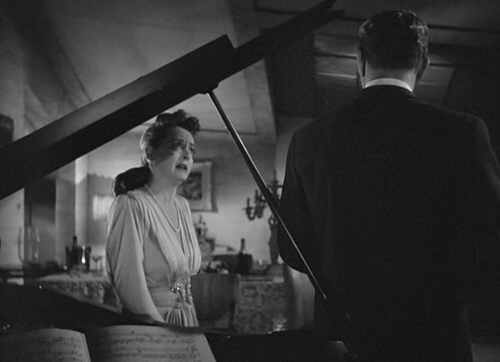
Deception (1946): Expressionist Noir Melodrama

In Irving Rapper’s 1946 dark melodrama Deception (1946) Bette Davis is no longer young and as fiery as in pictures past but she still packs a mean punch.  Her co-star Claude Raines chews up the scenery and dominates as a vain and vindictive lover. Though Bette gets to plug him in the end. Apparently during production Davis was so scared of Raines stealing the picture, she had the ending changed so that she literally put matters to rest. Director Rapper was reported as not being too happy with this change, but to my mind the scenario’s trajectory points to nothing less.

The story revolves around a passionate love triangle with the other co-star Paul Henreid.  Raines has been ‘mentoring’ struggling émigré pianist Davis and things change when her lost lover and cellist Henreid turns up.  These creative types set to it with a vengeance, with Davis establishing her own tragic entrapment by lies and an obsessive distrust of Raines, who plays at the homme-fatale. An impressive modern classical score by Erich Wolfgang Kor is used to wonderful effect.

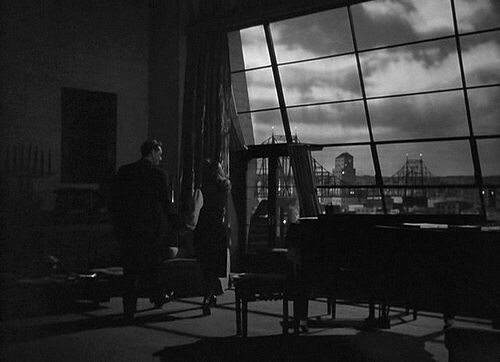
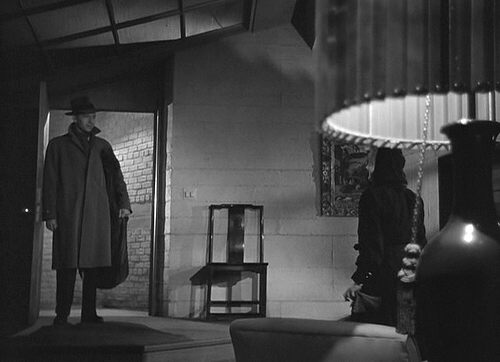
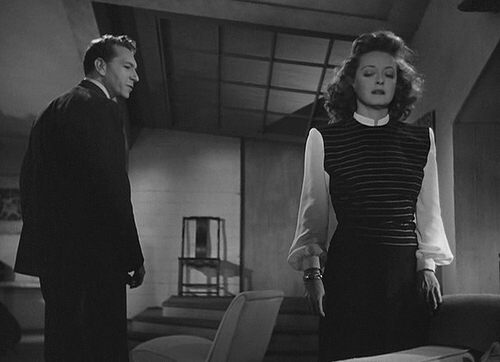
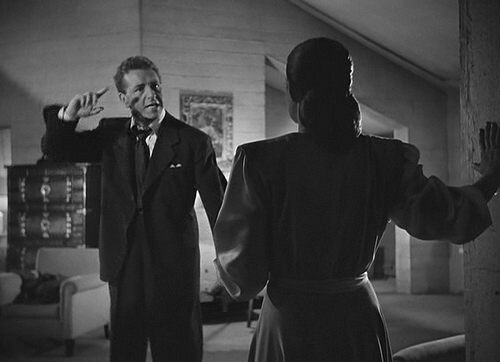
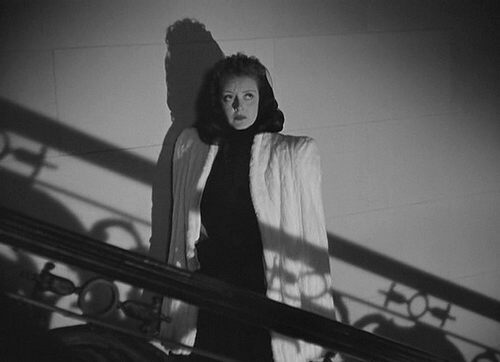
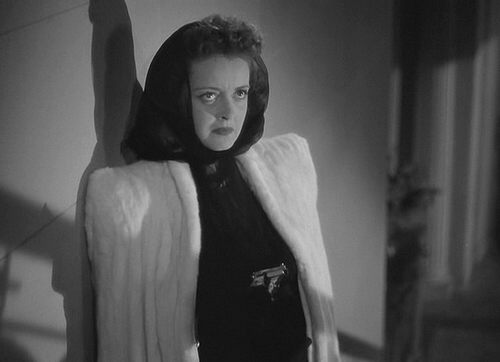
Deception is a strange film with a metropolitan gothic ambience.  Quite avant-garde for a Hollywood soapie of the period, with inventive low angles and expressionist lighting deftly overcoming set-bound constraints. Amazingly, Davis later admitted that Raines made the picture! The direction is certainly elegant and the collaboration with ace DP Ernest Heller and Art Director Anton Grot produced masterly monochrome visuals ranging from the sumptuous almost decadent elegance of Raines’ palatial home to the stark modernist lines of Davis’ NY loft apartment.  This apartment has the city as a brooding backdrop exposed by a massive window running the length of a wall of the tenement.

A must-see noir melodrama. Check out these other frames from the movie.


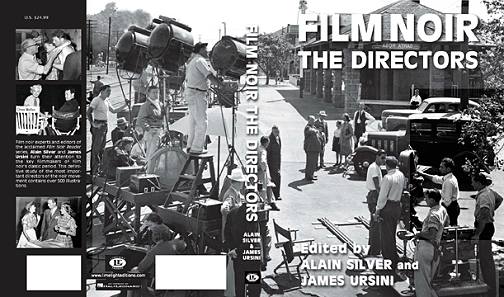
New Book – Film Noir: The Directors

Another book on film noir directors. Do we need another? Arguably rather we need more books on film noir screenwriters, cinematographers, and composers. That said, a new book on film noir is almost always worth reading, and this goes for Alain Silver’s and James Ursini’s latest editorial effort.

Film Noir: The Directors a book of nearly 500 pages covers 28 directors and is loaded with over 500 images, mostly production stills and on-location shots of directors at work. Contributions come from the editors and a wide-range of writers, with a strong leaning toward academics. Each chapter focuses on a director with a short bio, a noir filmography, and an analysis of each of their noirs. There are very few actual frames and this is disappointing.

Most names you would expect are included: Robert Aldrich, John Brahm, Jules Dassin, André de Toth, Edward Dmytryk, John Farrow, Felix Feist, Samuel Fuller, Henry Hathaway, Alfred Hitchcock, John Huston, Fritz Lang, Joseph H. Lewis, Joseph Losey, Ida Lupino, Anthony Mann, Max Ophuls, Gerd Oswald, Otto Preminger, Nicholas Ray, Don Siegel, Robert Siodmak, Jacques Tourneur, Edgar G. Ulmer, Raoul Walsh, Orson Welles, Billy Wilder, and Robert

But there are major omissions which I find hard to fathom: auteurs like Abraham Polonsky, Robert Rossen, Richard Fleischer, Vincent Sherman, Rudolph Mate, and Phil Karlson, spring to mind. The editors acknowledge there are omissions in their Introduction, and put them down to a rather cryptic rationale “the best directors are not necessarily the best examples”, and they don’t elaborate. The result is that a number of seminal and important films noir are not included in this otherwise comprehensive compendium.

In a book about directors one shouldn’t complain of that focus, but despite acknowledging the contributions of writers there is a tendency in the essays to conflate story elements as the work of the director. Certainly many noir directors were closely involved in the development of scripts, but the contribution of the scenarist demands greater recognition. Equally the contributions of the cinematographer and the composer in major noirs were integral to the output, with a director’s better movies often made in collaboration with a particular DP or with the aid of a great score.

After recently viewing Felix Feist’s The Threat (1949), in this post I have chosen to look at the chapter on that director by noir writer and blogger Jake Hinkson. Hinkson offers analyses of Feist’s four noir films:

Hinkson’s writing is rather flat, in keeping I suppose with the book’s academic slant. He reads rather too much into these movies which are solid b’s and, apart from The Man Who Cheated Himself, not highly distinguished. Tellingly Feist was said to see himself not as an artist or craftsman, but as a story-teller as related by his son in an interview with Hinkson.

The Threat (1949)

Hinkson uses the concept of POV (point of view) as a fair (but less then revelatory) approach in studying the dynamics of the noir protagonist’s interaction with the other characters in these films. In doing so Hinkson confuses the story told by the script with the director’s rendering of the playbook, by talking about a character’s POV as both a visual device and as an element of the story. While Hinkson is aiming to highlight how the director uses mis-en-scene to give visual cues to the dominance of the protagonist in each of the movies under discussion, the character’s actions are largely self-evident. (It is also hard to reconcile Hinkson’s focus on an aggressive protagonist with concluding his essay by saying that Feist consistently portrayed “weak-willed male protagonists”.) In any event it is the screenplay that determines this and Feist wrote the scenario for only one of these pictures, The Devil Thumbs a Ride, which was based on the 1937 novel by Robert C. Du Soe. I am happy with Hinkson’s solid treatment of that movie, though it is the strength of Lawrence Tierney’s perverse characterisation as the bad guy that distinguishes it from other b’s of the period.

Hinkson’s reading of The Man Who Cheated Himself, which I consider Feist’s best noir, is problematic. Oddly, Hinkson sees it as Feist’s weakest noir. In this film Feist goes beyond the confines of the b-picture and presents an overt moral ambivalence and a complex conflicted protagonist. Hinkson considers that Feist fails to convince the viewer of Lee J. Cobb’s infatuation with wealthy socialite Jane Wyman. He describes her as “sexless” and asserts “that Feist has a characteristic lack of interest in eroticism”. To the contrary, I think Wyatt is great in her role as the selfish society dame getting her kicks with an aging cop. Her narcissism and predatory sexuality are there – just not delivered with a sledgehammer. Ironically Hinkson later in his review of Tomorrow Is Another Day describes the relationship of the two lovers on the lam as an “amour-fou”. (Incidentally Hinkson fails to acknowledge that this amour-fou develops into a stable almost banal domestic intimacy that precipitates the protagonists’ redemption. In The Devil Thumbs a Ride there is also a strong sexual undercurrent with one of the abducted woman attracted to the violent Tierney.)

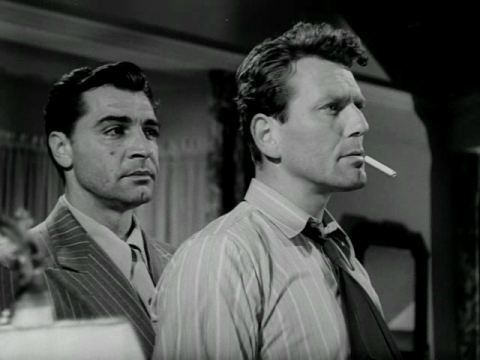
The Threat (1949) is an interesting screener. A vicious killer and gang-boss played by chronic bad-guy Charles McGraw breaks out of prison and hatches an elaborate plan to high-tail it to an isolated air-strip in the California desert where an accomplice will fly him out of the country. For vengeance and insurance he abducts the cop and the DA who put him in stir, and the ex-girlfriend of his plane-flying accomplice. (He thinks the dame sold him out to the cops.)

What is interesting is that McGraw’s protagonist is ruthlessly intelligent, hatching a wily ruse to get him past police road-blocks. Immediately after the break he repairs to a neat suburban home to lay low while he abducts his captives and readies his trip to the desert in a removalist’s van. Hinkson does a good job of dissecting the structure of Feist’s direction and his use of mis-en-scene. Although he incorrectly describes the staging hide-out as a “flop house”, and thereby misses a pivotal symbolic element.

McGraw holds the whole thing together and the scenario plays out in a decidedly subversive way. McGraw fails only because of chance after persistently outwitting the cops and the machinations of his hostages when they get the jump on him. His dénouement is one of retribution and driven by very primal instincts.

I hope to review other chapters in the coming months.